The air inside a returning spacecraft doesn’t smell like home. It smells of recycled breath, metallic tang, and the sterile hum of life support systems designed to keep the void of space at bay. For Christina Koch, the transition from the cosmic silence of the moon’s orbit back to the chaotic vibration of Earth isn’t just a matter of physics or orbital mechanics. It is a sensory assault. After months of training for the Artemis II mission and days spent suspended in the vast, ink-black nothingness, the human body craves something that a computer cannot simulate. It craves a heartbeat that isn’t its own.
We talk about space exploration in terms of propulsion, heat shields, and lunar gateways. We measure success in kilometers per second and the integrity of pressurized seals. But the most vital component of any mission isn’t bolted to the floor of the Orion capsule. It is the tether that pulls an explorer back across the 380,000-kilometer abyss. Often, that tether is covered in fur and smells faintly of wet grass.
The Weight of the World
Gravity is a cruel master when you haven’t felt it for a while. It pulls at your skin, makes your bones feel like lead pipes, and turns the simple act of standing into a feat of Herculean labor. Christina Koch knows this better than most. She has already spent 328 days in orbit, the longest single spaceflight by a woman. She knows the disorientation of the "return." But when the hatch opens and the Florida humidity rushes in, the scientific achievement of the Artemis program—humanity's first return to the lunar vicinity in over fifty years—suddenly shrinks. It becomes small enough to fit into a living room.
Science tells us that dogs experience time differently than we do. To a golden retriever, an hour is an age; a week is a lifetime. When Koch stepped through her front door after her most recent stint in the high-stress environment of NASA’s rigorous pre-flight cycles, the data points vanished. There was only Sadie.
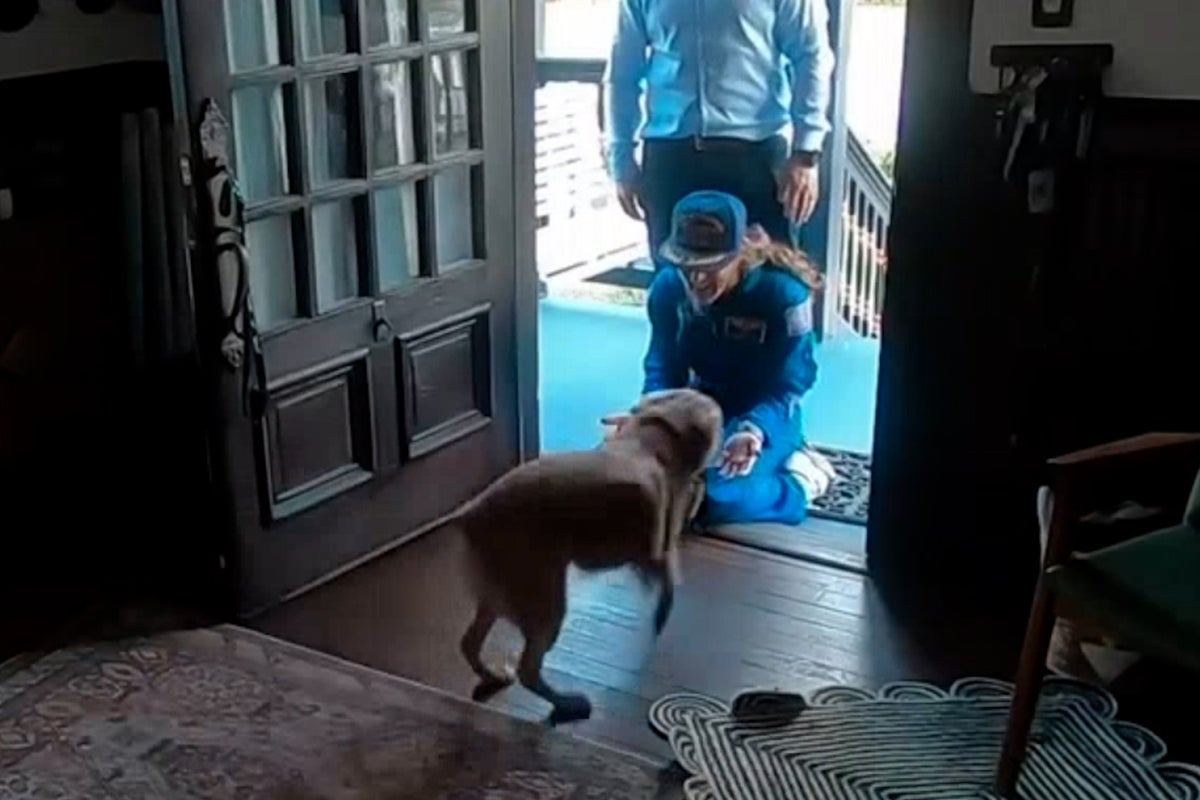
Sadie didn't care about the heat shield's thermal protection system. She didn't care that her human had just been named as a mission specialist for the most ambitious lunar voyage of the century. Sadie cared about the scent of a familiar jacket and the sound of a key in a lock. The video that eventually made its way across social media wasn't just "cute." It was a visceral reminder of what we are actually protecting when we send people into the stars.
The dog’s reaction was a frantic, blurring mess of limbs—a kinetic explosion of joy that defied the solemnity of a NASA press release. Sadie didn't just walk to her; she vibrated. She whined with a pitch that suggested her heart was too big for her ribs. In that moment, Koch wasn't an icon of the new space age. She was just a person who had been gone too long.
Beyond the Carbon Fiber
Why does this matter? Why do we find ourselves watching a twenty-second clip of a dog greeting an astronaut more times than we watch the technical briefings on the Space Launch System?
Because space is terrifyingly lonely.
To go to the moon is to leave behind every biological comfort our species has evolved to require. There is no wind. There is no scent of soil. There is no tactile feedback from a living, breathing creature that loves you without condition. The Artemis II mission is a bridge to the future, but it is also a test of human psychological endurance.
Consider the isolation of the lunar far side. When Koch and her crewmates—Reid Wiseman, Victor Glover, and Jeremy Hansen—swing behind the moon, they will be the most isolated humans in history. For those moments, the entire bulk of a celestial body will stand between them and every other living thing. No radio waves. No light. Just the cold, hard vacuum and the three other souls in the cabin.
Psychologists at NASA have spent decades studying the "overview effect," that cognitive shift experienced by astronauts when they see Earth as a tiny, fragile marble hanging in the dark. It creates a profound sense of connection to humanity. But the overview effect is a grand, sweeping emotion. It’s an H2-sized feeling. The "Sadie effect" is something different. It’s the micro-connection. It’s the realization that while you are looking at the Earth, there is a specific creature on a specific porch waiting for the specific sound of your footsteps.
The Invisible Stakes of Artemis
The Artemis program isn't just about planting flags or finding water ice in the shadowed craters of the lunar south pole. It is a dress rehearsal for Mars. And Mars is a different beast entirely.
A trip to the moon is a week-long commute. A trip to Mars is a multi-year exile. When we see Koch reunited with her dog, we are seeing the one thing we haven't yet figured out how to solve for long-duration space travel: the emotional cost of the distance. We can recycle water. We can scrub carbon dioxide. We can even 3D-print spare parts in zero gravity. But we cannot 3D-print the feeling of a cold nose pressed against a hand.
The excitement Sadie showed wasn't just a greeting; it was a grounding. For an astronaut, the transition back to "Earth-normal" is notoriously difficult. The world moves too fast. There are too many choices. The noise is overwhelming. Returning veterans of the International Space Station often talk about the strangeness of feeling the weight of a fork or the sensation of rain.
A dog simplifies that transition. A dog doesn't ask you about the telemetry of your re-entry. A dog demands that you exist in the present moment. By throwing herself at Koch, Sadie was forcing the commander back into the physical world. She was the anchor.
The Myth of the Cold Professional
For a long time, the image of the astronaut was the "Right Stuff" archetype: a steely-eyed missile man with a heart of granite and a pulse that never rose above sixty. We wanted our explorers to be machines. We thought that by stripping away the "human" elements—the family ties, the pets, the vulnerabilities—we made them better pilots.
We were wrong.
The Artemis generation is different. Koch, Glover, and the rest of the crew are unapologetically human. They talk about their families. They share their fears. They post videos of their dogs. This transparency doesn't make them less capable; it makes them more resilient. When we see the joy in that reunion, we aren't seeing a distraction from the mission. We are seeing the reason for the mission.
We go into the dark so that we can understand the light. We leave home so that we can appreciate the smell of the grass and the ridiculous, unbridled enthusiasm of a golden retriever who thinks you’ve been gone for a thousand years even if you only went to the grocery store—or the moon.
The technical hurdles of Artemis II are immense. The rocket must produce 8.8 million pounds of thrust. The capsule must survive 5,000 degrees Fahrenheit upon re-entry. The navigation must be precise to within meters across a quarter-million miles. But the most impressive feat of engineering isn't the rocket. It's the human heart's ability to travel that far and still beat in sync with a dog waiting on a rug in Texas.
As the mission nears, the images of the launch will dominate the news. We will see the fire and the smoke. We will hear the roar of the engines. We will marvel at the high-definition footage of the lunar surface. But the most important image has already been captured. It’s a woman in a flight suit, kneeling on a floor, being tackled by a creature that knows nothing of orbits and everything about love.
That is the gravity that matters. It’s the only force strong enough to pull us back from the stars.
The moon is a cold, dead rock. It has no atmosphere, no life, and no sound. It is a place of magnificent desolation. It is worth visiting, worth studying, and worth conquering. But as Koch’s reunion reminds us, the moon is only beautiful because of how far away it is from the people—and the pets—who make the Earth feel like a home.
Sadie’s tail, thumping against the floor like a frantic metronome, is the true heartbeat of the space program. It is the sound of a mission accomplished before it has even begun. It is the reminder that no matter how far we sail into the cosmic ocean, we are always, fundamentally, looking for the way back to the shore.