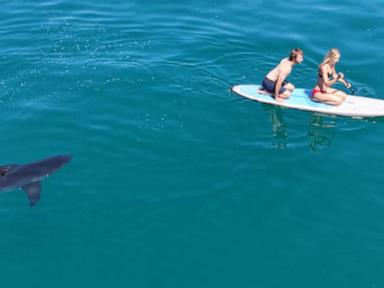
You are floating on a piece of foam miles from shore when a shadow appears. It is longer than your board. It moves with a quiet, terrifying grace that makes your heart hit your throat. This isn't a scene from a movie. It happened to a group of paddleboarders who found themselves being trailed by a massive great white shark. Their panic was real. They were terrified, and honestly, anyone would be.
But looking closer at these encounters reveals something unexpected about ocean wildlife. Sharks are closer than you think. They see us long before we see them. Most of the time, they simply do not care. For an alternative look, consider: this related article.
The Reality of Sharing Water With Apex Predators
Southern California and other coastal hotspots have seen a massive spike in drone footage showing white sharks swimming mere feet from surfers and paddleboarders. Dr. Chris Lowe and his team at the California State University Long Beach Shark Lab have spent years tracking these interactions. Their data shows something fascinating. Juvenile great white sharks frequently hang out in shallow waters right alongside humans.
Estimated distance of sharks to swimmers in tracking studies: Under 100 yards
Percentage of time sharks actively ignore humans: Over 97%
The fear is completely natural. Evolutionary biology wires us to dread things with large teeth that move fast in the dark. When those paddleboarders looked down and saw a apex predator circling, their survival instincts screamed. But notice what the shark actually did. It didn't attack. It didn't breach. It circled, investigated, and moved on. Related analysis on this matter has been published by The New York Times.
People often mistake curiosity for predatory stalking. White sharks explore the world through their senses, including their vision and lateral lines, which detect vibrations in the water. A paddleboard creates a unique acoustic signature. The rhythmic paddling sounds like a wounded fish or a strange creature. The shark checks it out, realizes it is just plastic and a bony human, and usually loses interest.
What to Do When a Shark Circles Your Board
If you find yourself in this situation, panic is your absolute worst enemy. Splashing, screaming, and paddling frantically makes you look like prey. It triggers the predatory drive of a shark.
Keep Your Eyes on the Shark
Sharks are ambush predators. They rely on the element of surprise to hunt seals and sea lions. When you turn your body and your board to face them, you take away that advantage. Keep visual contact. Let the animal know you see it.
Stand Tall and Stay Calm
If you are already standing, stay up if you have good balance. Standing makes you look large and formidable. If the water is choppy and you risk falling in, drop to your knees immediately. Falling into the water right next to a curious shark creates a massive splash that could startle the animal into a defensive bite.
Move Slowly Toward Shore
Do not sprint. Paddle with smooth, deliberate strokes. Keep your blade silent as it enters and exits the water. Move toward shallow water or the nearest boat, keeping the board between you and the animal whenever possible.
The Myth of the Mindless Eating Machine
Media coverage loves to focus on the terror aspect of these stories. Headlines scream about swimmers being stalked or hunted. The reality is far more mundane. White sharks are highly calculated hunters. They target high-fat prey like elephant seals and sea lions. Humans lack the blubber layer they need to sustain their massive energy requirements.
When bites do happen, they are almost always cases of mistaken identity or investigative bites. Unfortunately, a test bite from a two-ton animal causes severe damage. That is why staying calm and projecting dominance in the water works. You are letting the shark know you are a living, breathing entity that sees them, not a helpless piece of drift food.
The ocean belongs to them. We are just visitors. Understanding their behavior turns a moment of pure terror into a masterclass in marine ecology. Respect the water, watch the shadows, and know how to act when the wildlife gets a little too close for comfort.