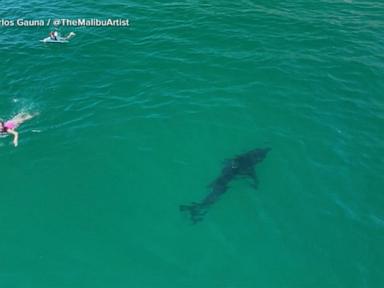
A 10-foot juvenile great white shark was caught on drone video gliding through shallow surf, coming within feet of an unsuspecting group of young swimmers off the Southern California coast. The kids kept splashing, totally oblivious. The operator behind the camera watched from over a mile away, heart in his throat, waiting to see if curiosity would turn into an attack.
It didn't. The shark checked them out, lost interest, and turned back toward deeper water.
If you spend any time on coastal social media, you've seen a dozen clips like this recently. Drones spot massive shadows lurking right near boogie boarders, surfers, and families wading in knee-deep water. It looks terrifying on a screen. Naturally, headlines start screaming about "stalking" ocean predators and dangerous waters.
The reality behind these close encounters isn't a real-life creature feature. It's actually a mix of recovering ocean ecosystems, changing water temperatures, and the fact that we now have flying cameras filming every inch of the coastline.
The SoCal Nursery Effect
Southern California isn't just a popular vacation spot for humans. It serves as one of the primary nursery grounds for juvenile white sharks in the North Pacific.
When great whites are young—roughly under ten or twelve feet long—they don't hunt seals or sea lions out in deep water. Their teeth aren't big enough yet, and they lack the sheer mass to overpower adult marine mammals. Instead, they stick to shallow, warm coastal waters where they feed on stingrays, bottom-dwelling fish, and small halibut.
Shallows mean warm water and easy food. California State University, Long Beach (CSULB) Shark Lab has tracked these juveniles for years. Their researchers found that young sharks spend a massive chunk of their time in water less than six feet deep.
When you go swimming in SoCal, you're literally hanging out in their nursery.
The sharks aren't hunting you. You're just standing in their living room.
Why Encounters Are Spiking Right Now
People keep asking why sightings seem so much higher lately. Are there more sharks, or are we just seeing them more?
It's both.
First, shark populations along the U.S. West Coast have actually been recovering over the last few decades. State and federal protections passed in the 1990s banned gillnet fishing in nearshore waters, which used to accidentally catch and kill countless young sharks. Coupled with marine mammal protections that restored food sources, the species has steadily bounced back.
Second, marine heatwaves and warmer coastal sea temperatures push juvenile sharks closer to shore earlier in the season. When water temperatures hit that sweet spot, young sharks aggregate in tight clusters along specific beaches.
Third—and most importantly—drone technology changed the game entirely.
Fifteen years ago, a shark could swim five feet past a surfer, and nobody on earth would know unless the dorsal fin broke the surface. Today, amateur pilots and wildlife photographers like Carlos Gauna (known online as The Malibu Artist) fly high-resolution drones over the ocean every single day. Drones eliminate water glare from above, exposing everything lurking beneath the surface.
We aren't necessarily seeing a sudden spike in aggressive shark behavior. We're just finally seeing what was always happening right under our noses.
They Know You're There, but They Don't Care
The most striking detail in almost every drone video is the sheer indifference of the shark.
In video after video, a 10-foot juvenile white shark swims directly beneath a paddleboard or circles a swimmer. The human rarely notices. The shark approaches, inspects the person, realizes it's not a stingray or fish, and casually swims away.
Dr. Chris Lowe, director of the CSULB Shark Lab, has stated repeatedly that if you swim in Southern California, a white shark has likely passed close to you without your knowledge.
Sharks rely heavily on electro-receptors in their snouts to detect faint electrical fields generated by living animals. They know you're alive, they know how big you are, and they can tell you aren't their usual prey. Human meat doesn't offer the blubber and fat content marine predators require. Bites happen mostly due to mistaken identity in murky water or exploratory nibbles when a shark gets overly curious.
Statistically, shark bites remain insanely rare. You're vastly more likely to drown, suffer a stingray barb through your foot, or get hit by a runaway longboard in the lineup than to get bitten by a great white.
How to Stay Safe in Shark Nurseries
Even though juvenile sharks generally ignore people, you're still dealing with a wild, powerful predator. You shouldn't panic, but you should respect the space.
Here's how to minimize risk when hitting SoCal beaches:
- Avoid swimming at dawn and dusk. Low light makes it harder for sharks to distinguish between a human and their actual prey, increasing the chance of an accidental bite.
- Don't swim near large schools of baitfish or feeding birds. If birds are diving and fish are jumping, predators are actively hunting in that exact spot. Move elsewhere.
- Stick together. Sharks are far more likely to investigate a single, isolated swimmer than a group of people making noise and splashing together.
- Ditch shiny jewelry. Flashy metal watches or necklaces mimic the shimmer of fish scales in murky water.
- Respect lifeguard warnings. Lifeguards work directly with local research teams and drone operators. If they post shark advisory signs or clear the water, get out without arguing.
If you happen to spot a fin while in the water, keep calm. Don't thrash around wildly—that mimics a dying fish in distress. Keep your eyes on the animal, back up smoothly, and head toward shore or your board while keeping your movements controlled.
The ocean belongs to them, but understanding their behavior makes sharing the water a lot less terrifying.