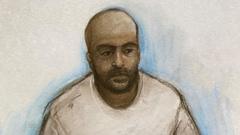
A not guilty plea is not a confession of innocence. It is not a moral statement. And in a Belfast knife attack case, it is rarely a signal that the prosecution has a weak hand.
Most readers treat the initial plea like the final score of a match. Someone stands in the dock, utters two words, and the lazy consensus forms in minutes: either "he's denying it cold" or "the system is dragging its heels." Both reactions are lazy. Both miss how criminal procedure actually works on the ground.
I have spent years sitting in courtrooms, reviewing charging sheets, watching plea hearings unfold, and advising clients and commentators who mistake courtroom mechanics for drama. I have seen media desks burn hours building narratives around a single arraignment hearing while ignoring the evidentiary clock ticking quietly in the background. When a defendant charged over a Belfast knife attack enters a not guilty plea, the real story is not the words spoken in the dock. It is the friction between preliminary appearances, disclosure timelines, forensic testing, and trial readiness.
The Myth of the Instant Verdict
Start with the biggest misunderstanding in court reporting: people assume a plea at an early hearing reflects a settled defense strategy.
Often, it does not. A not guilty plea preserves options. Defense counsel routinely advise clients to enter a not guilty plea early so the prosecution is put to strict proof, disclosure is compelled, and every piece of physical and digital evidence is tested before any strategic pivot is even considered. In knife-related prosecutions, evidence rarely arrives neatly packaged on day one. CCTV angles have to be enhanced and cross-checked. Mobile phone extractions take time. Blood and DNA comparisons from clothing or weapons sit in forensic queues. Scene notes have to be reconciled with witness statements given under shock.
A defendant who pleads guilty at the earliest possible opportunity gets credit toward sentencing in most common law jurisdictions, including Northern Ireland. A defendant who pleads not guilty gives up part of that early-guilty discount. That alone tells you this is not a casual move. Either the defense contests an element of the offense—identity, intent, self-defense, or the specific statutory charge—or it is refusing to concede anything before seeing the full weight of the state's file.
What does a not guilty plea actually mean in a Belfast knife case? Legally, it simply puts the prosecution to its burden of proving every element of the charge beyond reasonable doubt. Practically, it marks the start of pre-trial litigation, not the end of the story.
Imagine a scenario where two witnesses describe an altercation differently in the first twenty minutes after an incident, a camera on an adjacent street captures partial movement behind a parked van, and the suspect's coat has fibers that need laboratory analysis. Before a lawyer advises a client to surrender a trial and accept a conviction on a serious violent offense, they want every gap in that chain examined.
You Are Asking the Wrong Question About the Courtroom
When a headline drops about a man charged over a Belfast knife attack pleading not guilty, the reflex search query is almost always some version of: "Will he walk free?" or "Why would he plead not guilty if there's a charge?"
Both questions rest on a flawed premise.
First, being charged is not being convicted. A charge reflects an allegation supported by enough material to pass a charging threshold—it is an accusation, not a verdict. Second, pleading not guilty does not mean a trial happens tomorrow or that the accused is predicting an acquittal. Many cases that start with a not guilty plea evolve through months of disclosure, evidentiary rulings, witness availability checks, and sometimes revised charges or later pleas once the full case is visible.
In Northern Ireland's justice system, serious indictable offenses move through distinct procedural stages—from magistrates' court appearances and committal or preliminary processes up to the Crown Court for trial. Treating a plea moment as if it were closing arguments confuses the opening whistle with the trophy presentation.
Legal scholars and practitioners who write on criminal procedure and evidence—figures like Glanville Williams in classic criminal law theory and modern commentators on adversarial trial practice—have long pointed out a basic truth that outraged headlines ignore: the presumption of innocence is not a polite slogan. It is a structural rule that forces the state to prove its case rather than forcing the accused to prove their virtue.
Why Knife Crime Coverage Gets Twisted Before the Facts Settle
Violent crime involving knives triggers intense public anxiety in any city, and Belfast has its own acute sensitivities around public safety, policing, and community tension. When an incident happens and charges follow, public pressure pushes for immediate moral clarity.
Court procedure does not run on public anxiety. It runs on admissibility, chain of custody, witness credibility, and statutory elements.
Here is where commentators and casual observers trip over themselves:
- Confusing arrest with proof: An arrest is based on reasonable suspicion. A charge follows police investigation and prosecutorial review. Neither equals a jury finding.
- Treating delays as cover-ups: Adjournments, further evidence requests, and contested applications look suspicious from the outside. Inside the process, rushed trials that skip disclosure or forensic verification are the ones that collapse on appeal or fail basic fairness tests.
- Ignoring charge structure: A person can be charged with a specific offense tied to a knife or violence while contesting either the exact act alleged or the level of culpability—for instance, disputing intent to cause serious harm versus another statutory threshold.
There is a real downside to taking this measured, procedural view when emotions are high. It can sound detached. When victims, families, and neighbors are shaken by a knife attack, saying "let the evidentiary process run its course" can feel cold or overly clinical. Worse, an overly cynical observer might assume that explaining why a not guilty plea is normal means excusing violence. It does not. Accountability in a serious offense depends on getting the legal proof solid enough to survive cross-examination and scrutiny, not substituting outrage for evidence.
How to Read Court Updates Without Getting Played
If you want to understand a Belfast knife attack prosecution without falling for hot takes or courtroom theater, change what you track after the plea.
- Watch the venue and stage, not just the headline. A plea at an early stage is a procedural marker. Pay attention to whether the matter is being progressed to Crown Court arraignment or trial, and what pre-trial dates are set.
- Look for specific contested issues. When details emerge in open court, notice whether the dispute centers on identification, alibi, self-defense, mental state, or procedural admissibility. Those details tell you far more than the word "guilty" or "not guilty."
- Separate public commentary from evidential record. Social media and instant reaction pieces speculate on motive and certainty long before witnesses are tested under oath. Wait for what is actually put before the court.
- Expect time, not instant resolution. Serious violent prosecutions routinely stretch across months as forensic reports, statements, and legal arguments are exchanged. A slow calendar is standard in contested cases, not a sign that the file vanished.
A charge starts the legal clock. A not guilty plea keeps it running until the evidence is tested.