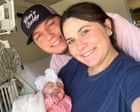
When doctors tell you a pregnancy is incompatible with life, your entire world fractures in a split second. Parents Nick and Savannah Roberts faced that exact nightmare in Louisiana when prenatal scans revealed their baby girl, Wren Michelle Roberts, had an extraordinarily rare combination of congenital conditions. She presented with heterotaxy syndrome, a complex disorder so rare that a pediatric specialist could only find about 15 similar documented cases in modern medical literature. Alongside that, she had spina bifida, multiple severe heart defects, and her stomach located entirely in her chest.
Medical teams prepared the family for the worst. They talked about palliative comfort care and expected the infant to pass away shortly after birth. The family even planned a funeral, buying pink outfits instead of black mourning clothes because they just wanted a single moment to hear their daughter cry. But Wren had other plans.
When Statistics Fail to Tell the Whole Story
Medicine relies on probability curves, historical data, and clinical averages. When a case sits so far outside normal parameters, textbooks offer little comfort. Dr. Gabriella Bluett-Mills, a complex care pediatrician at Ochsner Children's Hospital, noted that seeing all of these specific anomalies present simultaneously makes a patient truly one in a million.
Statistics can guide treatment, but they cannot measure the sheer tenacity of human biology. Wren survived birth, underwent successful spinal surgery at just one week old, and began meeting basic developmental milestones. She started drinking from a bottle, yawning, stretching, and cooing. Specialists looking at her chart can only scratch their heads and call her recovery unexplainable.
The Mental Toll on Medically Complex Families
Dealing with a severe congenital diagnosis during pregnancy isolates families in ways outsiders rarely understand. You live appointment to appointment, holding your breath at every scan.
- Anticipatory grief: Families often mourn a child before they are even born, trying to brace themselves for a devastating loss.
- Navigating second opinions: Finding doctors willing to look beyond grim statistical odds takes exhausting advocacy.
- The shift to daily living: Once the baby arrives defying predictions, the emotional landscape pivots instantly from grief to high-stakes vigilance.
Parents like the Roberts family face intense emotional whiplash. They went from planning a memorial service to feeding, changing, and comforting a living, breathing newborn who refuses to give up.
Why Medical Uncertainty Requires a Different Mindset
Doctors are trained to manage expectations, which often means delivering harsh truths about bleak survival rates. Yet, modern pediatric care continues to evolve through unexpected anomalies. When a clinical team encounters a patient who defies every established timeline, treatment protocols must adapt on the fly.
As pediatric specialists point out, nobody has every single answer in rare congenital medicine. Sometimes the only rational approach is to drop the rigid prognostic charts, follow the child's lead, and see what they are actually capable of achieving.
If you or someone you know is navigating a terrifying prenatal diagnosis, don't let initial statistics rob you of your fight. Lean on your support systems, push for specialized pediatric evaluations, and remember that medical science is constantly catching up to miracles. Take it one day at a time.