Sirens. That is the first thing people remember when a quiet street in Nottingham stops sounding like itself, even if they were half a mile away with the television humming in the living room.
Then comes the pause. A strange, heavy quiet that settles over brick terraces, wet tarmac, and corner shops where someone was just buying milk two minutes ago.
A police officer shot in the foot. Four people arrested.
On paper, those twelve words look tidy. Almost clinical. A headline built for fast scrolling between morning coffee and the commute. You read it, you nod once, maybe twice, and your brain tries to file it away under urban crime or policing risk.
Except a foot is where balance lives.
Think about that for a second. Not a movie wound. Not some dramatic silhouette falling in slow motion while orchestral brass swells. A foot. The small, stubborn, working architecture that carries a person up stairs, through dark hallways, across slick pavement in the Midlands rain, and back home to whoever left the porch light on. When a bullet goes through a boot, the shock isn't just physical—it is an immediate, disorienting jolt to every assumption about what a shift is supposed to cost.
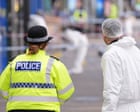
I have stood on cold British pavements outside cordoned streets long after the blue lights stopped spinning, watching neighbors stand in dressing gowns and puffa jackets with their arms crossed tight against the damp. You don't need a press briefing to feel the tension in a place like that. You smell wet wool and diesel. You hear radios crackling behind closed doors. You watch people look at a stretch of asphalt they have walked ten thousand times and suddenly see it as a place where violence happened in broad daylight or under streetlamps.
I should be clear right here: I wasn't holding the shield on that street, nor was I inside the custody suite when the four arrests were logged. Outside the verified facts of the incident—an officer sustaining a gunshot wound to the foot in Nottingham and four arrests following—exact operational details, individual motives, and court outcomes are not established in front of us. Where I sketch scenes of a responder's knee hitting cold stone or a family sitting by a phone, those are hypothetical illustrations designed to show the human weight behind a brief news report, never a claim of inside knowledge.
Still, we don't need inside knowledge to recognize the pattern.
The Myth Of The Routine Call
Ask anyone who has spent years around emergency work what scares people most, and they rarely say the obvious big event. Most folks brace for the big event. What wears people down—what makes hands shake three hours later when the adrenaline finally drains out—is the call that started out ordinary.
A knock on a door. A report of disturbance. A routine check that turns sharp in less than two seconds.
Consider what happens next: one second you are thinking about paperwork or whether your boots are letting water in at the seam; the next second there is a sharp crack, a burning sting low down, and the sudden realization that your weight won't stay even.
In British policing, firearms incidents remain rare compared with many other places, and officers do not walk every beat armed like action heroes. That rarity cuts two ways. On one hand, it means streets in Nottingham are not war zones; most days pass without a shot fired. On the other hand, when a firearm does go off, the shock hits a system—and a community—that isn't built around expecting gunfire around every corner.
Let's use a simple analogy to see why that matters. Imagine driving a car built for steady city roads and smooth country lanes. You know how it handles rain, roundabouts, and tight parking spots. Then someone tosses a spike strip across the lane. The car doesn't instantly explode, yet steering changes in a fraction of a second. Every muscle in your shoulders locks up. Even after you pull over safely, your heart is hammering against your ribs because your nervous system got a message it wasn't rehearsed for.
Policing runs on judgment under pressure. When an officer is shot in the foot, that split-second threat shifts everything—for the injured officer, for backup tearing through traffic with lights flashing, and for detectives piecing together every camera angle and witness statement before leads go cold.
Four Arrests And A Ripple Of Questions
Arrests sound like resolution. In real life, an arrest is often just the hinge where a chaotic street scene swings toward a much slower, quieter kind of work.
Four people taken into custody.
To the reader at home, four arrests can look like a neat bow tied on a grim story. Good. They caught them. And yes, quick detentions matter enormously—they can stop escalating trouble, secure evidence before it disappears, and give shaken residents a sense that the response wasn't sluggish.
Yet anyone who has watched cases unfold knows how complicated those first twenty-four hours are. Being arrested is not the same as being tried, convicted, or proven guilty of every allegation in the air. Investigators have to separate rumor from hard fact. Witnesses contradict each other because fear distorts memory; someone three doors down hears a pop and thinks it was fireworks, while someone across the road swears it was a shot. Forensic teams check casings, routes, phones, and alibis. Custody officers manage people who may be panicking, defiant, injured, or lying.
Meanwhile, a family is sitting in a hospital waiting area or a quiet kitchen.
Let's trace a hypothetical scenario so we don't lose sight of the person at the center of the headline. Picture an officer—let's call her Claire, though again, this is purely illustrative—who went out that morning expecting a normal shift. Maybe she picked up extra hours to cover sickness. Maybe she promised her kid she would be back in time for dinner or a football match. Then a single projectile changes her gait, her hospital bed, her weeks of rehab, and the quiet confidence that comes with simply walking out the front door without limping.
Even a "non-life-threatening" gunshot wound—and foot injuries often fall into that bracket—is a lie in slow motion if you treat it like a minor scrape. Bones in the foot are small, crowded, and unforgiving. Nerves and tendons run tight through narrow spaces. Recovery isn't neat. It's physio exercises that hurt, stairs taken one step at a time, sleep interrupted by throbbing aches, and mental replay of a sound you never wanted to hear up close.
And what about the four people arrested? Behind every arrest number sit lives, choices, neighborhoods, and often a long chain of missed off-ramps that nobody notices until a siren wails. A young person pulled into a dark cycle of street pressure. Someone who made a catastrophic decision in ten seconds that will shadow years of their life. Someone else who may end up released without charge once the facts are untangled.
I'll admit something honestly: writing about crime and policing makes me uncomfortable when people turn real human beings into cardboard cutouts. It is easy to roar from the sidelines—either demanding harshness without nuance or excusing harm without accountability. Real life is messier than slogans. You can care deeply about an injured officer's recovery and still insist on careful, lawful investigation and honest answers about how guns reach neighborhood streets in the first place.
Why Nottingham Feels It Differently
Cities have personalities. Nottingham isn't London, with its endless roar and millions of strangers passing like tides. Nottingham is tight-knit enough that news travels fast through families, workplaces, school gates, and local group chats.
When something violent happens in a smaller, more connected city, the circle feels closer. Someone knows someone who lives two streets over. Someone's cousin works near the cordon. Someone walks past that exact bus stop every weekday morning at 7:40 a.m.
That closeness changes how fear behaves. Instead of abstract dread, it becomes personal calculation. Should I take the other route tonight? Did the kids get home before dark? Why is the helicopter hovering again?
History leaves fingerprints on places like this too. For decades, British cities have wrestled with how street violence, illicit firearms, and local rivalries flare up, cool down, and flare up again. Even when broader crime rates fluctuate over years, a single shooting can reset local anxiety to zero. A metaphor helps here: trust in a neighborhood is like frost on glass. It takes time to form evenly, and one sharp tap cracks a whole pane.
People often ask a few blunt questions whenever a headline like this breaks:
Was the officer targeted specifically, or caught in the crossfire of something already boiling over?
How did a firearm end up on that street?
Does an arrest mean the immediate danger to the public is over?
Those are fair questions. Anyone reading the news wants to know if their own front door is any less safe today than yesterday. The honest answer in the early hours of an investigation is usually partial: police arrest suspects to contain risk and build a case, while urging anyone with dashcam footage, doorbell video, or a memory of someone running down an alley to come forward before silence hardens into habit.
The Quiet Aftermath Nobody Headlines
News cycles move like sprinters. By tomorrow afternoon, another story will push this one down the screen. A new crisis, a new debate, a new set of numbers.
Limp.
That is the word that stays with me. Not a dramatic word. A small, ordinary word.
When the cameras pack up and the tape comes down, life doesn't snap back to normal on command. A street reopens. Buses reroute back to their usual stops. Shop shutters roll up. Outwardly, the city looks like itself again—brick, cloud cover, traffic lights turning green and red in their usual rhythm.
Yet somewhere behind a curtain, someone is testing how much weight their left foot can take without wincing. Somewhere else, four people are inside walls where time moves differently, waiting on interviews, legal advice, and decisions that will alter trajectories. And along a row of terraced houses, people who didn't fire a shot and didn't wear a uniform are quietly adjusting the way they listen to footsteps outside at night.
A police officer shot in the foot. Four arrested.
Twelve words at the top of a page, carrying enough weight to bend an entire street out of shape.
Rain keeps falling on Nottingham, dark and steady against the windowpanes, while a single person tries to take one unhurried step forward.