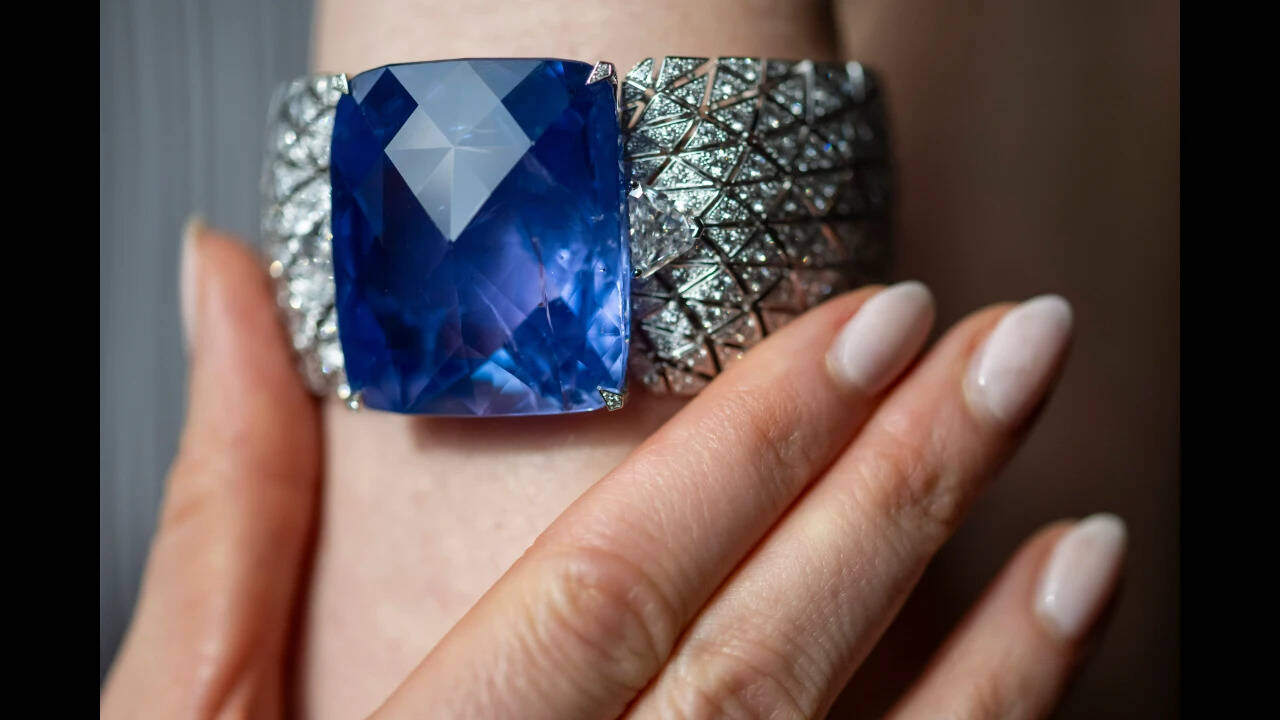
Weight.
You never really understand the physics of wealth until you hold something the size of a robin’s egg that carries the gravitational pull of a collapsed dynasty, feeling its cold, oily density press into the center of your palm while an auctioneer three feet away tries very hard not to sweat through his bespoke wool suit.
I spent fourteen years covering high-stakes estate liquidations and private vault transfers in Geneva and London before I stopped romanticizing old stones. You walk into those wood-paneled viewing rooms expecting fairy tales, and what you actually find is cold fluorescent lighting, armed guards with earpieces coiled like plastic snakes behind their ears, and heirs who look relieved to trade an unbearable family burden for a wire transfer. When news broke that a 197-carat sapphire once belonging to the Russian imperial family had hammered down for $4.9 million—crushing its pre-sale estimate—the financial press reported it like a quarterly earnings beat. They tallied the carats. They noted the percentage over the high estimate. They moved on to tech stocks.
They missed the entire point.
A stone like that is not a commodity. It is a survivor that watched an empire rot from the inside out, slipped through the fingers of revolutionaries in the dead of night, and sat quietly in the dark while the world burned twice. When someone pays nearly five million dollars for a piece of crystallized aluminum oxide stained blue by trace amounts of iron and titanium, they are not buying jewelry. They are buying immunity from time.
The Anatomy of a 197-Carat Obsession
To understand why collectors lose their minds over a stone of this scale, you first have to strip away everything you think you know about gemstones from mall jewelry stores.
Think of a standard engagement ring. One carat. Maybe two if someone had a good year in software sales. A 197-carat sapphire is roughly the weight of forty teaspoons of sugar compressed into a single, translucent blue heart. In the geological lottery, stones of this size almost never survive intact; tectonic shifts fracture them, heat clouds them, or miners shatter them with careless pickaxes before anyone realizes what is embedded in the rock.
Most experts trace the finest imperial Russian sapphires back to the legendary deposits of Ceylon—modern-day Sri Lanka—or the high-altitude pockets of Kashmir, though large cushion-cut stones of this specific velvety hue almost always whisper of ancient Sri Lankan riverbeds. In the late nineteenth century, the Romanov court was effectively a vacuum cleaner for the world's rarest minerals. Tsar Alexander II and later Nicholas II didn't just collect jewels; they weaponized aesthetics to project divine permanence.
Consider a hypothetical scene in St. Petersburg around 1895—let us invent a minor court jeweler named Mikhail to see how these objects actually lived. Mikhail would not have worked under bright LEDs. He would have squinted by tallow candles and north-facing winter windows, turning this massive blue stone between thumb and forefinger, terrified that a single slip of his brass calipers would ruin a piece worth more than three provincial estates. To Mikhail, the sapphire was not an investment vehicle. It was a physical piece of the Tsar's authority.
Then came 1917.
What Happens When a Dynasty Runs Out of Pockets
History books love dates and treaties, so they sanitize the sheer, frantic panic of an aristocracy realizing its currency has become toilet paper overnight.
When the Bolsheviks seized power, the Romanovs and their extended cousinage—the Grand Dukes and Duchesses who had spent three centuries treating the Russian treasury like a personal checking account—suddenly faced a brutal logistical problem. You cannot sew a hundred acres of timberland into the lining of a winter coat. You cannot hide a palace in a hatbox.
You can, however, hide a 197-carat sapphire inside a hollowed-out bar of soap, a jar of cold cream, or the hem of a maid's petticoat.
During the chaotic exodus through Crimea, Constantinople, and eventually into the rented apartments of Paris and London, imperial jewels became the ultimate underground banking system. Imagine sitting in a drafty Parisian flat in 1922. Your titles mean nothing. The French landlord wants francs, not memories of the Winter Palace. You reach into a battered leather trunk, pull out a blue stone that once hung around the neck of a Grand Duchess at a ball for four thousand guests, and you realize you have to sell it to a dealer who knows you are desperate.
That is the invisible stain on almost every great Russian jewel that surfaces at auction today. The $4.9 million price tag reflects the glamour of the Romanov provenance, yet the reason that provenance exists in the private market at all is desperation. A century ago, someone had to let go of that stone so their children could eat, pay rent, or buy passage across an ocean.
I remember inspecting a much smaller Romanov brooch in Zurich back in 2014. The clasp was slightly bent, crudely repaired with cheap solder. The dealer told me the family had likely used it to pin a heavy wool shawl together during a winter train crossing through war-torn Europe. Looking at that cheap solder against platinum and old-mine diamonds made my stomach turn. The stone didn't care who owned it. It stayed cold, brilliant, and completely indifferent to the human misery swirling around its setting.
The Auction Room Psychology Nobody Admits
So why did a buyer in our modern era step forward and push the bidding to $4.9 million, blowing past the pre-sale estimate?
If you have never sat inside a major evening sale in Geneva, New York, or Hong Kong, the atmosphere feels less like a retail store and more like an operating theater right before an incision. Nobody yells. Nobody waves a paddle like they do in movies. Instead, a specialist in a sharp suit stands near a bank of telephones, nodding microscopically to an invisible voice on the other end of a line in Singapore or Riyadh.
Pre-sale estimates are notoriously conservative by design—a psychological snare set by auction houses to get two ego-driven collectors into the ring together. Once the bidding passes the high estimate, rational valuation dies. You are no longer calculating price-per-carat. Let's do the math anyway just to see how absurd the numbers become: at $4.9 million for 197 carats, the buyer paid roughly $24,873 per carat. For context, high-grade commercial sapphires might trade for a few thousand dollars a carat. That extra $20,000 per carat is pure story tax.
Collectors at this altitude suffer from a very specific kind of terror. They have plenty of money; what they lack is permanence. Modern wealth is terrifyingly abstract—digits flickering on servers in New Jersey, equity tied up in volatile supply chains, currencies losing purchasing power every time a central bank sneezes.
A 197-carat sapphire that survived the Russian Revolution cannot be hacked. It cannot be diluted by a stock split. It has already survived the worst geopolitical collapse of the twentieth century and emerged without a scratch. When a billionaire buys it for $4.9 million, they are subconsciously hiring the stone as a bodyguard for their own legacy. They are betting that a hundred years from now, when their tech company or hedge fund is a footnote, someone will still hold this blue rock up to the light and whisper their name alongside the Tsars.
The Myth of the "Cursed" Stone and the Reality of Vaults
Whenever a massive royal gem makes headlines, commentators inevitably trot out tired tropes about curses, blood diamonds, or mystical energy. That is lazy storytelling, and frankly, it lets modern buyers off the hook.
There is nothing supernatural about a big blue corundum crystal. The real strangeness is what happens to these objects the moment the gavel falls.
You might picture the winning bidder wearing the sapphire to a charity gala, catching the chandelier light as they raise a champagne flute. Almost never happens. In reality, a $4.9 million historic sapphire goes straight from the auction house armored courier into a high-security freeport vault—places like the Geneva Freeport, windowless concrete fortresses near airport tarmacs where the world's rarest art and gems sit in climate-controlled darkness for decades.
Think about the tragic absurdity of that lifecycle.
For millions of years, the crystal sat buried in the dark earth of South Asia. Then, for a brief flash of human history—maybe a century or two—it saw the sun, glittered under the ballroom candles of St. Petersburg, rode in the pockets of terrified exiles, and flashed for ten minutes under the spotlights of an auction podium. Now, having fetched $4.9 million, it returns to total darkness inside a steel safe-deposit box, traded on paper between holding companies without ever touching human skin again.
I used to think that was a crime against beauty. Now I'm not so sure. Maybe the stone prefers the dark.
What We Actually See When We Look at Blue
Still, I keep coming back to the photograph of the stone before the sale.
Even flattened onto a glossy catalog page, a 197-carat sapphire exerts a weird optical trick on the human eye. Unlike diamonds, which throw white fire and sharp, aggressive flashes of rainbow light, a great sapphire absorbs light and holds it. It looks deep—like staring straight down into twenty feet of cold alpine water just before dusk.
In a world drowning in cheap plastic, disposable screens, and synthetic everything, we are starved for things that have genuine weight and genuine history. Most of us will never hold a 197-carat stone, nor would we know what to do with a $4.9 million asset if someone dropped it into our lap tomorrow. We'd probably panic about the insurance premiums before we even admired the color.
Yet we click the headline. We read the sale price. We pause for half a second while scrolling through bad news on our phones to stare at a blue rock that belonged to people who lost everything.
We do it because, deep down, we know our own lives are brief and fragile. Empires fall. Fortunes evaporate. Families scatter across continents with whatever they can carry in their coat pockets.
And somewhere in a dark vault tonight, a cold blue stone the size of a robin's egg sits completely unbothered, waiting to outlive its newest owner too.