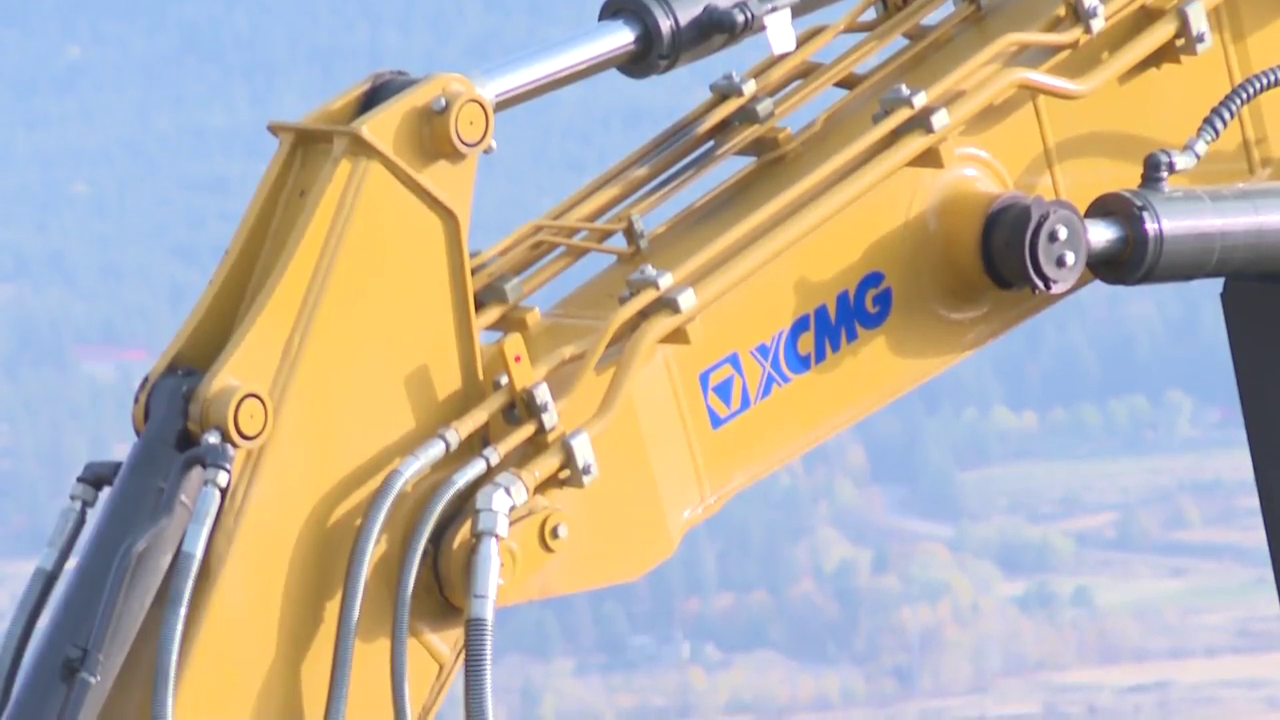
Steel does not lie. When a three-hundred-ton crawler crane lifts a precast concrete bridge girder sixty feet into the humid air above a river valley, gravity conducts an immediate, unforgiving audit. Either the hydraulic cylinders hold their pressure and the welded boom distributes the load according to the laws of physics, or the machine buckles, the cable snaps, and steel screams as it tears itself apart. You cannot bribe a weld seam. You cannot negotiate with torque.
Paper, however, bends easily.
For decades, Xuzhou Construction Machinery Group—known across the globe by its four stark yellow letters, XCMG—built its reputation on the honesty of heavy iron. Born in the industrial heartland of Jiangsu province in 1943, rising from a wartime munitions workshop to become one of the three largest construction equipment manufacturers on earth, XCMG became a physical manifestation of modern ambition. Its excavators dug the foundations of megacities from Shanghai to São Paulo. Its mining trucks hauled copper out of the Andes and iron ore from the Pilbara. To stand beneath an XCMG super-crane is to witness human engineering at its most audacious, a towering yellow monument to state-backed industrial might.
Yet when news broke that a senior official within this state-owned titan was facing criminal charges in an alleged fraud case, the tremor was not felt on construction sites. No booms collapsed. No engines stalled. Instead, the shockwave rippled through boardrooms, procurement offices, and compliance departments from Frankfurt to Singapore. It was a reminder of an uncomfortable truth that haunts global infrastructure: the machines may be forged from solid alloy, but the empires that sell them still run on human frailty.
The Anatomy of a Shadow Deal
To understand how an official inside a flagship Chinese state-owned enterprise ends up in the crosshairs of criminal prosecutors, you have to look past the gleaming trade-show floors and step into the gray zones of industrial supply chains.
Consider a hypothetical scenario, built from the documented patterns of dozens of real-world corporate fraud prosecutions across the heavy machinery sector. Let us call our protagonist Chen—a mid-to-senior procurement and regional sales director. He has spent twenty years climbing the rigid hierarchy of a state-owned manufacturer. He knows the technical specifications of every hydraulic pump and undercarriage assembly in the catalog. He also knows the immense pressure to hit quarterly growth targets in a domestic real estate market that has cooled from a roaring boil to a sluggish simmer.
Chen sits in a private dining room in a provincial capital, far from corporate headquarters in Xuzhou. Across the table sits a regional distributor—or perhaps a component supplier—who needs a contract approved before the fiscal year closes. The paperwork is almost in order, save for a few missing certifications or a price point that sits slightly above market average.
In a clean system, the bid is rejected. In a compromised one, a quiet arrangement takes shape.
Invoices are inflated by four percent. A shell consulting firm, registered under the name of a distant cousin in a coastal free-trade zone, bills the supplier for "market research" or "logistics coordination." The money flows out of the state-owned enterprise's treasury under the guise of legitimate operational expenses, loops through the intermediary, and settles quietly into offshore accounts or luxury real estate holdings. Alternatively, the fraud runs in the opposite direction: fictitious sales contracts are booked to inflate regional revenue numbers, securing bonuses and political promotions while leaving the parent company holding uncollectible debt and phantom inventory.
None of this is glamorous. There are no briefcases handcuffed to wrists in dark alleys. It happens through stamped forms, encrypted messaging apps, and subtle nods over cups of oolong tea. For years, the numbers on the ledger balance just well enough to survive routine internal audits. Until they do not.
Why State-Owned Giants Are Uniquely Vulnerable
I remember walking the floor of a massive industrial equipment expo in Munich several years ago, watching procurement officers from European engineering firms inspect the cabs of Chinese excavators. They tapped the welds. They checked the seals on the hydraulic hoses. They were genuinely impressed by how quickly the engineering gap had closed. Yet over coffee afterward, a veteran compliance director for a German conglomerate leaned across the table and voiced the exact fear that still keeps global executives awake at night.
"I trust their steel," he told me, stirring his espresso. "I just don't know who actually owns the signature at the bottom of the contract."
That anxiety points directly to the structural paradox of the modern Chinese state-owned enterprise, or SOE. Companies like XCMG operate as hybrid creatures. On one hand, they are aggressive, publicly traded multinational corporations competing head-to-head with Caterpillar, Komatsu, and Liebherr for lucrative tenders in Europe, North America, and the Global South. They publish glossy sustainability reports, adhere to international accounting standards on their listed subsidiaries, and employ thousands of brilliant engineers.
On the other hand, they remain deeply woven into the state apparatus. Their senior leaders are not merely corporate executives; they are cadres whose career trajectories are dictated by party committees and state asset supervision commissions. This dual identity creates immense pressure to perform—not just financially, but politically. When national policy demands rapid overseas expansion or domestic economic stimulus, regional managers face intense incentives to deliver growth at any cost.
At the same time, the sheer scale of these conglomerates creates blind spots. XCMG is not a single factory; it is a sprawling constellation of subsidiaries, joint ventures, financing arms, and regional distribution networks. When billions of yuan flow through thousands of vendor contracts every month, oversight becomes a monumental challenge. A single well-placed official, armed with signing authority and intimate knowledge of internal approval bottlenecks, can exploit the gap between headquarters' policy and ground-level execution for years before an audit flags an anomaly.
The Invisible Stakes of a Criminal Indictment
When a press release announces that an official at a state-owned giant faces criminal charges for fraud, the public often treats it as just another headline in a decade-long anti-corruption drive. Read the paragraph. Shrug. Move on.
That reaction misses the real damage entirely. Fraud inside a company of XCMG's stature is never a victimless administrative error. Its consequences bleed outward in concentric circles, touching people who have never heard of Xuzhou or read a balance sheet.
Start with the engineers and assembly-line workers. Thousands of men and women spend their lives perfecting metallurgy, coding autonomous mining software, and assembling precision gearboxes under brutal factory conditions. Every time a senior official is charged with fraud, their collective labor is tarnished by association. In international bidding wars, competitors do not hesitate to slide news clippings of governance scandals across the table to hesitant municipal buyers in London, Toronto, or Sydney. A single compromised official can undo five years of painstaking brand-building by honest engineers.
Then look at the financial markets and minority shareholders. XCMG Construction Machinery Co., Ltd. is listed on the Shenzhen Stock Exchange. Pension funds, retail investors, and institutional asset managers rely on the integrity of its financial disclosures. When fraud distorts procurement costs or sales figures, it poisons the data that investors use to price risk. Trust, once fractured in capital markets, takes years of steep valuation discounts to repair.
Most critically, consider the global infrastructure projects that depend on these machines. Modern construction financing relies on intricate chains of vendor credit, lease-to-own agreements, and sovereign guarantees. If an official manipulates loan guarantees or falsifies credit assessments for favored distributors—a common thread in heavy machinery fraud cases—the resulting defaults can stall highway projects, delay hospital construction, and leave local contractors bankrupt in emerging economies thousands of miles away.
The Reckoning Inside the Machine
It is tempting to view a criminal fraud charge inside a major state-owned enterprise as proof of systemic rot. That would be a mistake. In reality, the public exposure and prosecution of a high-ranking official often signal the exact opposite: an internal immune system finally kicking into overdrive.
Over the past decade, China's corporate governance landscape has undergone a turbulent, often painful transformation. Beijing recognized early on that its state-owned champions could never truly dominate global markets—or survive prolonged economic headwinds—if their balance sheets were quietly bled dry by insider self-dealing, fake trade financing, and kickback schemes. Consequently, internal audit teams, state anti-corruption inspectors, and judicial prosecutors have turned their focus aggressively toward the industrial and financial sectors.
Think of it like non-destructive ultrasonic testing on a crane boom. Outwardly, the painted yellow steel looks pristine. Only when technicians pass high-frequency sound waves through the metal do they detect the microscopic internal fractures that could eventually cause a catastrophic failure under load. Criminal prosecutions are the corporate equivalent of cutting out that fractured section and re-welding the joint before the entire structure gives way.
Yet the process is messy, frightening, and deeply uncertain for everyone inside the organization. When an investigation begins, decision-making freezes. Mid-level managers become terrified of signing off on routine vendor payments lest a future auditor misinterpret a standard commercial discount as a kickback. Suppliers face sudden payment delays as compliance teams comb through years of invoices line by line. For months, the giant moves with the cautious, stiff gait of an athlete recovering from major surgery.
What Comes After the Verdict
As the legal proceedings unfold against the accused XCMG official, prosecutors will meticulously reconstruct the paper trail—every bank transfer, every altered contract, every unauthorized seal. The courtroom outcome will likely follow the stern trajectory of Chinese corporate criminal law, where fraud involving state assets carries severe penalties designed to deter anyone else tempted to treat a public balance sheet as a personal ATM.
For the rest of the business world, however, the lesson extends far beyond one company or one jurisdiction. Whether in a state-owned conglomerate in Jiangsu, a defense contractor in Virginia, or a logistics giant in Rotterdam, the fundamental vulnerability remains identical. Corporations love to believe they are governed by algorithms, ERP software, and airtight compliance manuals. They are not. They are governed by human beings navigating ambition, fear, loyalty, and greed.
Outside XCMG's sprawling manufacturing base in Xuzhou, massive yellow cranes still stand sentinel against the gray horizon, their lattice booms stretching toward the clouds like steel cathedral spires. They are marvels of modern force and precision, capable of hoisting locomotives into the sky without trembling.
Inside the glass office towers beside them, the lights stay on late into the night as auditors, lawyers, and executives pore over spreadsheets, searching for the quiet places where human nature bent the rules. Because in the end, any empire built on heavy iron is only as strong as the integrity of the hands holding the pen.