The water between Montevideo and Buenos Aires is brown, wide, and deceptively calm. On a Tuesday morning in late November, the ferry takes two hours and fifteen minutes to cross the Río de la Plata, carrying commuters, tourists, and—on this particular week—the weight of a thousand unspoken grievances.
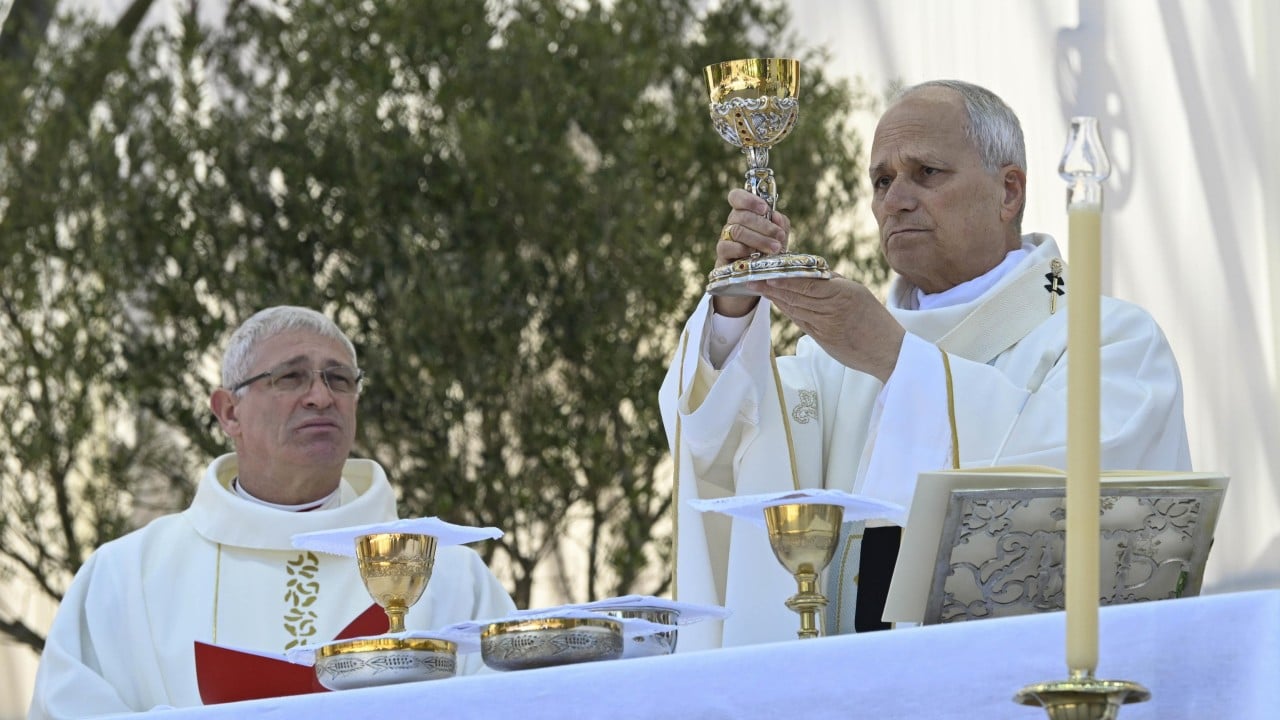
When Pope Leo XIV boarded his flight out of Uruguay, leaving behind the quiet, secular predictability of Montevideo, he was not merely crossing a border. He was stepping onto a stage set with dynamite.
Buenos Aires awaits him. And in Buenos Aires, Javier Milei is waiting, too.
To understand why this short hop across the river is the most fraught leg of the pontiff’s South American tour, you have to stop looking at diplomatic itineraries and start looking at the kitchen tables of La Matanza, the sprawling working-class district on the western edge of the Argentine capital.
The Anatomy of a Collision
Picture a retired schoolteacher named Elena. She is hypothetical, a composite of the millions of Argentines navigating the sharpest economic shock therapy in modern democratic history, yet her grocery bill is entirely real.
Two years ago, Elena spent half her pension on meat, bread, and bus fare. Today, under President Milei’s radical austerity program—the famous motosierra, or chainsaw, that slashed public spending, eliminated subsidies, and brought hyperinflation down from a dizzying 211 percent to manageable monthly single digits—Elena’s currency is finally stable. The numbers on the price tags have stopped spinning like a slot machine.
Yet Elena’s refrigerator is emptier than it has been in a decade.
She stands in the doorway of her concrete-block home, watching the television news. On one side of the split screen is Milei, the anarcho-capitalist economist with the wild hair and leather jacket, who once described the state as a criminal organization and social justice as an aberration. On the other is Pope Leo, the successor to Francis, carrying the ancient, stubborn doctrine of the Catholic Church: that the market has no soul, that the poor have a prior claim on the earth’s wealth, and that efficiency without mercy is just another name for cruelty.
Silence.
That is what hung over the tarmac in Montevideo as the papal plane lifted off. Not the peaceful silence of a retreat, but the pressurized quiet before a storm breaks over a dry plain.
Two Gospels of Survival
Why does this visit matter so much? Because Argentina is currently the world’s loudest laboratory for two irreconcilable ideas about how human beings should live together.
To grasp the tension, imagine two doctors arguing over a patient who has been poisoned for decades.
The first doctor, Milei, insists the patient must endure immediate, agonizing surgery without anesthesia. Cut the gangrene of state bloat, stop printing fake money, let the body burn through its fever, and trust that the natural laws of supply and demand will eventually rebuild the tissue. In his worldview, charity forced through taxation is theft. True morality lies in individual liberty and voluntary exchange.
The second doctor, represented by the Vatican’s social teaching, looks at the patient’s failing heart and warns that the surgery will kill the host before the cure can take effect. Pope Leo represents an institution that has watched empires rise, balance their ledgers, and crumble into dust because they forgot the people sleeping outside the palace gates. For the Church, the economy exists to serve human dignity, not the other way around.
I have walked through the villas miseria—the informal settlements of Buenos Aires—during past economic collapses. You never forget the smell of wet cardboard and cheap kerosene, or the specific, hollowed-out look in the eyes of a father who has just realized his wages no longer buy milk. When you have stood in those narrow alleys, macroeconomic theory ceases to be an academic debate. You feel the friction of policy against skin.
And that is the friction Pope Leo is walking directly into.
The Ghost of Francis
Complicating every handshake and every homily is a shadow that neither man can escape: the memory of Pope Francis.
For twelve years, Jorge Mario Bergoglio sat on the Throne of Peter, yet he never once returned to his native Argentina after his election in 2013. His absence became a national obsession, a Rorschach test onto which every Argentine projected their political tribalism. To the Peronist left, he was a distant patron saint; to Milei’s libertarian movement, he was an ideological enemy—a man Milei infamously insulted during his presidential campaign before later offering a pragmatic, politically necessary apology at the Vatican.
Now, Pope Leo arrives where Francis never stepped foot.
He comes without the baggage of Argentine party politics, which gives him a rare, terrifying clarity. He cannot be dismissed as a Peronist operator or a local partisan. When Leo speaks about the dignity of labor or the peril of abandoning the vulnerable, his words land not as local political maneuvering, but as a universal moral reckoning.
Yet the stakes are treacherous. If the Pope speaks too forcefully against the human toll of austerity, Milei’s supporters—and the millions of exhausted Argentines who voted for him out of sheer desperation to escape decades of corruption and inflation—will accuse the Church of defending a broken, parasitic system. They will say the Vatican prefers comfortable poverty over painful recovery.
Conversely, if Pope Leo offers only safe, sanitized platitudes about peace and harmony, the priests working in the slums—the curas villeros who run the soup kitchens now stretched past their breaking points—will feel betrayed by their own shepherd.
What Happens When the Cameras Blink
Diplomatic protocol is a masterclass in disguise. Over the next seventy-two hours, we will see the familiar choreography: the rigid smiles at the Casa Rosada, the exchange of ceremonial gifts, the carefully vetted joint statements about "dialogue" and "mutual respect."
Do not be fooled by the handshakes.
Consider what happens beneath the surface of these state visits. In Uruguay, Leo met a nation that largely separated church and state over a century ago. Montevideo treats religion like an antique clock on the mantelpiece—respected, occasionally admired, rarely consulted on matters of daily survival. In Uruguay, the Pope was a distinguished guest.
In Argentina, Catholicism is woven into the floorboards of the national psyche, even among those who never attend Mass. The constitution still mandates federal support for the Roman Catholic faith. Every street corner has a shrine; every political movement claims the blessing of the Virgin of Luján.
When Leo celebrates Mass at the Plaza de Mayo, or visits a parish on the periphery of the capital, every gesture will be decoded like an intelligence briefing. Who sits in the front row? Which union leaders are granted an audience? Does the Pope linger with the mothers of soup kitchens, or does he prioritize meetings with business leaders urging foreign investment?
I remember watching a similar papal visit in Latin America years ago, standing behind a metal barricade in the pouring rain. A woman next to me held a laminated photograph of her son, who had disappeared during a period of state violence. She didn't care about the geopolitical speeches being broadcast over the loudspeakers. She was waiting for one thing: to see if the man in white would look toward her section of the crowd, or if he would keep his eyes fixed on the dignitaries on the stage.
People in crisis have an uncanny radar for authenticity. They can tell within three seconds whether a leader sees them as souls or as statistics.
The Trap of Easy Answers
It is tempting, from the safety of distance, to turn this encounter into a simple morality play. Hero versus villain. Compassion versus greed. Or, depending on your politics, realism versus utopia.
That would be dishonest. And anyone who has watched Argentina cycle through crisis after crisis—the hyperinflation of 1989, the corralito bank freeze of 2001, the slow bleed of the 2010s—knows that easy answers are what broke the country in the first place.
Milei did not emerge from a vacuum. He was conjured into existence by decades of institutional rot, by politicians who preached social justice while pocketing public funds, and by an economic model that hollowed out the middle class while pretending to protect it. To ignore why millions of ordinary people handed a chainsaw to an outsider is to misunderstand the depth of their trauma.
At the same time, to pretend that a balance sheet is a substitute for a society is a delusion of a different kind. Argentina’s poverty rate surged past fifty percent during the initial shock of the reforms before beginning a slow, uneven retreat. Behind every decimal point in those quarterly reports is a child skipping dinner, a diabetic rationing insulin, a small workshop padlocking its doors forever.
This is the tightrope stretched across the Río de la Plata. Pope Leo cannot fix Argentina’s central bank, and Javier Milei cannot legislate grace.
The Real Question in Buenos Aires
As the papal motorcade rolls down Avenida 9 de Julio, past the Obelisk and the towering billboards advertising discounted loans and imported electronics, the world’s press will focus on the body language between the libertarian president and the Catholic pontiff. They will count the minutes of their private meeting. They will parse every adjective in the Vatican press releases.
They will be looking in the wrong direction.
The real test of this visit is not whether Javier Milei softens his economic doctrine, nor whether Pope Leo endorses a fiscal blueprint. Neither will happen.
The real test is whether the presence of the Pope forces a fiercely polarized nation to pause, even for an afternoon, and look at the people they have trained themselves not to see. In a political culture addicted to slogans—where the poor are either romanticized as political props or dismissed as freeloaders—moral authority does not work through policy memos. It works by interrupting the noise.
Back in La Matanza, Elena turns down the volume on her television. She walks out to the small concrete patio, sweeps away a scatter of dry jacaranda blossoms, and sets a kettle on the stove for mate.
Across the river, the plane from Montevideo has already touched down, its tires smoking briefly against the runway before rolling toward the terminal gates.