The polish on a ceremonial boot does not happen by accident. It requires heat, spit, horsehair, and hours of circular motion until the black leather stops looking like animal skin and starts looking like dark water.
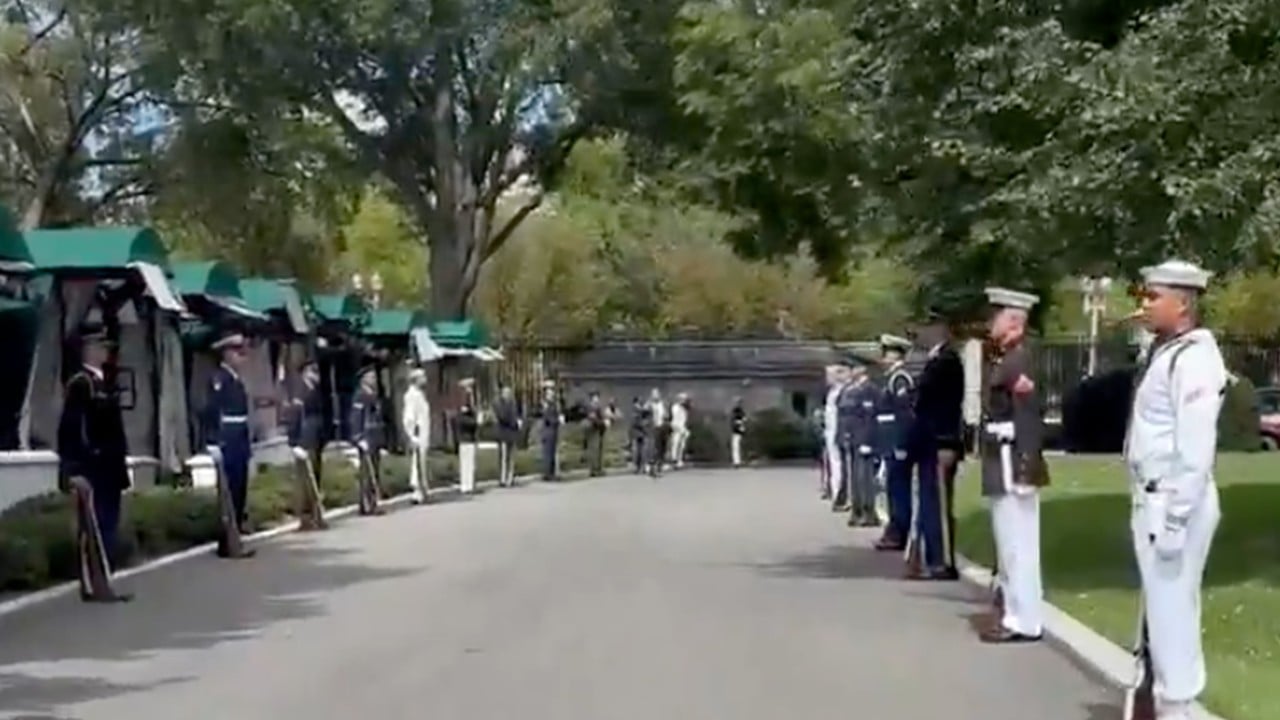
Down at Joint Base Myer-Henderson Hall, just across the Potomac River from the White House, the air smells of brasso, wool starch, and cold morning diesel. Men and women who have spent years training to become invisible—to move as a single, breathing organism of navy blue and crisp white—are lining up in the pre-dawn gray. They are practicing a choreography that has remained largely unchanged since the nineteenth century. Twenty-one guns. A red carpet rolled out with carpenter-level precision. The slow, deliberate inspection of the troops.
All of it is being prepared for one man. Xi Jinping.
If you read the standard wire reports, this event is reduced to a checklist of diplomatic logistics. You will read about traffic closures around Lafayette Square, the number of service members participating from the five branches of the armed forces, and the exact minute the motorcade will turn onto the South Lawn. The news cycles treat it like a parade. A bit of pomp before the real business happens behind closed doors.
They are missing the entire point.
When the United States military prepares a ceremonial welcome for the General Secretary of the Chinese Communist Party, the pageantry is not a distraction from geopolitics. The pageantry is the geopolitics. Every squared shoulder and synchronized rifle slap is a silent, high-stakes negotiation conducted in the language of muscle, steel, and memory.
The Weight of the White Gloves
To understand what happens on the South Lawn during a state arrival, you have to stop looking at the podium and start looking at the hands holding the rifles.
Consider a hypothetical young specialist in the 3rd U.S. Infantry Regiment—The Old Guard. Let us call him Miller. He is twenty-two years old, from a town in Ohio where the local factory closed the year he started high school, and his knees ache from standing at rigid attention for four hours at a stretch on concrete. Miller does not read foreign policy journals. He does not spend his evenings analyzing semiconductor export controls or maritime territorial claims in the South China Sea.
Yet, when Xi Jinping steps out of his armored Hongqi limousine, Miller’s eyes—locked straight ahead, unblinking—become the first diplomatic frontier between the world’s two superpowers.
Think about the surreal geometry of that moment.
For the past decade, the relationship between Washington and Beijing has hardened into something brittle and cold. In the Pentagon, planners run war games over the Taiwan Strait. In the halls of Congress, lawmakers draft legislation to decouple supply chains and ban apps. Across the Pacific, the People’s Liberation Army conducts massive naval exercises, rehearsing blockades and projecting power farther from its shores than at any point in modern history.
And then, on a crisp morning in Washington, the men who prepare to fight each other are ordered to salute each other.
I remember standing near the press risers during a previous state arrival at the White House, years ago, when the frost was still clinging to the boxwoods. What struck me was not the grandeur of the President or the visiting head of state. It was the sheer physical tension radiating off the honor guard. You could hear the fabric of their wool coats creaking in the quiet. You could feel the collective holding of breath among hundreds of soldiers, sailors, airmen, Marines, and Guardians. They were offering the highest possible martial respect to a leader whose government views their very existence in the Indo-Pacific as an intolerable provocation.
It is an exhausting paradox. And it is entirely intentional.
Theater as a Weapon of Peace
Why do we do this? Why spend millions of dollars and thousands of man-hours rehearsing a ritual of medieval courtesy in an age of hypersonic missiles and cyber warfare?
To answer that, you have to look at the psychology of absolute power.
Diplomacy between rival nations is essentially an exercise in managing ego and fear. Think of a state visit like two heavyweight boxers meeting at the center of the ring before the first bell. The referee gives instructions. The fighters touch gloves. That brief contact of leather is not an expression of affection; it is an acknowledgment of mutual lethality. It says: I see what you can do, you see what I can do, and for the next few minutes, we agree to abide by the rules of this house.
For Xi Jinping, legitimacy is everything. Back home in Beijing, his political survival and historical legacy are built on a singular narrative: that China has finally stood up after a century of humiliation at the hands of Western powers, and that under his guidance, it commands the undeniable respect of the world’s preeminent military superpower.
When the United States Army Band plays the March of the Volunteers—China’s national anthem—across the manicured grass of the White House, that sound travels far beyond the black iron fence on Pennsylvania Avenue. Within minutes, carefully edited clips of the U.S. military snapping to attention for Xi will be broadcast to over a billion people on state television in China.
Washington knows this. The generals at the Pentagon know this. The President knows this.
By granting Xi the full, unvarnished splendor of an Armed Forces Full Honor Arrival, the United States is handing him a potent domestic victory before a single trade agreement is signed or a single prisoner is released. It is a calculated gamble. American diplomats are trading the optics of deference for the chance to pull a rival back from the brink of miscalculation.
Because the alternative to the red carpet is silence. And in the nuclear age, silence between superpowers is how people die.
The Invisible Ledger of History
We have been here before, though the stakes look wildly different in the rearview mirror.
In February 1972, when Richard Nixon stepped off Air Force One in Beijing, the Chinese Premier Zhou Enlai met him on the tarmac with a crisp line of People’s Liberation Army troops. The soldiers were dressed in heavy padded winter coats, standing motionless in the biting wind. Nixon walked down the line, staring intently into their faces, later remarking on the sheer discipline and intensity of the men he saw. Back then, China was poor, isolated, and convulsing from the Cultural Revolution. The ceremonial welcome was an olive branch extended from a position of strategic desperation against the Soviet Union.
Fast forward to 1979, when Deng Xiaoping arrived at the White House. Jimmy Carter welcomed him on the South Lawn with the exact same military honors being prepared today. Deng, a tiny man standing barely five feet tall, beamed beneath a ten-gallon hat in Texas a few days later, charming the American public while quietly setting in motion the economic engine that would transform China into a titan.
The ritual has not changed. The balance of power has flipped upside down.
Today, the nation rolling out the carpet is no longer dealing with an impoverished giant looking for an entry ticket to the global economy. It is dealing with a peer competitor that possesses the largest navy on earth by ship count, a rapidly expanding nuclear arsenal, and an industrial base capable of outproducing the West in everything from solar panels to artillery shells.
This is what makes the preparations at Joint Base Myer feel so heavy, almost tragic, in their precision.
When you watch the rehearsals, you notice the obsession with symmetry. Every step is measured at thirty inches. Every rifle is held at a forty-five-degree angle. The military creates a world of absolute order precisely because the political world outside the gates is spiraling into chaos. It is a psychological anchor. If the soldiers do not flinch, if the cannons fire on the exact second required, then maybe—just maybe—the adults in the room can keep the world from catching fire.
What Happens Behind the Music
Let us pull back the curtain on what the cameras rarely show during these ceremonies.
Hours before the visiting leader arrives, bomb-sniffing dogs sweep every inch of the turf. Secret Service snipers take positions on the roof of the White House and the adjacent Eisenhower Executive Office Building, their silhouettes barely visible against the sky. Underneath the temporary press risers, miles of thick black cables snake across the grass, connecting satellite trucks to broadcast booths in London, Tokyo, Taipei, and Beijing.
Meanwhile, the troops are waiting.
Standing at attention is an unnatural act for the human body. Blood pools in the lower extremities. If a soldier locks their knees, oxygen stops reaching the brain, and they will pitch forward onto their face like a felled tree—a humiliation that haunts ceremonial units for decades. So they learn to wiggle their toes inside their glossy shoes. They subtly flex their calves. They focus on a single fixed point in the distance, detaching their minds from the cold wind slicing through their uniforms.
Think about what is going through the minds of the senior officers standing at the front of those formations.
Many of them have spent their entire careers rotating through bases in Okinawa, Guam, and South Korea. They have watched Chinese fighter jets buzz American reconnaissance planes over international waters. They have sat in classified briefings looking at satellite imagery of man-made islands militarized with runways and anti-ship missiles in the Spratly archipelago. Some of them have sons and daughters serving aboard destroyers currently patrolling the Taiwan Strait.
And now, they are commanded to raise their right hands to the brims of their caps and hold a salute while the leader responsible for those threats walks past them.
It requires a level of emotional compartmentalization that most civilians will never experience. In a democracy, the military does not choose its friends or its enemies. It executes the will of the civilian leadership. When the President decides that the path to peace requires rolling out the red carpet for a strategic adversary, the military swallows its personal reservations, polishes its brass, and puts on the finest show on earth.
The Fragility of the Performance
I have to be honest with you: there is something deeply unsettling about watching this unfold right now.
Part of me wants to believe in the magic of the ritual. History shows that personal rapport between leaders—built over state dinners, shared toasts, and walk-and-talks through the Rose Garden—can occasionally pierce through bureaucratic paralysis. In 1985, Ronald Reagan and Mikhail Gorbachev stood by a fireplace in Geneva, stripped away their talking points, and began the slow dismantling of the Cold War. Sometimes, looking a rival in the eye reminds you that they, too, have children, fears, and a desire not to be remembered as the person who ended civilization.
Yet another part of me looks at the structural collision course between Washington and Beijing and wonders if the pageantry has become a hollow shell.
Can a twenty-one-gun salute bridge the chasm over the future of Taiwan? Can a military band playing in harmony resolve a technological cold war over artificial intelligence and quantum computing? Of course not. No amount of ceremonial grace can erase the fact that China’s vision for the twenty-first century fundamentally clashes with the American-led order that has governed the globe since 1945.
And there is a danger in the performance itself.
When the public sees images of American soldiers honoring Xi Jinping, it creates a cognitive dissonance. Voters in the Midwest who watched their towns hollow out after China joined the World Trade Organization look at their television screens and feel betrayed. Hawks in Washington see weakness. Allies in Manila, Tokyo, and Canberra watch nervously, wondering if the United States is preparing to cut a grand bargain over their heads.
Simultaneously, hardliners in Beijing watch the same footage and draw the opposite, equally dangerous conclusion: that America is declining, desperate, and willing to appease Chinese power.
Both sides are walking a razor’s edge. The ceremony is designed to project strength and magnanimity, yet it constantly risks being misread as submission or deceit.
The Echo After the Cannon Fire
Eventually, the motorcade will depart.
The red carpet will be rolled up and hauled away in trucks. The barriers along Pennsylvania Avenue will be lifted, and tourists in sneakers will once again press their faces against the White House fence, taking selfies where, just hours earlier, the fate of the Pacific hung in the balance.
Down at Joint Base Myer, Specialist Miller—and hundreds of real young men and women just like him—will walk back into the barracks. They will unbuckle their belts, peel off their heavy wool coats, and kick off their mirror-shined boots. They will rub their aching calves, grab a lukewarm coffee from a vending machine, and check their phones to see if the world looks any safer than it did at four o’clock that morning.
Inside the West Wing, the diplomats will gather around long mahogany tables to dissect every micro-expression, every pause in translation, every subtle shift in Xi Jinping’s posture during the review of the troops. They will spend months arguing over what it all meant.
But out on the South Lawn, while the smoke from the ceremonial cannons still hangs low over the grass, the truth of the moment is remarkably simple.
Two empires, armed with enough firepower to turn the northern hemisphere into ash, paused for forty-five minutes to march in a straight line and listen to music. It was not peace. It was not friendship. It was just a brief, disciplined refusal to let the darkness win for one more day.