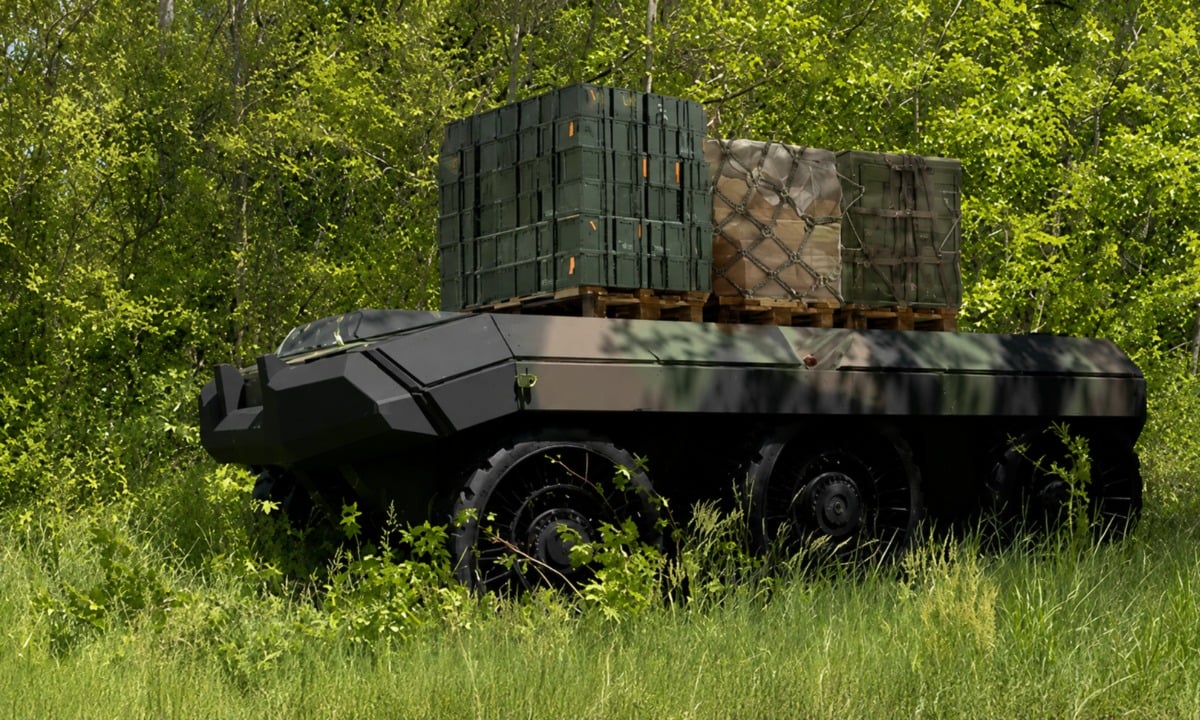
HDT Robotics—operating as BLADE—secured a position as one of five industry partners in the U.S. Army's Project Sustainment program through the National Advanced Mobility Consortium. The award puts BLADE's Dire WOLF unmanned ground vehicle directly into the Pentagon’s drive to solve the lethal problem of contested tactical supply. Military planners have long recognized that quartermasters taking water, ammunition, and fuel to forward edge fighting positions suffer staggering casualties in modern high-intensity conflict. Replacing human drivers with autonomous machines is no longer an intellectual exercise; it is an urgent requirement for survival.
The decision to elevate BLADE’s platform highlights a shift in how defense acquisition officials view autonomous ground operations. For years, defense contractors pitched sleek, fully electric, software-centric platforms that looked impressive on proving grounds. Those machines routinely broke down when confronted with deep mud, heavy electronic warfare, and long operational tempos. The selection of the Dire WOLF—a six-wheeled diesel-electric hybrid system built on the architecture of the WOLF-X—signals that practical engineering is finally overriding defense tech idealism.
The Mechanics of Last Mile Battlefield Resupply
Amphibious operations and distributed warfare across wide geographic expanses create severe supply chain bottlenecks. When artillery, loitering munitions, and commercial recon drones cover every square meter of a frontline, moving a standard two-and-a-half-ton truck to resupply a squad is a suicide mission. The Army terms this environment the "contested tactical edge".
"By leveraging advanced autonomy and proven UGV performance, we are ensuring that essential supplies reach soldiers at the tactical edge – safely and reliably." — Tom Van Doren, President of Robotics at BLADE
The core objective of Project Sustainment is simple on paper but brutal in execution. Deliver thousands of pounds of heavy supplies across broken terrain without revealing the target coordinates to enemy sensors.
| Feature | Legacy Tactical Resupply | Dire WOLF Autonomous Platform |
|---|---|---|
| Crew Requirement | 2 to 4 personnel exposed | Zero on-board crew |
| Drive System | Standard Internal Combustion | Hybrid Diesel-Electric with Pivot Steering |
| Tire Technology | Standard Pneumatic (Prone to Flats) | Michelin Tweel Airless Systems |
| Power Generation | Single Engine Alternator | High-capacity Exportable Microgrid Power |
| Obstacle Mobility | Dependent on Driver Skill | Automated 2-foot Vertical Step Traversing |
Traditional logistics rely on large convoys that produce massive thermal and acoustic signatures. A single heat-seeking missile or thermal sensor on an overhead drone can locate a diesel convoy miles away. Small, dispersed robotic systems break that target profile into manageable, low-risk segments.
+-------------------+      +----------------------+      +------------------------+
| Central Depot /   | ---> | Dispersed Unmanned   | ---> | Forward Units          |
| Tactical Base     |      | Ground Vehicles      |      | (Concealed Positions)  |
+-------------------+      +----------------------+      +------------------------+
                             (Low Thermal Signature)
Why Unmanned Ground Vehicles Fail When the Shooting Starts
Unmanned platforms face a harsh reality off the paved road. Aerial drones enjoy the luxury of open sky, where navigation math relies primarily on clear line-of-sight and basic obstacle avoidance algorithms. Ground vehicles do not have that luxury.
A six-wheeled ground vehicle must process mud depth, tree stumps, boulder clusters, hidden ditches, and shifting soil compositions in real time. If an autonomous vehicle gets stuck in a ditch during a resupply run, it does not just fail its mission—it becomes an enemy sensor magnet and a road-block for following units.
The Problem with Soft Earth and Pneumatics
Flat tires kill combat momentum faster than enemy fire. Standard pneumatic tires shredded by shrapnel, jagged rocks, or barbed wire will immobilize a supply vehicle within minutes.
To overcome this failure mode, the Dire WOLF incorporates non-pneumatic airless tires developed by Michelin, known as Tweels.
- Zero Flat Risk: Removing pressurized air eliminates mobility losses caused by small-arms fire or puncture fragments.
- Debris Deflection: Flexible spoke structures deform over jagged obstacles, maintaining a consistent contact patch.
- High Load Stability: Airless tires maintain structural rigidity even under multi-ton payload weights.
Geometry and Obstacles
Steep embankments stop most commercial robotics cold. The Army's tactical profile requires vehicles capable of climbing vertical two-foot steps and crossing wide trenches without tipping.
Pivot steering—allowing wheels on opposite sides to rotate in opposing directions—gives six-wheeled configurations the capability to turn on a dime in tight forest channels or narrow urban alleyways. Without pivot steering, a vehicle forced into a dead end must execute multi-point turns under active artillery observation.
Beyond Autonomous Hype and Into the Hybrid Powertrain Reality
Pure electric ground vehicles generate minimal noise, which makes them attractive for quiet operations. Yet their operational radius remains severely restricted by energy density limitations. Lithium battery packs weigh thousands of pounds and require hours to recharge—a luxury that does not exist at a forward operating base under shellfire.
Diesel fuel remains the lifeblood of military logistics. It is dense, widely available in military supply lines, and simple to handle.
                    +-----------------------------+
                    |    Onboard Diesel Engine    |
                    +-----------------------------+
                                   |
                                   v
+------------------+    +--------------------+    +------------------+
| Battery Storage  | <--| Onboard Generator  | -->| Electric Drive   |
| (Silent Watch)   |    +--------------------+    | Motors (Wheels)  |
+------------------+                              +------------------+
A diesel-electric hybrid architecture solves the range problem while preserving tactical quiet. The diesel engine acts as a continuous onboard generator, charging a high-density battery bank while propelling the wheels via electric motors.
When approaching a dangerous target zone, the vehicle cuts its internal combustion engine entirely. It runs purely on battery reserve for the final kilometer, lowering its acoustic and infrared signature to near zero. Once clear of the target zone, the diesel engine fires back up to recharge the system on the return leg.
Exportable Tactical Power
A hidden requirement of modern infantry squads is electrical power. Soldiers carry radiovision gear, targeting optics, electronic warfare jammer packs, and drone controllers—all of which exhaust batteries within hours.
The Dire WOLF functions as a rolling power plant at the forward edge. By converting high-horsepower mechanical engine output into exportable electrical energy, the machine can recharge squad gear, power field command systems, or run localized anti-drone systems while parked in a concealed position.
The Hidden Vulnerabilities of Autonomous Convoy Networks
Autonomy software is the center of gravity for military ground robotics. BLADE's integration with software specialists like Carnegie Robotics underscores that hardware is only half the battle.
Civilian autonomous cars rely on GPS, detailed high-definition HD maps, and cloud connectivity. In a high-intensity combat zone, those dependencies disappear instantly.
COMMERCIAL AUTONOMY             TACTICAL COMBAT AUTONOMY
--------------------             ------------------------
[ GPS Signals ]      --> LOST    [ Sensor Fusion LiDAR ]
[ HD Cloud Maps ]    --> LOST    [ Optical Odometry ]
[ Cell / 5G Link ]   --> LOST    [ Inertial Navigation ]
GPS signals are routinely jammed or spoofed across active conflict sectors. A military autonomous vehicle that relies on GPS will spin in circles or drive off a cliff the moment an enemy jammer activates.
Tactical autonomy demands GPS-denied navigation. The onboard computer must combine optical odometry, thermal cameras, LiDAR sensors, and inertial navigation units to map terrain in real time without transmitting radio signals that enemy direction-finders can track.
The Cyber and Electronic Threat Profile
An autonomous ground vehicle is a computer with wheels. If enemy signals intelligence intercepts its control feed, they can trick its perception systems or shut it down entirely.
- Sensor Blinding: High-powered lasers or smoke screens can blind optical LiDAR arrays, forcing reliance on low-resolution radar.
- Acoustic Spoofing: Ultrasonic frequencies can disturb inertial measurement units, causing the vehicle's computer to miscalculate its tilt and velocity.
- Physical Capture: A stalled autonomous supply wagon becomes an instant prize for enemy forces seeking to harvest its onboard cryptographic modules and code libraries.
Software architectures must incorporate zero-trust protocols. If a vehicle detects it has been isolated or tampered with, it must wipe sensitive navigational logs and lock down its drives.
The Industrial Footprint Behind Autonomous Resupply
The defense industrial base is undergoing a massive consolidation. Legacy contractors built massive, expensive platforms over decades-long procurement cycles. Today's environment demands rapid iteration cycles borrowed from commercial hardware startups, backed by manufacturing scale.
HDT Robotics' rebranding to BLADE marks a structural pivot toward dedicated tactical automation. Operating out of facilities in Fredericksburg, Virginia, the company is positioning itself to bridge the gap between traditional military hardware and commercial robotics software.
Competing alongside four other industry partners under the National Advanced Mobility Consortium, BLADE's battle lab approach aims to demonstrate that low-cost, repairable ground vehicles can be produced in large quantities.
The economic reality is straightforward. A single destroyed manned supply truck costs millions of dollars, along with trained human lives that cannot be replaced on a short timeline. A modular robotic platform costing a fraction of that amount can be written off as an acceptable loss on the battlefield.
Military logistics has reached an inflection point where blood and steel must be decoupled. Project Sustainment represents a step toward an operational environment where machines bear the physical cost of moving war materiel through lethal fires. If platforms like the Dire WOLF can execute under real combat stress, the days of exposing human drivers to ambush and artillery on last-mile supply routes are drawing to a close.