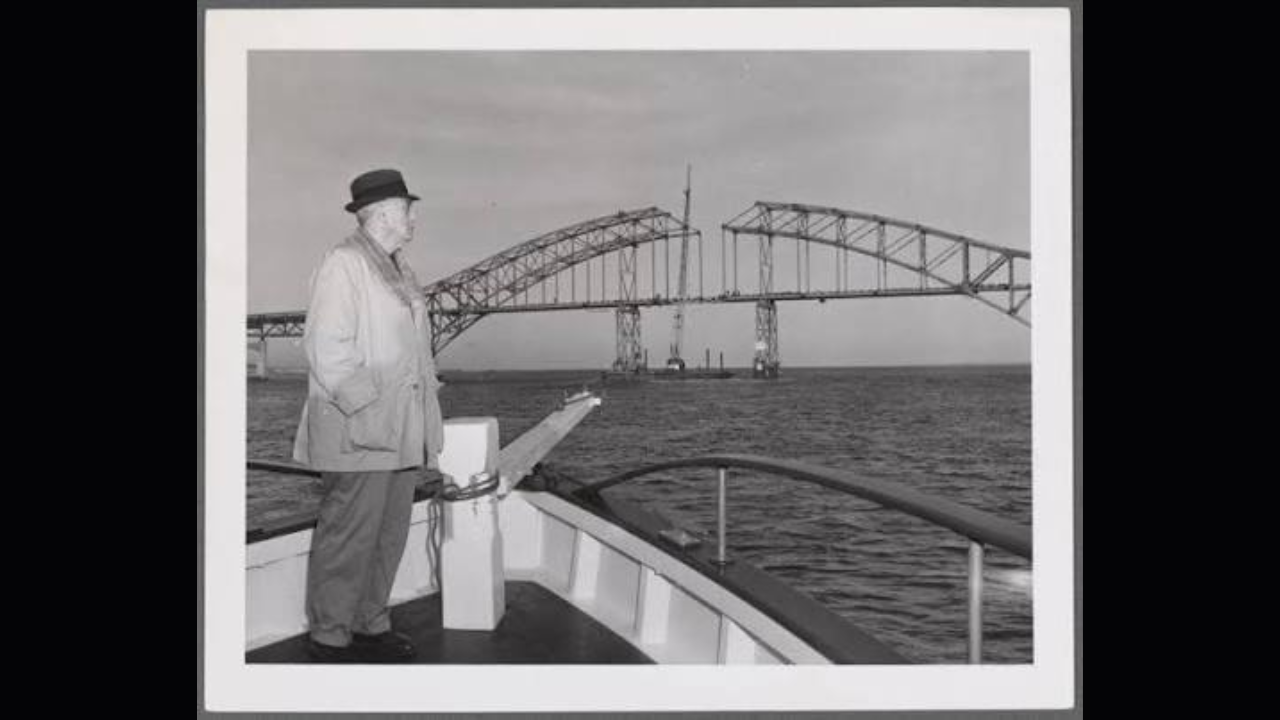
The Atlantic does not negotiate. When it rises, it brings a weight that fractures wood, lifts foundations from their damp anchors, and reshapes the geography of the New York coastline overnight.
Ask anyone who stood on the dunes of Fire Island in the chaotic wake of the Ash Wednesday storm of 1962. For days, the ocean battered thirty-two miles of narrow barrier beach, chewing through sand, swallowing homes, and turning the thin strip of land into a churning sieve of saltwater and foam. The sea wanted the island back. To many sitting in air-conditioned offices across the East River, that seemed like a reasonable bargain.
Enter Robert Moses.
He looked at the bleeding shoreline not with sorrow, but with the cold, unyielding geometry of a master builder. To Moses, the storm was not a warning from nature. It was an engineering error waiting to be corrected. His solution was breathtakingly arrogant and entirely predictable: concrete.
He proposed paving the spine of Fire Island with a multi-lane oceanfront highway.
Imagine it. Asphalt humming where the beach plum grows. Exhaust mixing with the salt spray. The quiet, fragile sanctuary of the Outer Banks’ northern cousin turned into an extension of Long Island’s relentless suburban sprawl. Commuters zipping past deer tracks on a high-speed ribbon of progress, insulated from the very elements that made the place wild. Moses believed asphalt was armor. He genuinely thought that if you poured enough heavy stone and thick tar over a shifting ecosystem, you could bully the ocean into submission.
He was wrong. And thankfully, the island fought back.
The Anatomy of Concrete Hubris
To understand why the proposed Fire Island highway failed to materialize, you have to understand the man who dreamed it and the fragile architecture of a barrier beach.
Barrier islands are not solid ground. They are dynamic, restless ribbons of sand held together by stubborn beach grass, sheer luck, and constant movement. They breathe. When storms hit, sand washes over them, migrating backward toward the bay in a natural process of survival. A fixed structure—like a massive concrete highway—tries to arrest that breath. It acts as a dam. Stop the sand from moving, and you starve the ocean side while drowning the bay side.
Moses did not care about the breathing. He cared about throughput.
By 1962, his name was synonymous with modern New York. He had carved the Meadowbrook Parkway through the marshes, looped the city in grand parkways, and bridged rivers with monumental grace. But Moses suffered from a terminal affliction common among planners of his era: he believed nature was merely an unpolished draft of a city waiting to be built.
When the March storm carved temporary inlets through Fire Island, slicing the beach into jagged pieces, Moses saw his opening. He pushed for a state-funded highway that would run the length of the island, connecting a string of sleepy, eccentric beach communities to the mainland grid.
The rationale was dressed up in the language of public safety and emergency access. How could police reach a crisis? How could fire trucks save a burning cedar shingle cottage? How could the ordinary citizen enjoy the shore if they had to rely on weathered ferries and wooden docks?
It sounded practical. It sounded modern.
It was a Trojan horse for real estate development. A highway does not just transport people; it invites density. It invites motels, strip malls, gas stations, and weekend traffic jams. Had the asphalt been poured, Fire Island would today look less like a sanctuary of boardwalks and red wagons and more like Jones Beach stretched thin into the horizon—a concrete breakwater choked with tailpipes.
The Line in the Sand
Opposition did not arrive as a unified political movement. It bubbled up from the dirt, carried by people who loved the island precisely because it lacked the conveniences of the mainland.
Property owners, summer residents, fishermen, and environmentalists formed an unlikely coalition. They were joined by conservationists who looked at the fragile maritime forests—like the stunted, wind-sculpted oaks of the Sunken Forest—and understood that a highway would slice the ecosystem’s heart clean out.
(To picture the Sunken Forest, imagine walking through a cathedral built by gnarled trees that grew just low enough to hide beneath the protective ridge of the primary dunes, sheltered entirely from the salt-laden gales.)
The debate turned fierce. Town halls grew hot and crowded. People shouted across folding chairs. On one side stood the unstoppable force of twentieth-century modernization, armed with federal disaster relief funds, heavy machinery, and the terrifying bureaucratic momentum of Robert Moses. On the other side stood a collection of stubborn individualists who simply wanted to keep their shoes sandy and their horizons free of streetlights.
They argued that Fire Island's isolation was its primary defense. A highway wouldn't just ruin the aesthetic; it would accelerate erosion. Every storm would wash over the pavement, undermining the roadbed, requiring millions in endless repairs, turning the public treasury into a perpetual-motion machine of concrete replacement.
They were pointing out a truth that civil engineers often ignore: sometimes, the cheapest and most resilient infrastructure is no infrastructure at all.
The Quiet Victory of the Unpaved
Slowly, the momentum fractured. The Department of the Interior, under the Kennedy administration, began looking at the Atlantic coastline with a new conservationist lens. Secretary Stewart Udall and other federal officials realized that barrier beaches were national treasures worth preserving in their raw state, not paving over for weekend drivers.
In 1964, just two years after Moses floated his grand design, Congress did the unthinkable. They established the Fire Island National Seashore, protecting a massive swath of the island from commercial development and, crucially, killing the highway dead in its tracks.
Moses rumbled, protested, and pushed back, but his absolute grip on New York's planning apparatus was finally slipping. The age of unbridled, asphalt-first environmental engineering was meeting its first real, systemic limits.
Today, if you visit Fire Island, you notice what is missing immediately.
There is the distinct absence of the hum of tires. There are no cars allowed on the western and central parts of the island. Grocery runs are done with canvas tote bags hauled in red Radio Flyer wagons. Luggage is stacked on wooden carts at the ferry terminals. The main thoroughfares are narrow boardwalks weathered to a soft, silver grey, flanked by bayberry and poison ivy.
When the wind picks up and the Atlantic surges against the dunes, the island still takes a beating. Storms still chew at the sand. Erosion remains a relentless, expensive reality. But the island absorbs the blow on its own terms. The sand shifts. The dunes rebuild. The ecosystem adapts because nothing rigid was bolted down to break.
We live in an era obsessed with fixing every vulnerability with thicker shields, smarter algorithms, and heavier materials. We look at climate change and coastal erosion and often default to the Moses playbook: build higher seawalls, pour more concrete, engineer our way out of the consequence of our own presence.
Yet the ghost of the unbuilt Fire Island highway whispers a different lesson across the salt marshes.
Restraint is an infrastructure. Leaving things wild is an act of design. And sometimes, the most enduring thing a civilization can build is the wisdom to stop at the edge of the water and put the asphalt down.