Olena’s hands smelled of yeast and ash. In a small kitchen in Kyiv, she was kneading dough for paska, the traditional Ukrainian Easter bread, but the rhythm of her work was out of sync. Every few minutes, the low, vibrating thrum of an air-raid siren would cut through the air, a sound so familiar it had become a second heartbeat. It is a peculiar thing to celebrate the resurrection of life when the horizon is painted in the orange glow of things dying.
This was the promise of the Easter truce. A moment of stillness. A breath. But as the sun rose over the gold-domed cathedrals of a nation under fire, the stillness felt less like peace and more like a held breath before a scream.
The facts of the conflict are cold and immutable. We track the movement of lines on a map, the number of shells fired per hour, and the diplomatic failures that litter the floors of international summits. But the true cost isn't found in a briefing. It is found in the way Olena looks at her son, knowing he is forty miles away in a trench, watching the same sunrise through the sights of a rifle. For her, the "grim mood" reported by the international press isn't an abstract sentiment. It is a physical weight, a pressure behind the eyes that never truly goes away.
The Myth of the Quiet Morning
War does not respect the calendar. While the world looked toward Ukraine hoping for a symbolic pause, the reality on the ground was a jagged contradiction. In cities like Kharkiv and Zaporizhzhia, the expected "truce" was met with the same mechanical cruelty of the weeks prior. Missiles do not have a religion. They do not recognize the sanctity of a Sunday.
Consider a hypothetical soldier named Mykhailo. He sits in a dugout carved into the frozen mud of the Donbas. To the rest of the world, he is a statistic, one of hundreds of thousands holding the line. But in the pre-dawn light of Easter, Mykhailo is simply a man who wants to hear a church bell instead of a mortar. He waits for the silence that was promised. It never comes. Instead, there is the distant, rhythmic thud-thud-thud of artillery, a reminder that the machinery of destruction is indifferent to the soul.
The failure of this truce wasn't just a military reality; it was a psychological blow. When you offer a starving man a glimpse of a feast and then snatch it away, the hunger becomes more acute. By dangling the possibility of a ceasefire, the aggressors didn't just maintain the violence—they weaponized hope.
The Invisible Stakes
Why does a failed truce matter more than a standard day of combat? Because it erodes the very concept of a shared humanity. Peace requires a baseline of trust, a mutual agreement that certain moments are bigger than the grudge. When that is shattered, something deeper than a building is destroyed.
We often talk about the "stalemate" in Ukraine as if it were a game of chess. It isn't. Chess pieces don't feel the damp cold of a cellar. They don't have to explain to a six-year-old why they can't go outside to hunt for eggs because the grass might contain "petals"—the colloquial name for small, devastating landmines.
The stakes are the preservation of the spirit. If a people can be convinced that even their holiest days are subject to the whims of a predator, the goal isn't just territory. It is the total exhaustion of the will. The grim mood observed in the streets of Kyiv isn't a sign of defeat, however. It is a hardening. It is the realization that the only peace that will ever be "real" is the one they forge with their own hands, because the ones offered by the enemy are made of smoke.
The Architecture of Endurance
In the absence of a true ceasefire, the people of Ukraine have built their own cathedrals of resilience. You see it in the subway stations turned into bomb shelters, where choirs still sing. You see it in the volunteers who drive vans filled with bread into the "gray zones" where the fighting is thickest.
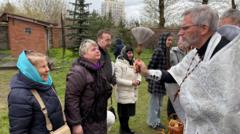
Imagine a priest in a village that has been shelled until the trees are nothing but charred toothpicks. He stands in a roofless church, the sky visible through the rafters. He is not wearing the ornate robes of a peaceful era. He is wearing a flak jacket under his vestments. He blesses the water, he blesses the bread, and he blesses the soldiers who will be back in the mud by nightfall.
This is the "real peace" the headlines cry out for, but it looks nothing like the peace we imagine in the West. It is gritty. It is defiant. It is a peace that says: You can take the roof, but you cannot take the prayer.
The Logic of the Long Shadow
Statistics tell us that millions have been displaced, that the economy is a fraction of its former self, and that the environmental damage will take generations to heal. These are the "macro" truths. But the "micro" truth is that a failed Easter truce means a grandmother in Lviv spends the day looking at a photo of a grandson she hasn't seen in two years, wondering if the "quiet" reported on the news is reaching his sector.
The failure of diplomacy is often framed as a lack of communication. In this case, the communication was crystal clear. By refusing to honor a pause, the message sent was that there is no limit to the suffering that can be inflicted.
This creates a terrifying precedent. If the world accepts that even a few hours of reprieve for the sake of the spirit is too much to ask, then we have moved into a new era of total war—one where the human element is entirely discarded in favor of the kinetic objective.
The Weight of the Bread
Back in the kitchen, Olena pulls the paska from the oven. It is golden and smells of better times. She doesn't have a truce, but she has this bread. She will take it to the hospital later this afternoon, walking past the sandbagged monuments and the posters of fallen heroes.
She is tired. Everyone is tired. The "grim mood" isn't a temporary cloud; it is the atmosphere of a nation that has been forced to adapt to the unthinkable. But beneath that grimness is a tectonic plate of resolve. You cannot break a people who have already looked at the worst-case scenario and decided to keep baking bread.
The bells in the cathedrals did ring this year. They were muffled by the sound of generators and the distant rumble of the front, but they rang. They didn't signal a ceasefire. They didn't signal the end of the war. They signaled that the people were still there, standing in the ruins of a promise, waiting for a dawn that didn't come from a diplomat's pen.
The hollow bell doesn't mean the church is empty. It means the strike was hard enough to be heard in the next life.
Olena places the bread on the table and turns off the light, saving the electricity for someone who might need it more. Outside, the sirens begin again, a rising and falling wail that mimics the wind. She doesn't flinch. She simply waits for the next note.