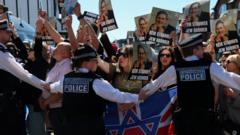
Keir Starmer walked into Golders Green expecting a controlled photo opportunity but left facing the raw, unscripted friction of a community that feels increasingly abandoned by the political center. While the official narrative focuses on a handful of vocal hecklers, the real story lies in the widening gap between Labour’s strategic caution and the visceral anxiety of British Jews. This wasn't just a minor breach of security. It was a symptom of a deeper breakdown in trust that no amount of rehearsed messaging can easily repair.
The visit was intended to project an image of stability and solidarity. Instead, it served as a stage for the very tensions Starmer has spent years trying to suppress. For the Labour leadership, every public appearance in North London is a high-stakes gamble. They are fighting to prove that the party has fundamentally changed since the era of Jeremy Corbyn, yet they are finding that the scars of that period are far deeper than a few policy shifts can heal.
The Strategy of Managed Presence
Political visits to sensitive areas are usually choreographed with surgical precision. Staffers scout the locations, friendly faces are placed in the foreground, and the press is kept at a distance that allows for good visuals without risking difficult audio. When Starmer arrived in Golders Green, the machinery of the Labour press office was geared toward a specific outcome: a quiet, respectful engagement that would yield a few usable clips for the evening news.
The failure of that choreography is telling. When a politician is heckled in a stronghold or a high-interest area, it suggests a lapse in local intelligence or a fundamental misreading of the room. Starmer’s team banked on the idea that simply "showing up" would be enough to satisfy the demands of the community. They underestimated the level of frustration regarding the party’s current stance on international affairs and domestic security.
In the world of high-level politics, silence is often mistaken for consent. Because the Labour leadership has successfully purged the most radical elements of the party's previous iteration, they have operated under the assumption that the Jewish community is now a "solved problem." The events in Golders Green prove that the community is not a monolith and that "not being Corbyn" is no longer a sufficient platform.
The Weight of Recent History
To understand why a few shouts in a crowded street matter, one has to look at the historical baggage Starmer carries every time he steps into a Jewish neighborhood. He served in the Shadow Cabinet during a period when the party was investigated by the EHRC for institutional antisemitism. While he has taken significant steps to expel offenders and change internal processes, many voters in Golders Green view him as a man who stayed silent when the heat was highest.
This isn't just about the past, though. The current volatility is fueled by a perception that Labour is trying to walk an impossible tightrope. On one side, they must retain the support of a traditional urban base that is increasingly critical of Israeli government policy. On the other, they must convince Jewish voters that their safety and concerns are a priority.
When Starmer is heckled, he is being caught in the middle of that tightrope. The protesters aren't just shouting at the man; they are shouting at the perceived ambiguity of his positions. They see a leader who uses carefully calibrated language to avoid offending anyone, which in turn leaves everyone feeling unheard. It is the paradox of the modern centrist: in trying to be everything to everyone, you become nothing to anyone.
Security and the Illusion of Safety
There is a physical reality to these visits that often goes unremarked in political analysis. Golders Green is a neighborhood where security is a constant, lived reality. High fences around schools, private security patrols, and a heightened state of alert are the norms, not the exceptions. When a political leader visits, they bring a temporary bubble of protection that often feels jarringly out of sync with the daily anxieties of the residents.
The heckling shattered that bubble. It showed that despite the police presence and the suit-clad aides, the environment remains volatile. For the residents, the sight of a politician being confronted isn't just political theater; it is a reminder that the tensions of the wider world are always pressing at their doorstep.
Starmer’s reaction—or lack thereof—was characteristic of his broader political style. He maintained a stoic, almost detached expression, moving quickly through the crowd. This "forensic" approach to public life serves him well in a courtroom or at the dispatch box, but it fails in the streets. It lacks the human warmth or the fiery conviction needed to de-escalate a heated moment. It looked like a man trying to survive an appointment rather than a leader engaging with a community.
The Problem with Canned Responses
Following the incident, the standard political responses were deployed. Statements were issued about "constructive dialogue" and "the importance of listening." But these phrases have become so devalued that they now act as a barrier to actual understanding.
The community knows the script. They know that a visit like this is often a box-ticking exercise for a party that wants to win back the "North London belt" in a general election. When the engagement is disrupted, the party’s instinct is to minimize the disruption rather than address the grievance that caused it. This creates a cycle of resentment.
- The Politician arrives with a pre-set message.
- The Community feels the message is disconnected from their reality.
- The Incident occurs when the disconnect becomes unbearable.
- The Aftermath involves both sides retreating into their established narratives.
Beyond the Photo Op
If Labour wants to truly reconcile with this demographic, they have to move beyond the managed visit. They need to address the hard questions that Starmer's team usually tries to sideline. This includes concrete positions on the protection of religious freedoms, a clearer stance on international security partnerships, and a willingness to engage with critics who aren't part of the "approved" list of community leaders.
The hecklers in Golders Green may have been few in number, but they represented a significant undercurrent of skepticism. That skepticism is rooted in the belief that Labour’s change is cosmetic—driven by electoral necessity rather than a genuine shift in soul. Starmer has done the hard work of fixing the machinery of his party, but he has not yet mastered the art of convincing the skeptical that he truly understands their fear.
Reliability in politics is built on consistency over time. You cannot mend a broken relationship with a single afternoon walk through a high street, especially when that walk is interrupted by the very voices you are trying to ignore. The silence from the Starmer camp regarding the specific nature of the complaints heard on the ground is perhaps more damaging than the heckling itself. It suggests a lack of a plan for when the PR goes wrong.
The Fragility of the Lead
In the broader context of British politics, Starmer holds a commanding lead in the polls. This often leads to a sense of inevitability within his team, a belief that they just need to avoid making "big mistakes" until election day. However, the Golders Green incident highlights how fragile that lead can be when it encounters the reality of local grievances.
A party that cannot walk through a friendly or neutral neighborhood without a significant security incident is a party that is still on probation. The "safe" lead that Labour currently enjoys is built on a foundation of "not being the other guys." But as the election draws closer, "not being the other guys" is a diminishing asset. People start to look at who you actually are.
The heckling was a demand for clarity. It was a demand for a leader who doesn't just manage a situation but masters it with conviction. Starmer's retreat to the safety of his car was a metaphor for a campaign that is increasingly insulated from the very people it claims to represent.
The real danger for the Labour Party isn't the heckler on the corner. It is the thousands of quiet voters who watched that interaction and saw a man who looked like he couldn't wait to leave. They saw a candidate who was more concerned with the optics of the disruption than the substance of the anger. In the quiet streets of North London, that perception is more damaging than any headline.
Leadership requires the courage to stand your ground when the script fails. It requires the ability to look a critic in the eye and offer something more than a practiced talking point. Until Starmer can do that, every visit to Golders Green will be a reminder of the work he has left to do. The path to power runs through these streets, and right now, that path is looking remarkably steep.
The cameras may have moved on, but the tension remains, thick and unresolved, in the air.