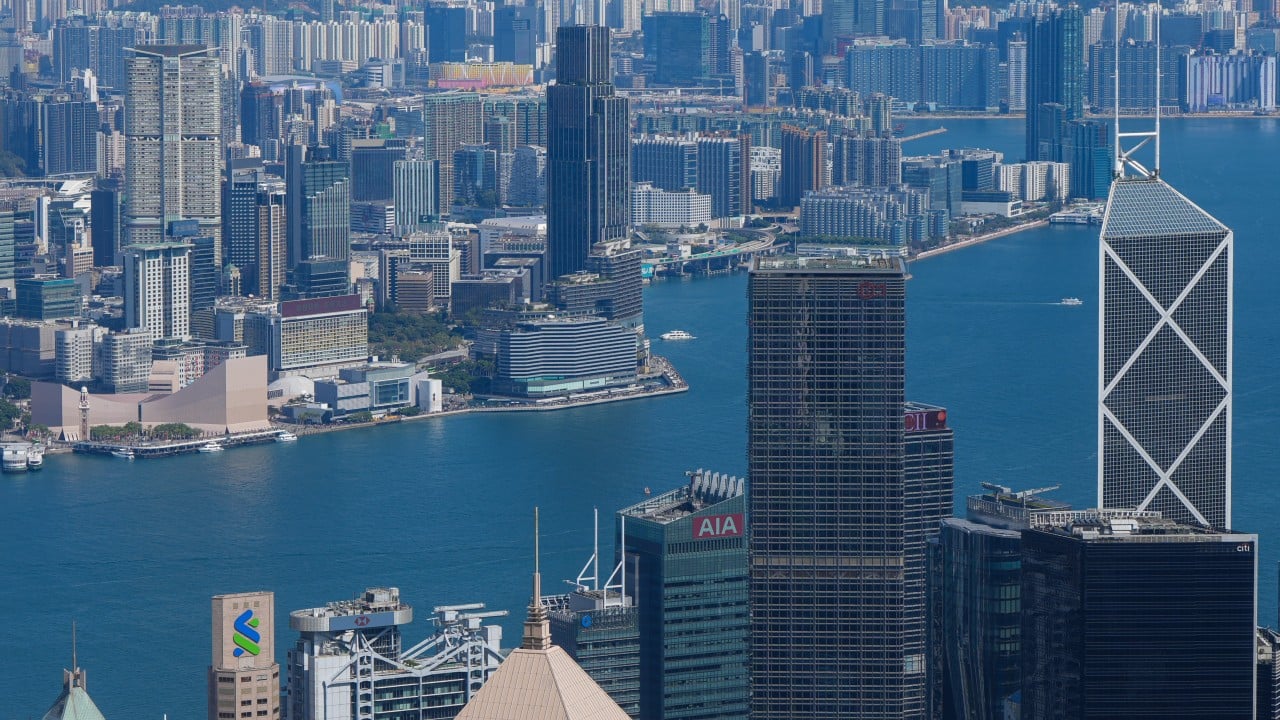
Washington’s obsession with choking off China’s high-tech oxygen has found its most convenient target in Hong Kong. As of 2026, this city holds the dubious distinction of being the most sanctioned territory under U.S. export controls, with over 340 entities blacklisted. The white house isn’t just looking for spies; it is trying to freeze the sub-atomic future in its tracks. The primary objective is to prevent Hong Kong from becoming the "quantum gateway" for the mainland—a loophole where Western cryogenic hardware and American venture capital could theoretically slip through the bamboo curtain.
But the strategy is producing a paradox that the State Department didn't plan for. By treating Hong Kong as a contagion zone, the U.S. has effectively forced a shotgun marriage between the city’s world-class research universities and the mainland’s massive, state-directed industrial complex.
The end of the middleman
For decades, Hong Kong’s value proposition was its ambiguity. It was Chinese enough to access the mainland market and Western enough to buy the tools the mainland couldn't. In the quantum sector, this meant importing dilution refrigerators from Bluefors in Finland or Oxford Instruments in the UK, often using American-made components that require specific export licenses.
Those days are over. The U.S. Treasury Department’s Final Rule, which took full effect in early 2025, essentially erased the distinction between Hong Kong and Beijing for high-stakes tech. U.S. persons are now flatly prohibited from investing in any entity involved in quantum computer development, sensing, or networking within the territory. This isn't a "notify-and-proceed" scenario; it is a total financial blackout.
The impact was immediate. Private capital, the lifeblood of nimble startups, evaporated. When Alibaba and Baidu shuttered their quantum labs in late 2024 and early 2025, donating their hardware to state-affiliated institutions, it signaled the end of the "commercial" era for Chinese quantum research. The work has moved into the shadows of the "national team," and Hong Kong has been forced to follow.
The Hetao pressure cooker
If you want to see where the gateway is being built, look at the Hetao Shenzhen-Hong Kong Science and Technology Innovation Cooperation Zone. This is a 3.89-square-kilometer strip of land where the border is becoming a blur.
The "investigative" reality here is that the Hong Kong section of Hetao isn't a bridge to the West anymore; it’s a staging ground for the mainland. While the U.S. adds companies like Scikro and Physike to the Entity List for distributing imported cryogenic systems, the Hetao zone is busy integrating Hong Kong’s theoretical talent with Shenzhen’s manufacturing muscle.
The strategy is simple:
- Recruit at the source: Use Hong Kong’s high global rankings to attract international talent that would never move directly to Hefei or Beijing.
- Insulate the supply chain: Develop domestic alternatives to the "600 µW at 100 mK" cooling threshold that the U.S. Department of Commerce uses as a benchmark for sanctions.
- Data as currency: Since physical hardware is restricted, use the city’s legal framework to act as a "data port" for quantum-encrypted communications.
Why the sanctions might be backfiring
The U.S. is betting that without Western "precision" components—specifically parametric signal amplifiers and pulse tube cryocoolers—China’s quantum progress will hit a ceiling. This assumes the Chinese are incapable of basic engineering. It is a dangerous bet.
In February 2024, the Anhui Quantum Computing Engineering Research Center announced the "mass production" of the ez-Q Fridge. It wasn't as sleek as a Western model, but it worked. By late 2025, Chinese researchers were publishing papers in Review of Scientific Instruments detailing systems achieving 6.6 mK base temperatures using parallel dilution units. They aren't just replicating Western tech; they are engineering around the specific constraints of the sanctions.
Hong Kong’s role in this is no longer about being a "gateway" for foreign goods. It is about being the intellectual refinery. The city’s universities provide the algorithmic breakthroughs—the software side of the quantum race—which is much harder to "sanction" than a 500-pound piece of stainless steel.
The capital flight that stayed local
We often hear about the "flight of capital" from Hong Kong, but the narrative misses where the money is going. While American VC firms have pulled out to avoid the Remote Access Security Act, state-backed funds from the mainland have moved in to fill the vacuum.
The goal is no longer a "Global Quantum Hub." It is a "Sovereign Quantum Stack." By cutting Hong Kong off, the U.S. has removed the city’s incentive to play by international rules. If the city is going to be treated like a sanctioned mainland province, it has every reason to behave like one.
The real risk isn't that China gets a few more qubits. The risk is that by the time the West realizes the sanctions didn't stop the hardware, the "Hong Kong gateway" will have already finished the software architecture for a quantum-encrypted financial system that doesn't use a single American patent.
Washington is playing a game of hardware containment in a field where the most valuable assets are the people and the code. You can't put a customs stamp on a mathematical formula, and you can't stop a researcher in Kowloon from uploading a breakthrough to a server in Shenzhen. The "gateway" is open; it just doesn't face West anymore.
Stop looking for the loophole. The wall is the new door.