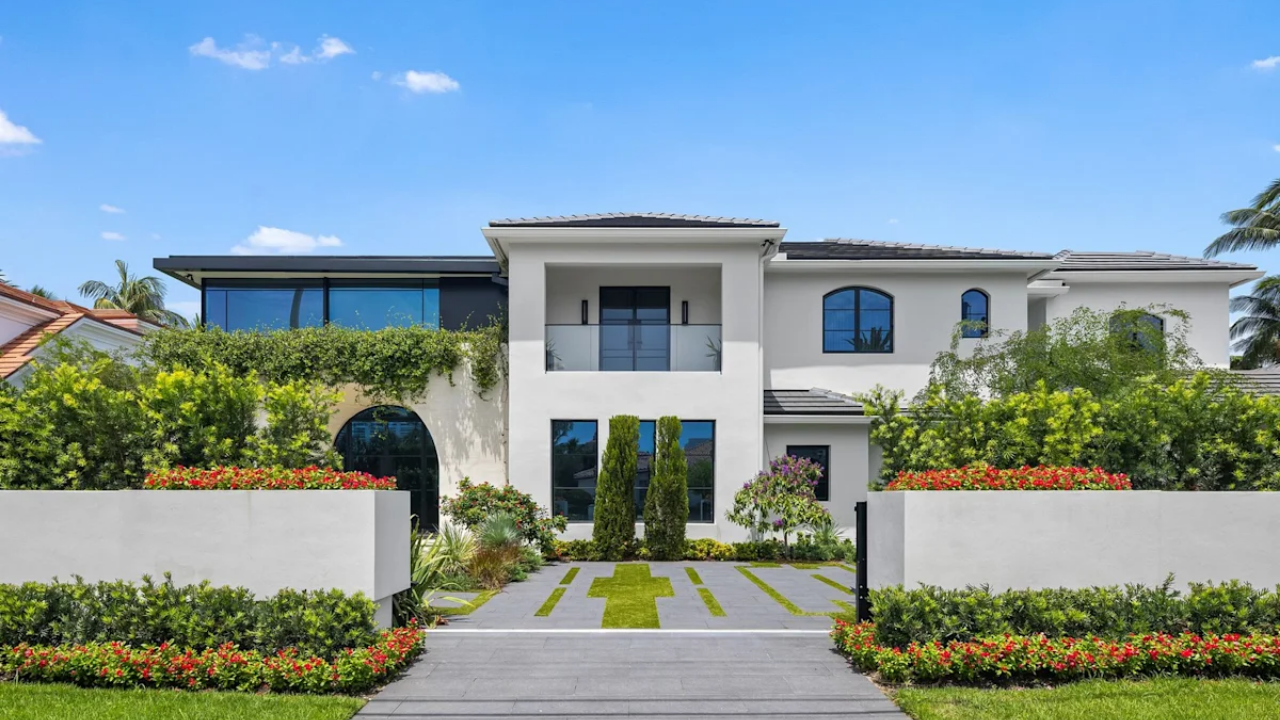
The air inside does not move the way air usually moves. It arrives cool, precisely weighted with just enough moisture to keep the throat from tightening, gliding across teak floors with the quiet discipline of a butler who has memorized every footprint in the house.
Stand in the center of the primary pavilion at dusk, when the Atlantic slips into bruised shades of violet and navy, and you will hear nothing. Absolutely nothing. The city of Boca Raton hums three miles away, a distant static of traffic and sirens, but here, suspended over one hundred and fifty feet of private waterfront, the world has simply stopped shouting.
This is what twenty-five million dollars buys you. Not gold leaf. Not marble imported from quarries where men risk their lungs for vanity. It buys silence. It buys total, unyielding dominion over the elements.
Let us introduce Julian. Julian is not a real person, but he stands in for every architect, engineer, and weary titan of industry who has ever walked into a sprawling Florida estate only to find themselves hostage to a keyring holding forty different brass keys and a wall thermostat that requires a degree in thermodynamic engineering to adjust. Imagine Julian standing in the foyer of this specific mansion, staring up at a twelve-meter ceiling of pecky cypress.
He tries to turn on the lights. He doesn't touch a switch.
"Awake," Julian says, his voice pitched low, conversational.
Above him, hidden slots in the millwork exhale. The recessed lighting does not flash on with the harsh, industrial shock of a commercial office; it warms into existence like the sun rising through a heavy fog, creeping from two percent up to twenty over the course of thirty slow seconds. Across the room, panes of electrochromic glass—costing more than a suburban subdivision—shift their tint from opaque sun-blocker to crystal clarity, framing the Intracoastal Waterway as if it were a live painting mounted behind museum glass.
The house is watching. The house is listening. The house is calculating.
Behind the walnut paneling, a small city of server racks and fiber-optic cables hums quietly in a climate-controlled vault. This is the brain of the estate. It monitors the barometric pressure outside, anticipating a sudden Florida torrential downpour before the first heavy drop hits the manicured zoysia grass. It communicates with the dock lift, ensuring the fifty-foot yacht bobs safely against the pilings even as the tide rolls in with the insolence of the moon. It adjusts the humidity in the wine cellar down to the exact percentage required to keep a 1982 Bordeaux from weeping through its cork.
We have spent centuries building homes to keep nature out. We wanted thick stone walls, iron-studded doors, moats if we could afford them. We wanted a fortress against the damp, the heat, the insects, the thieves.
Then we realized something terrifying. By locking nature out, we had also locked ourselves in. We had built gilded cages where we still had to get up to adjust the AC, still had to worry if the back patio door was latched against a hurricane, still had to live as nervous caretakers of our own possessions.
So we invited the machine inside.
To understand why a house needs artificial intelligence controls, you have to understand the specific cruelty of the South Florida climate. This is a landscape that wants to reclaim everything you own. Leave a wooden chair outside through a single July afternoon, and the humidity will begin to chew through the glue. Leave the HVAC off for forty-eight hours while you are in London, and mold will bloom across your master bedroom rug like a watercolor painting of ruin.
In a standard mansion of this scale—let us say, ten thousand square feet under air, with six bedrooms, eight baths, and a pool that infinity-edges directly into the horizon—the mechanical burden is staggering. There are eighty-four separate lighting zones. There are fourteen distinct climate zones. There are security cameras with facial recognition, motorized hurricane shutters that drop in unison at the touch of a single screen, and a water-leak detection grid beneath the marble flooring that can spot a pinhole drip in a copper pipe before it ruins the subfloor.
No human can manage this. Not a property manager working forty hours a week. Not a stressed owner trying to decompress after a board meeting in New York.
The twenty-five million dollar price tag is not for the square footage. It is not even for the prime Boca Raton waterfront real estate, where dirt alone costs more than a royal treasury. You are paying for cognitive offloading. You are paying for the privilege of never having to think about the house again.
Walk outside onto the terrace. The air changes. The salty breath of the Atlantic mixes with the manicured scent of night-blooming jasmine.
Here, the waterfront is not just a view; it is a border. One hundred and fifty feet of deep-water dockage sits quietly against the bulkhead. A vessel capable of carrying you to the Bahamas in three hours rests on its hydraulic cradle. You could leave right now. You could drop your passport on the quartz island in the kitchen, tell the system you are departing for the Abacos, and watch as the estate locks its own doors, drops the shutters, arms the perimeter sensors, throttles down the refrigeration in the guest wings to save power, and sends a digital confirmation to your phone.
The house goes to sleep when you leave. It wakes up when it hears the low rumble of your car pulling up the driveway.
Some call this luxury. Some call it an obscene display of wealth in a world where millions struggle to pay rent. Both things can be, and usually are, entirely true.
Wealth at this altitude is detached from the gravity that holds the rest of us. It operates in a stratosphere where convenience has been refined into an art form, where every minor friction of daily existence has been smoothed away by algorithms written by coders who will never set foot on these teak floors.
Yet, standing here, looking out across the dark water where the moonlight cuts a silver highway toward the inlet, you feel the strange poetry of it. We have built artificial minds to take care of our physical shelters, creating a closed loop of technology and nature where the machine cares for the man, and the man surrenders to the machine.
Julian is gone now, vanished back into the hypothetical ether from whence he came. The house remains. The water laps against the seawall with a steady, rhythmic cadence that existed long before the first concrete piling was driven into the muck of Palm Beach County, and will remain long after the silicon chips inside the walls have turned to dust.
The lights dim to one percent. The doors check their deadbolts. The air keeps moving, cool and quiet, through the dark.