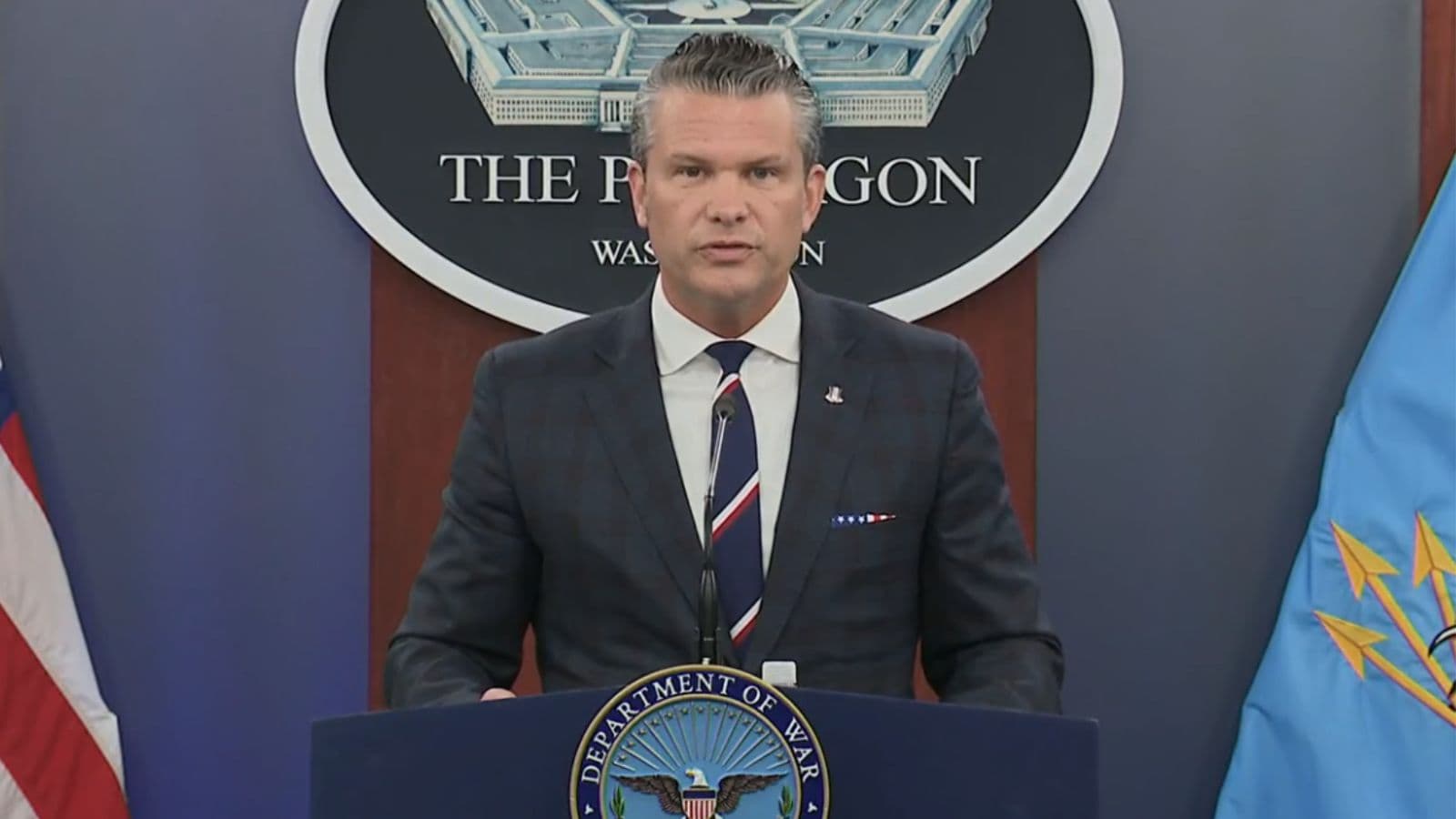
Washington loves a clean villain and a simple timeline. Right now, the political class is locked into a predictable script regarding Defense Secretary Pete Hegseth, military escalation with Iran, and the resulting calls for impeachment.
One side argues the administration was dragged into an unavoidable conflict. Critics counter that executive overreach bypassed Congress and sparked an unauthorized war. Both arguments rely on a convenient fiction—the idea that modern military conflicts have a single, obvious starting gun.
If you look closely at how Pentagon decision-making, constitutional war powers, and regional deterrence actually operate, the current shouting match looks less like constitutional oversight and more like political theater designed to obscure decades of bipartisan failure.
The Myth of "Who Started It" in Modern Deterrence
In conventional warfare, historians can point to a border crossing or a declaration of war. In gray-zone conflict—especially across the Middle East—that metric breaks down entirely.
According to statements from Defense Secretary Pete Hegseth's office and administration defenders, recent U.S. military actions against Iranian-backed networks and assets were strictly defensive responses to ongoing provocations, proxy attacks on American personnel, and threats to maritime shipping lanes. From the Pentagon's perspective, responding to kinetic strikes with decisive force is not starting a war; it is restoring deterrence after years of perceived hesitation.
Conversely, congressional critics and legal scholars pushing for impeachment proceedings argue that scaling up strikes without explicit authorization violates the Constitution's Article I war powers and the 1973 War Powers Resolution. To them, crossing certain operational thresholds constitutes initiating hostilities, regardless of prior proxy skirmishes.
Here is the nuance both camps ignore. Neither side wants to admit that the United States has been operating in a continuous, low-grade state of undeclared regional engagement for years.
- Deterrence requires credibility. When military planners calculate retaliation, they look at escalation dominance—the ability to impose costs an adversary cannot match. If a defense secretary limits responses strictly to proportional, tit-for-tat strikes, adversaries treat the cost of attacking U.S. troops as a predictable operational expense.
- Escalation carries structural risk. Critics rightly point out that moving from targeted strikes on proxy militias to direct confrontation with Iranian state infrastructure fundamentally alters the strategic equation. Once a regional power feels its regime survival or core sovereignty is threatened, rational deterrence models often collapse.
Arguing over who threw the first punch misses the operational reality. Every administration since the Carter Doctrine has expanded executive military latitude while Congress steadily surrendered its constitutional responsibility to debate and vote on authorizations for the use of military force (AUMF).
Why Impeachment Is a Political Distraction From Real Oversight
When lawmakers immediately reach for impeachment during an active foreign policy crisis, they rarely achieve accountability. Instead, they trigger partisan tribalism that shields the executive branch from substantive scrutiny.
Constitutional scholars have long debated what constitutes "high crimes and misdemeanors" in the context of commander-in-chief powers. Historically, Congress has almost never successfully used impeachment to halt an ongoing military operation. Why? Because the threshold for removal in the Senate requires a two-thirds supermajority, an almost impossible bar during moments of national security tension when lawmakers fear appearing weak or undermining deployed troops.
More importantly, focusing on impeachment lets Congress off the hook for its own institutional laziness.
- The 2001 and 2002 AUMFs remain zombie laws. For over two decades, presidents of both parties have stretched post-9/11 authorizations to justify operations in countries and against groups that did not exist when those bills were passed.
- The War Powers Resolution lacks teeth. While the 1973 law theoretically requires the president to withdraw forces within 60 to 90 days without congressional approval, presidents routinely dispute its constitutionality or define military engagement narrowly enough to bypass the clock.
- Funding is the real lever. Congress holds the absolute power of the purse under Article I, Section 9. Lawmakers do not need an impeachment trial to restrict military operations; they can simply pass appropriations riders prohibiting funds from being used for unauthorized strikes in or against Iran.
They rarely do this because voting on military funding forces every representative and senator on the record. Impeachment resolutions, by contrast, allow members in safe districts to generate cable news clips without taking responsibility for the strategic consequences of either authorizing a war or defunding a military campaign.
What Defense Planners Actually Worry About
Step outside the Capitol building and talk to defense logisticians, naval commanders, and intelligence analysts. Nobody in those rooms is debating talking points about who started the conflict. They are worried about math, munition stockpiles, and geographic overextension.
Modern warfare consumes precision-guided munitions at an astonishing rate. Intercepting low-cost drones and ballistic missiles with multi-million-dollar air defense interceptors creates an asymmetric cost exchange that favors the attacker.
- Industrial base limits: Replacing advanced interceptors, naval missiles, and artillery shells takes months or years, not weeks. Every munition expended in the Middle East is one unavailable for deterrence contingencies in the Indo-Pacific or Europe.
- Force posture fatigue: Keeping carrier strike groups, air defense batteries, and refueling tankers on continuous high-alert deployment degrades maintenance schedules and troop readiness.
- Alliance friction: Regional partners often rely on American security guarantees privately while distancing themselves publicly to avoid becoming targets themselves.
Hegseth's defense strategy rests on the premise that overwhelming, rapid force ends conflicts faster than protracted, incremental engagement. History offers mixed verdicts on that theory. Sharp, decisive strikes can re-establish red lines—as seen in targeted operations that degraded adversary command networks without triggering full-scale invasion. Yet history also shows that air and naval campaigns rarely achieve political capitulation on their own without clear, achievable diplomatic off-ramps.
Asking the Right Questions About American Strategy
If voters and lawmakers want genuine accountability, they need to abandon binary narratives and demand concrete answers from both the Pentagon and Congress.
Stop asking whether a single press conference proves innocence or guilt. Start asking questions that force strategic clarity:
- What is the defined end state? Is the objective solely to stop attacks on shipping and regional bases, degrade specific nuclear or missile capabilities, or force broader behavioral changes in Tehran? Without a clear definition of victory, military operations drift toward open-ended commitment.
- Where are the diplomatic channels? Even during the height of the Cold War, Washington and Moscow maintained direct backchannels to prevent miscalculation from spiraling into existential conflict. Deterrence without communication is just blind escalation.
- Will Congress vote on a specific authorization? If the threat is severe enough to warrant sustained military action, the legislative branch owes the public and the military an explicit debate and vote—not procedural maneuvers.
There is a massive downside to demanding strict congressional authorization before every military response: speed. Adversaries operate inside tight decision loops, and waiting weeks for legislative consensus can leave forward-deployed forces vulnerable. A credible defense posture requires the executive branch to retain tactical flexibility to defend troops in harm's way.
Yet tactical self-defense is fundamentally different from sustained strategic warfare. Blur that line long enough, and constitutional checks disappear altogether.
Washington's obsession with pinning blame on a single official—or defending him unconditionally—turns a profound question of national survival and constitutional law into another disposable news cycle. Until Congress reclaims its budget authority and the Pentagon pairs military force with a transparent strategic endgame, the names in the headlines will change, the legal arguments will recycle, and the underlying crisis will remain completely unresolved.