When Prime Minister Narendra Modi wrapped up his recent five-nation diplomatic tour across the UAE, the Netherlands, Sweden, Norway, and Italy, the headlines focused on defense pacts and trade corridors. But the real masterclass was happening quietly in the background. It was packed in custom boxes, wrapped in tissue, and handed over to world leaders.
Diplomatic gifting isn't just about good manners. It's an unspoken language of geopolitical positioning. For decades, state gifts were predictable. Think silver platters, generic crystal bowls, or framed photographs. India has completely flipped that script. By replacing corporate luxury with highly localized, masterfully curated regional crafts, the government is executing a brilliant soft power strategy.
From Assam's golden silk presented to Italian Prime Minister Giorgia Meloni to a Kutchi Rogan painting handed to UAE President Sheikh Mohamed bin Zayed Al Nahyan, these items do something money can't buy. They tell a story of civilizational depth, ecological intelligence, and shared histories.
The Strategic Subtext of the Gifts to Italy
The relationship between India and Italy has grown noticeably warmer over the last few years. The selection of gifts for Italian Prime Minister Giorgia Meloni and President Sergio Mattarella reflects this mutual alignment. It also highlights a keen understanding of Italy's own cultural pride.
The Textiles for Meloni
Meloni received two distinct, high-end silk stoles from Northeast India. The first was a Muga silk stole from the Brahmaputra Valley in Assam. Muga is widely known as the "Golden Silk" due to its natural, rich golden tint. It's incredibly resilient. It actually grows more lustrous with every wash.
By presenting one of the rarest natural fibers on earth to the leader of a country famous for luxury fashion houses, India made a bold statement about its own heritage of premium textiles.
The second gift was a silk stole inspired by the Shirui Lily, a delicate flower blooming exclusively on the Shirui Kashong Peak in Manipur. For the indigenous Tangkhul Naga community, this lily is a symbol of identity and cultural pride. Interestingly, the lily motif shares a deep connection with European art history, particularly the Renaissance paintings of Italy, where the flower denotes grace and refinement.
The Historical Mirror for Mattarella
For Italian President Sergio Mattarella, the choice was a highly customized white marble inlay work box crafted by master artisans in Agra. The box utilizes the precise Pacchikari (or Pietra Dura) technique, where semi-precious stones like lapis lazuli, malachite, coral, and mother-of-pearl are meticulously shaped and embedded into polished marble.
There's a brilliant historical irony here. The Pietra Dura technique originally developed in Florence, Italy, before travelling to India, where it was embraced by Mughal architects and immortalized on the walls of the Taj Mahal. Handing this back to the Italian head of state acts as a tangible symbol of an ancient cross-continental artistic bridge.
To add intellectual depth, the box contained archival musical compilations of two legends of Indian classical music: Hindustani vocalist Pandit Bhimsen Joshi and Carnatic icon M.S. Subbulakshmi.
Blending Art and Ecology in Northern Europe
When moving through Scandinavia and the Netherlands, the diplomatic messaging shifted seamlessly from historical luxury to environmental stewardship, directly appealing to the region's progressive climate and sustainability values.
+----------------+--------------------------+------------------------------------------+
| Recipient      | Gift Presented           | Cultural & Strategic Relevance           |
+----------------+--------------------------+------------------------------------------+
| King Willem-   | Jaipur Blue Pottery      | Iconic vibrant cobalt blue matching      |
| Alexander (NL) |                          | Dutch artistic traditions                |
+----------------+--------------------------+------------------------------------------+
| Queen Máxima   | Meenakari & Kundan       | Customized in orange and blue to honor  |
| (Netherlands)  | Earrings                 | the royal House of Orange-Nassau         |
+----------------+--------------------------+------------------------------------------+
| PM Rob Jetten  | Madhubani Painting       | Features the fish motif, symbolizing     |
| (Netherlands)  |                          | ecological balance and abundance         |
+----------------+--------------------------+------------------------------------------+
| PM Jonas Gahr  | Pressed Orchid Art       | Real blooms from Sikkim, highlighting    |
| Støre (Norway) |                          | India's first fully organic state        |
+----------------+--------------------------+------------------------------------------+
| PM Ulf         | Shantiniketan Bag &      | Commemorates civilizational ties and    |
| Kristersson    | Tagore's Selected Works  | shared intellectual histories            |
| (Sweden)       |                          |                                          |
+----------------+--------------------------+------------------------------------------+
The Netherlands and the House of Orange
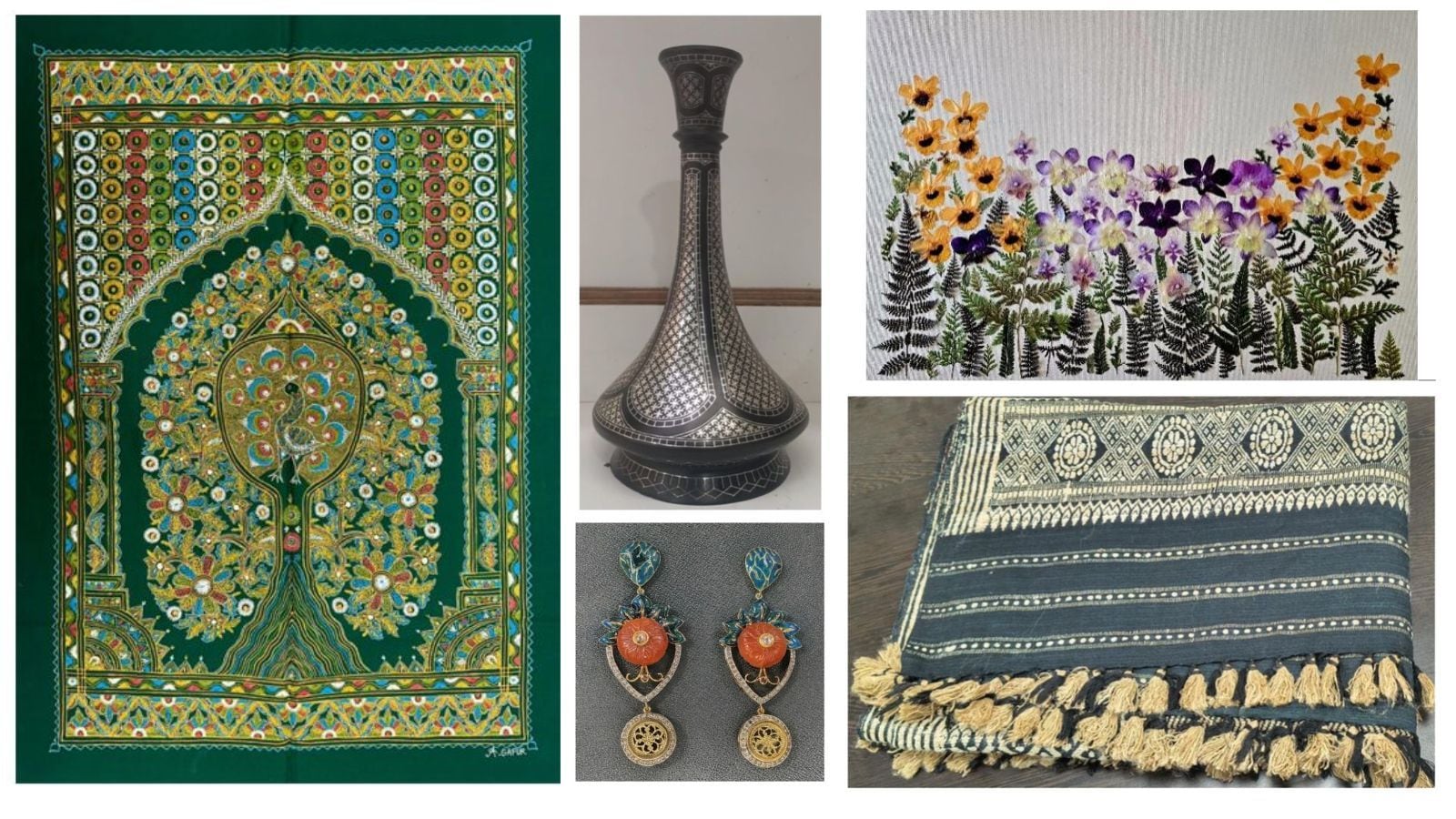
For the Dutch royal family, the gifts were intensely customized. Queen Máxima was presented with traditional Meenakari and Kundan earrings from Rajasthan. The artisans intentionally used vibrant orange and deep blue enameling. Orange pays direct homage to the ruling Dutch royal House of Orange-Nassau, while the blue represents the nation's profound relationship with the sea.
King Willem-Alexander received a classic piece of Jaipur's famous blue pottery, while Dutch Prime Minister Rob Jetten was gifted a traditional Madhubani painting featuring a sacred fish motif. The fish represents harmony and natural abundance, drawing a quiet parallel to the Netherlands' massive investments in marine conservation, such as the Fish Migration River at the Afsluitdijk.
Nordic Green Diplomacy
In Norway, Prime Minister Jonas Gahr Støre received an intricate piece of art featuring pressed orchids and ferns sourced entirely from the mist-covered valleys of Sikkim. By highlighting that these came from Sikkim—India's first completely certified organic state—the delegation signaled a shared commitment to biodiversity and green principles.
Meanwhile, Swedish Prime Minister Ulf Kristersson received a handcrafted Shantiniketan leather messenger bag alongside a curated selection of works by Rabindranath Tagore. This reminded the hosts of the historic ties established when Tagore became the first non-European to win the Nobel Prize in Literature, awarded by the Swedish Academy in 1913. The package also included a pure wool stole from Ladakh and small-batch Loktak tea from Manipur.
Securing the West Asian Partnership
The United Arab Emirates remains one of India's most crucial strategic and economic allies in West Asia, hosting millions of Indian expatriates. The gifts chosen for the leadership in Abu Dhabi focused heavily on ancestral master-crafts and premium agricultural exports.
UAE President Sheikh Mohamed bin Zayed Al Nahyan was presented with an exquisite Rogan painting depicting the traditional Tree of Life. Rogan art is an incredibly rare, centuries-old textile art form native to the Kutch region of Gujarat. It involves using a metal stylus to paint dense, intricate patterns onto fabric using a paste made from boiled castor oil and mineral pigments. The level of precision required means only a handful of master artisans can execute it at this level.
Alongside the artwork, the President received a selection of India's finest seasonal produce: Geographical Indication (GI)-tagged Kesar mangoes from Gujarat and premium, sweet pineapples from the hills of Meghalaya.
The UAE Queen Mother was gifted an elegant Maheshwari silk fabric from Madhya Pradesh, alongside a portion of aromatic Chak-Hao (black rice) from Manipur. These selections show that the gifting strategy isn't just about beautiful objects; it's a calculated effort to market India's diverse, high-value agricultural wealth to global markets.
Why This Strategy Matters for Indian Artisans
This systematic approach to gifting does far more than ease high-level political talks. It serves as a massive global marketing platform for rural Indian economies.
When a craft like Bidri silverwork (gifted to Denmark's Prime Minister Mette Frederiksen) or a Kamal Talai Pichwai painting (presented to Finland's Prime Minister Petteri Orpo) is featured in international diplomatic dispatches, it instantly elevates the status of that entire art form.
Many of these crafts are protected by Geographical Indication (GI) tags. They provide a direct livelihood for thousands of handloom weavers, woodworkers, and tribal artists across rural India. By positioning these indigenous products as ultimate luxury items fit for kings and prime ministers, the government is actively building global brand equity for grass-roots Indian craftsmanship. It bridges the gap between ancient rural workshops and the highest corridors of global power.