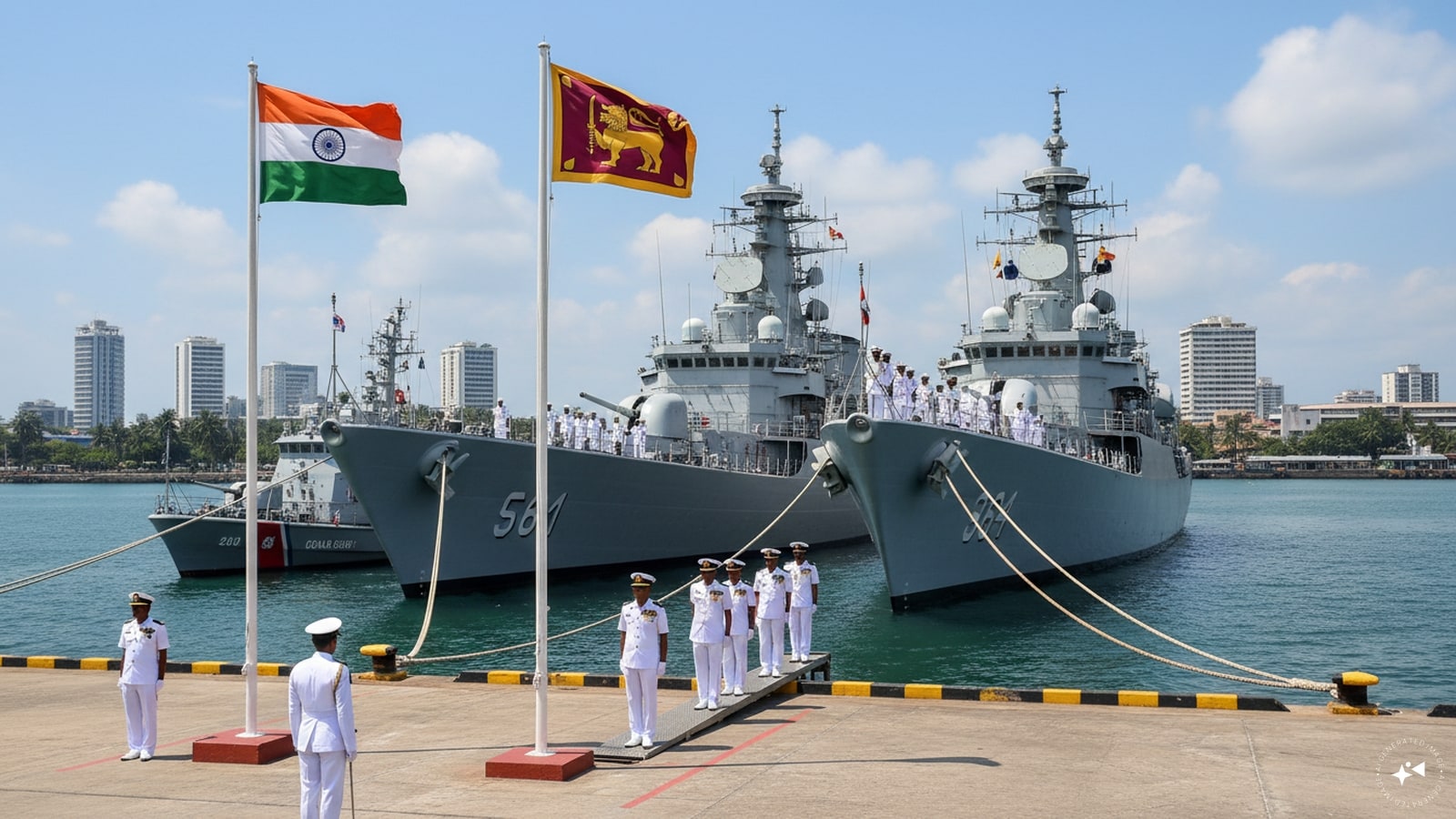
Mainstream defense reporters love a polite press release. When the Indian Navy’s First Training Squadron drops anchor in Colombo or Trincomalee for a three-day visit, the standard coverage reads like a tourist brochure. You get the usual boilerplate about "bilateral bonhomie," "maritime cooperation," and "shared cultural heritage." It is lazy journalism that completely misses the steel beneath the ceremonial whites.
Stop reading these deployments as routine goodwill tours. Every time an Indian cadet vessel docks in Sri Lanka, New Delhi is running a calculated, low-cost, high-visibility deterrence operation right in Beijing’s backyard. The cadets are learning navigation, sure. Meanwhile, the admirals in South Block are drawing a bright red line across the Palk Strait.
The Lazy Consensus of Maritime Diplomacy
If you only read wire copy, you would think a three-day port call consists entirely of deck receptions, friendly volleyball matches, and joint yoga sessions on the pier. Defense ministries want you to believe that. Soft power is an easy sell to domestic taxpayers and an unthreatening headline for neighboring governments.
I have spent fifteen years tracking naval deployments across the Indian Ocean Region (IOR), and I have watched analysts waste millions of words dissecting diplomatic communiqués while ignoring hull movements. When a warship enters a foreign port, the diplomacy is the wrapper. The hull itself is the message.
Let us define what a training squadron actually is. In the Indian Navy, the First Training Squadron (1TS)—historically comprising vessels like INS Tir, INS Sujata, and Coast Guard ships like ICGS Sarathi—is designed to transition officer cadets from classroom theory to blue-water reality. These are not frontline guided-missile destroyers bristling with BrahMos batteries.
That is precisely why they are so effective.
Sending a frontline destroyer into Colombo triggers immediate parliamentary uproar in Sri Lanka and frantic cables from the Chinese embassy. Sending a training squadron achieves the exact same operational reconnaissance and port-access normalization without triggering a diplomatic crisis. It is grey-zone presence disguised as an educational field trip.
What Happens When the Press Leaves the Pier
To understand why these visits matter, you have to look past the photo-ops with the Sri Lankan Navy commander. Once the local journalists pack up their cameras, the real work begins.
- Hydrographic and Bathymetric Familiarity: You cannot fight in waters you do not know. Every approach into Colombo, Hambantota, or Trincomalee gives Indian navigators real-time data on shifting sandbars, current anomalies, and port traffic patterns. Electronic charts are great until you need to slip a task force through a narrow channel under electronic warfare conditions.
- Logistics and Bunkering Stress-Tests: A navy is only as lethal as its supply chain. Port calls test local fueling infrastructure, freshwater replenishment rates, and customs clearance speeds. New Delhi needs to know down to the minute how fast Colombo can turn around a vessel if the Strait of Malacca ever goes hot.
- Human Intelligence and Officer Bonding: The Sri Lankan naval officers hosting these Indian cadets today will command Sri Lanka's maritime flank in ten years. India trains a massive percentage of Sri Lanka’s military officer corps at institutions like the National Defence College in New Delhi and the Indian Naval Academy in Ezhimala. These three-day visits lock in personal loyalty long before Beijing can buy political loyalty with infrastructure loans.
The Questions You Should Actually Be Asking
When these stories hit the news cycle, search engines flood with predictable, surface-level queries. Let us dismantle the flawed premises behind them.
Why does India send training ships to Sri Lanka so often?
The mainstream answer is "Neighborhood First" policy. The real answer is geographical paranoia—and it is entirely justified. Sri Lanka sits 18 nautical miles off India’s southern tip, directly astride the primary East-West shipping lanes connecting the Strait of Hormuz to the Strait of Malacca. Over 60 percent of global container traffic and 70 percent of global oil shipments pass within sight of Sri Lanka’s southern coast. If a hostile power controls Sri Lankan ports, India’s maritime trade can be throttled in 48 hours. Frequent training visits establish persistent presence so India never has to fight its way back into a port it already occupies routinely.
Does Sri Lanka benefit from Indian Navy visits, or is it caught in a superpower tug-of-war?
Sri Lanka is not a helpless victim; it is an agile player extracting maximum rent from two competing giants. Colombo plays New Delhi and Beijing against each other brilliantly. When Sri Lanka needs debt restructuring, fuel credit lines, or emergency food aid—as it did during its catastrophic 2022 economic collapse—it leans into Indian security assurances. When it wants massive port infrastructure without environmental or governance strings attached, it opens the door to Chinese state-owned enterprises. Hosting Indian training squadrons costs Sri Lanka zero political capital while keeping New Delhi’s checkbook open.
Are Indian Navy visits a direct response to Chinese spy ships?
Not a direct reaction, no. Naval schedules are drafted months in advance. However, the optics and operational tempo are absolutely calibrated to counter People's Liberation Army Navy (PLAN) incursions. When Chinese research vessels like the Yuan Wang 5 or Shi Yan 6 dock in Hambantota or Colombo, they are mapping the seabed for future PLAN submarine operations. India cannot legally stop a sovereign nation from hosting Chinese ships, though it applies immense diplomatic pressure—resulting in Sri Lanka’s temporary moratorium on foreign research vessels. Instead, India floods the zone with constant, routine naval traffic to remind Colombo who the resident security provider actually is.
The Heavy Hitters Know This Game
You do not have to take my word for it. Read the foundational texts of maritime strategy. Alfred Thayer Mahan argued over a century ago that naval dominance relies on control of chokepoints and forward coaling stations. Today, coaling stations are deep-water container terminals and fuel bunkering facilities.
Look at how Admiral Arun Prakash, former Chief of the Naval Staff of India, has repeatedly framed the Indian Ocean. He has warned for years that India cannot take its geographic advantage for granted, noting that China’s "String of Pearls" strategy is explicitly designed to neutralize India’s peninsular leverage. Similarly, defense analyst C. Raja Mohan has consistently pointed out that Delhi’s maritime diplomacy is fundamentally about denying strategic space to extra-regional powers.
When the Indian Navy executes a mission under the SAGAR doctrine (Security and Growth for All in the Region), strip away the acronym. SAGAR is India’s Monroe Doctrine for the Indian Ocean. It is a polite way of telling Washington, Beijing, and Tokyo that New Delhi expects to be the primary net security provider in these waters.
The Flaw in India’s Grey-Zone Strategy
Here is where my contrarian take hits a wall, and you need to understand the downside of New Delhi’s approach. Persistent, low-level naval presence has diminishing returns when your rival is writing billion-dollar checks.
You cannot dock a training ship against a deep-water port lease.
In 2017, Sri Lanka handed over the Hambantota International Port to China Merchants Port Holdings on a 99-year lease because it could not service its debt. No amount of cadet exchanges or joint coastal cleanups reversed that reality. While Indian warships were doing ceremonial pass-exercises off Colombo, Chinese engineers were pouring concrete that altered the strategic geography of South Asia for a century.
Furthermore, over-relying on military-to-military ties breeds resentment among Sri Lankan nationalists. Every time New Delhi muscles Colombo into canceling a Chinese research vessel visit, local politicians accuse India of bullying a smaller neighbor. If India pushes too hard, it risks driving Sri Lankan public sentiment straight into Beijing’s arms, rendering those friendly naval port calls completely toxic.
How to Read Naval Deployments Like an Insider
If you are an analyst, an investor watching regional supply chains, or just someone tired of being spoon-fed diplomatic fluff, change how you consume defense news. Stop reading the press releases and start tracking the metrics that actually dictate maritime power.
- Watch the Hull Numbers, Not the Speeches: Track which specific ships are deployed. If India rotates from training vessels to hydrographic survey ships (like the Sandhayak-class) or anti-submarine warfare corvettes (like the Kamorta-class) in Sri Lankan waters, the threat assessment in New Delhi has just spiked.
- Monitor the Duration and Port Selection: Colombo is a commercial and diplomatic hub. Trincomalee, on Sri Lanka’s eastern coast, is one of the finest natural deep-water harbors in the world. Whenever Indian naval activity shifts from Colombo to Trincomalee—where India is actively developing an oil tank farm—New Delhi is preparing for high-end contingency operations in the Bay of Bengal.
- Cross-Reference with Coast Guard Deployments: The Indian Coast Guard is often the tip of the spear for maritime domain awareness. When Coast Guard ships accompany Naval training squadrons, they are usually establishing joint surveillance grids, radar chains, and narcotics/smuggling interdiction protocols that double as submarine-tracking networks.
- Ignore the "Joint Exercise" Hype: Passing Exercises (PASSEX) conducted at the end of port calls are basic communication and maneuvering drills. They look great on social media, but they do not equate to wartime interoperability. True interoperability only happens when two navies share encrypted datalinks and live-fire logistics—something India reserves for Quad partners, not Sri Lanka.
Stop Confusing Politeness with Peace
The Indian Ocean is no longer a quiet backwater; it is the primary theater of twenty-first-century great power competition. Every nautical mile between the Horn of Africa and the Sunda Strait is being contested, mapped, and wired for surveillance.
When three Indian Navy ships tie up alongside a pier in Colombo for seventy-two hours, do not let the brass bands and floral garlands fool you. You are watching a regional superpower quietly measure the depth of the water, test the loyalty of its neighbor, and remind a rival three thousand miles away who owns the front yard. Start reading the wake behind the ships, not the press releases handed out on the dock.