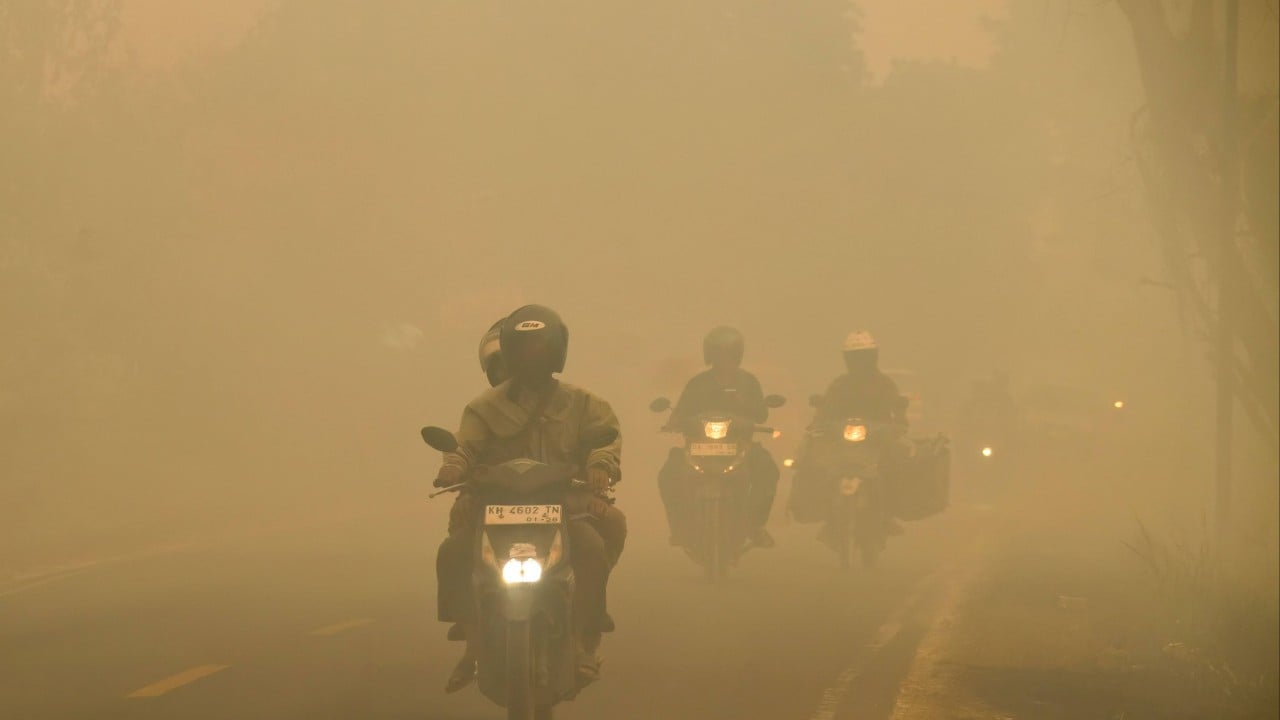
Air quality shouldn't dictate whether a child gets an education. Yet, every dry season across Southeast Asia, millions of kids watch their classrooms vanish behind a wall of yellow-gray smoke.
When Indonesian wildfire haze forces 1.4 million students to move to online learning, it is not just a temporary inconvenience. It represents a recurring institutional failure. We treat massive seasonal forest fires like sudden natural disasters. They are not. They are predictable, man-made crises that governments fail to prevent year after year.
Schools close. Screens turn on. Parents scramble. And the children breathe cleaner indoor air while the root cause burns unchecked.
The immediate fallout of toxic skies
Smoke doesn't care about municipal boundaries. When peatland fires rage across Sumatra and Kalimantan, fine particulate matter blankets entire regions. Visibility drops to meters. Hospitals fill up with patients struggling to catch their breath.
Forcing 1.4 million students into remote learning overnight sounds like a safe pivot. It protects young lungs from heavy air pollution. But the reality on the ground is messy.
Many families lack stable internet connections. Devices are shared among siblings. Teachers who received zero training in emergency remote instruction are suddenly expected to manage digital classrooms through choked power grids.
Children lose more than academic hours. They lose socialization. They lose access to school meals. And in lower-income areas, remote learning simply means kids drop out of the loop entirely until the wind changes direction.
Why this keeps happening every single year
You can trace this crisis back to land-clearing practices. Agricultural companies and smallholders use slash-and-burn methods because it is cheap. Peatlands, which act as massive carbon sinks, get drained and dried out. Once they catch fire, they burn underground. Rain barely touches them.
Governments issue warnings. They threaten fines. They deploy water-bombing helicopters. But these are reactive band-aids applied to a hemorrhage.
The enforcement gap is enormous. Local authorities often lack the resources or the political will to hold powerful plantation owners accountable. Until illegal burning carries severe, non-negotiable legal and financial penalties, the smoke will return.
The digital divide exposed by toxic air
Online learning works on paper. In practice, shifting millions of students online exposes deep economic fractures.
If you live in an urban center with fiber-optic internet and air purifiers, remote schooling during a haze event is an annoyance. If you live in a rural district where electricity flickers out during storms and mobile data is a luxury, school simply stops.
Education ministries roll out emergency apps and broadcast lessons on local television channels. Coverage remains patchy. Teachers report reaching barely half their students during severe smoke lockdowns.
We need to stop pretending that emergency online pivots are a real solution. They are damage control.
Moving past temporary shutdowns
Emergency school closures protect children from immediate poisoning, but they fix nothing. Schools need permanent infrastructure upgrades.
Air filtration systems should be standard in every school building within high-risk provinces. If offices and malls can install heavy-duty HEPA filters, classrooms can too. Buildings should be sealed properly so kids can stay inside safely without needing to shut down physical schooling entirely.
At the same time, regional cooperation needs teeth. Haze crosses borders into Malaysia and Singapore, sparking diplomatic spats that yield very little actual change.
Stop accepting seasonal toxic air as normal. Demand real land reform, strict enforcement against corporate burners, and proper indoor air safety for every school in the region.