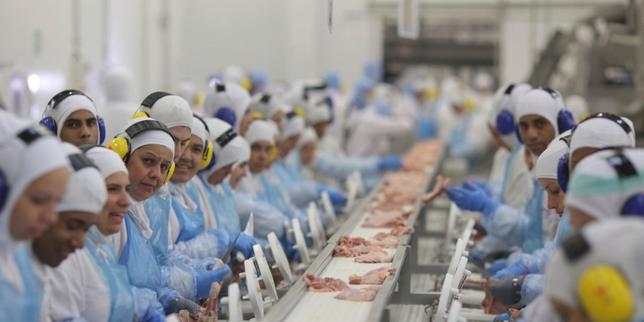
The global protein supply chain relies on a thermodynamic paradox: the conversion of biological life into standardized commodities through the maximization of kinetic output per square meter of factory floor. In Chapeco, Brazil—a region colloquially termed the "slaughterhouse capital"—this process has reached its logical extreme. The operational efficiency of major meatpackers is no longer gained through mechanical innovation alone, but through the extraction of "human dividends" by accelerating line speeds beyond the physiological limits of musculoskeletal recovery.
The Triad of Industrial Extraction
The dominance of the Chapeco meatpacking cluster is built upon three structural pillars that dictate the life-cycle of both the product and the producer. Understanding these pillars reveals why individual complaints about "working like robots" are not glitches, but features of the optimized business model.
- Line Velocity as a Fixed Variable: Production targets are determined by global demand and cold-chain logistics. To maintain margins against fluctuating feed prices, the only internal variable a plant manager can control is the velocity of the disassembly line.
- Labor Fungibility: The recruitment strategy targets high-turnover populations, including local rural workers and increasing percentages of migrants. This creates a workforce that is technically replaceable, reducing the incentive for firms to invest in long-term ergonomic health.
- Regulatory Arbitrage: While Brazilian labor laws (such as NR-36) provide a framework for repetitive motion protection, the implementation gap between "documented compliance" and "floor reality" allows for continuous over-extension of worker capacity.
The Mechanics of Repetitive Strain
The physical deterioration of the workforce in Chapeco follows a predictable biological trajectory. The core issue is the disconnection between the cadence of the blade and the rate of cellular repair. In a standard shift, a worker may perform the same cutting motion upwards of 15,000 to 20,000 times.
From a physiological perspective, this creates a state of chronic inflammation. When the rest intervals required by NR-36 (usually 10 to 20 minutes for every 50 to 100 minutes worked) are shortened or neutralized by the increased intensity of the active work period, the body enters a "deficit phase." The "robot" metaphor used by workers is a precise description of their role: they are biological actuators in a system designed for mechanical persistence.
The economic consequence of this is the externalization of healthcare costs. When a worker develops Carpal Tunnel Syndrome or Tendonitis, the industrial system treats the individual as a depreciated asset. The cost of rehabilitation and long-term disability is shifted from the corporate balance sheet to the public social security system (INSS).
The Invisible Pressure of Cold-Chain Optimization
Environmental factors in the slaughterhouse act as force multipliers for physical injury. Chapeco’s plants operate at temperatures typically ranging between 10°C and 15°C to maintain food safety standards.
- Vasoconstriction: Cold environments reduce blood flow to the extremities, decreasing the elasticity of tendons and muscles.
- Grip Force Requirements: Decreased sensitivity in the hands due to cold requires workers to apply more grip force to hold knives and tools, exponentially increasing the strain on the forearm muscles.
- Thermal Fatigue: The metabolic cost of maintaining core body temperature reduces the overall energy available for physical labor, leading to "micro-lapses" in form that precede acute injury.
The combination of high velocity and low temperature creates a "high-friction" environment for human biology. Companies prioritize the cold chain for the product because a rise in temperature results in immediate spoilage and financial loss. The "spoilage" of the human worker, being slower and less visible, is factored into the cost of doing business.
The Psychological Bottleneck: Surveillance and Quotas
Beyond the physical mechanics, the Chapeco model utilizes a sophisticated layer of psychological management. Productivity is not merely encouraged; it is enforced through a culture of "benchmarking" where the fastest workers set the baseline for the entire line.
This creates a socially engineered acceleration. If one segment of the line slows down, it creates a "logistical debt" for the next station. This peer-to-peer pressure reduces the need for direct managerial oversight, as the workers themselves become the enforcers of the pace to avoid falling behind.
The "robotization" mentioned by employees refers to the elimination of cognitive variance. There is no room for judgment, pacing, or individual adjustment. The worker is an extension of the stainless steel machinery, and any deviation from the rhythmic requirement is treated as a mechanical failure.
Structural Failures in Oversight and Enforcement
The persistence of these conditions in a major industrial hub like Chapeco suggests that the existing oversight mechanisms are insufficient to counter the economic incentives of high-speed production. Several factors contribute to this enforcement gap:
- The Proximity of Interests: In regions where a single industry accounts for a significant portion of the GDP and employment, there is an inherent reluctance to impose sanctions that might threaten the "competitiveness" of the local economy.
- Reporting Lag: Musculoskeletal disorders often take months or years to manifest fully. By the time a cluster of injuries is identified, the production cycles have already shifted, making it difficult to link specific line speeds to specific medical outcomes.
- Psychosocial Barriers: Many workers, particularly those from marginalized or migrant backgrounds, lack the legal resources or social capital to report violations. The fear of being blacklisted from the region's primary employers serves as a silent non-disclosure agreement.
The Logic of the Transition to Automation
The current tension in Chapeco is a transitional phase. Large meatpacking firms are currently calculating the Break-Even Point of Automation. Until the cost of a robotic arm capable of the dexterity required for deboning falls below the cost of a high-turnover human workforce (including the occasional legal settlement), the human-as-robot model will persist.
We are seeing a strategic delay in full automation because humans currently offer a level of "disposable flexibility" that robots lack. A human can be told to work faster for a specific shift to meet a surge in orders; a robot has a fixed maximum operating speed. As such, the worker in Chapeco is currently competing against an idealized mechanical version of themselves—a competition they are biologically destined to lose.
Strategic Reconfiguration of the Labor Model
To move beyond the cycle of human depreciation, the industry requires a shift from a "volume-first" to a "resilience-first" operational framework. This is not a matter of corporate altruism, but of long-term economic sustainability.
- Dynamic Line Calibration: Implementing IoT sensors to monitor the relationship between line speed and worker fatigue markers in real-time. If biometric indicators (such as heart rate variability or grip strength decline) show a significant drop across a cohort, the line must automatically decelerate to a sustainable cadence.
- Internalizing the Disability Cost: Shifting the financial burden of work-related injuries back to the employer through higher insurance premiums linked specifically to repetitive strain metrics. This would align the CFO’s incentives with the safety manager’s goals.
- Mandatory Cross-Training: Reducing the "wear pattern" on specific muscle groups by rotating workers across different stations every two hours. While this slightly reduces the extreme efficiency of hyper-specialization, it extends the productive life-cycle of the employee.
The future of the Chapeco industrial complex depends on whether it can evolve into a system that respects the biological limits of its primary asset. Failure to do so will result in a permanent labor shortage as the local population realizes that the wage offered does not cover the long-term cost of a broken body. The "capital of slaughterhouses" must decide if it is processing meat or processing people.
The most immediate strategic move for firms in this sector is to decouple production quotas from the physical endurance of the workforce. By integrating collaborative robotics (cobots) to handle the most repetitive, high-strain motions while humans oversee quality and precision, plants can maintain output without the high cost of human turnover. The transition must move toward a model where technology augments the human, rather than attempting to force the human to mimic the technology.