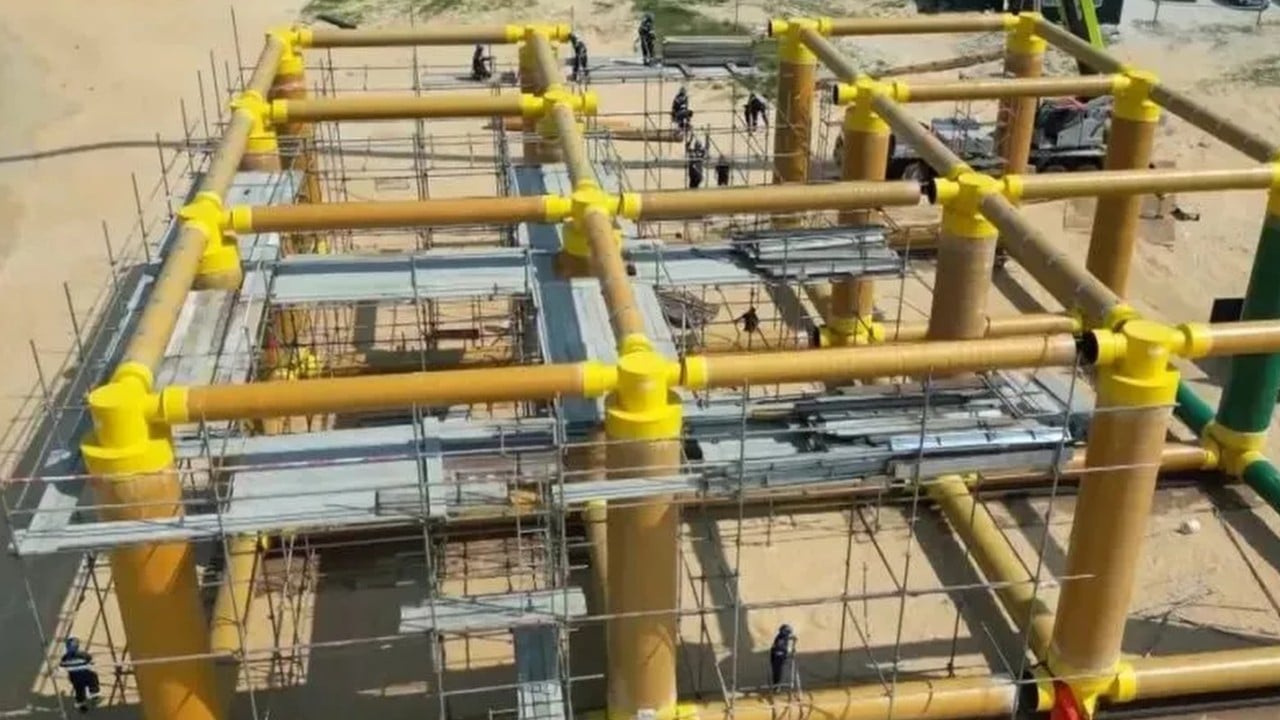
The maritime boundary off Yantai, Shandong, does not care about corporate press releases. Salt spray bites at steel, relentless wave action fatigues welds, and marine biofouling coats anything stationary within weeks. Yet, engineers have anchored a 100kW floating solar platform here constructed primarily from an unexpected material: bamboo. Built as the Jilin No. 2 by a consortium including CIMC Raffles and the China Forestry Group, this offshore photovoltaic experiment aims to answer a brutal engineering question. Can a grass native to terrestrial forests survive the open ocean while replacing carbon-heavy steel and petroleum-derived high-density polyethylene?
For decades, the expansion of marine solar energy has suffered from an economic and ecological paradox. Floating photovoltaic arrays demand vast structural framing to keep solar panels above corrosive waves, but traditional materials carry heavy environmental and financial costs. Steel requires energy-intensive smelting, releases significant carbon, and corrodes rapidly in saltwater despite heavy coatings. High-density polyethylene floats degrade under prolonged ultraviolet exposure and contribute to microplastic pollution when battered by storms. Industry players gloss over these material limitations while chasing gigawatt-scale buildouts. Beneath the optimistic capacity numbers lies a grinding reality of high maintenance budgets and short replacement cycles for marine infrastructure. Building on this theme, you can find more in: Inside the MIT Quantum Breakthrough That Proves Electrons Freeze Like Ice.
Enter the bamboo-wound tube. Engineers transformed natural bamboo through advanced resin impregnation and mechanical compression into a prestressed fiber-reinforced composite known as Sea Bamboo Pipe. This material boasts a high strength-to-weight ratio that rivals structural aluminum while maintaining inherent elasticity. Wood and grass composites flex with wave action rather than fighting it, distributing stress points across a broader surface area. When a three-meter swell hits a rigid steel platform, the weld joints absorb the brunt of the kinetic energy. When that same wave strikes a bamboo-composite frame, the material absorbs and dissipates the shock through elastic deformation.
The Material Science of Marine Grass
Scaling organic materials for harsh marine environments requires shifting away from traditional carpentry and entering heavy chemical processing. Raw bamboo rots quickly and loses structural integrity when exposed to constant moisture and fungi. To counter this, developers use high-pressure winding technologies, binding fibers with specialized bio-resins that seal out saline water entirely. Experts at MIT Technology Review have provided expertise on this situation.
This process changes the economics of marine manufacturing. Producing steel plate involves massive capital expenditure, localized supply chain bottlenecks, and volatile commodity pricing dictated by global ore markets. Bamboo grows to maturity within a few years, offering a rapid, renewable feedstock that decouples structural fabrication from heavy industrial mining.
Skeptics point out that a 100kW platform is a microscopic drop in an ocean dominated by multi-megawatt installations. Critics argue that laboratory-scale success rarely translates to commercial durability over a twenty-year operational lifespan. Saltwater infiltration, micro-cracking from thermal cycling, and unexpected degradation modes remain genuine risks. The consortium acknowledges these gaps, treating the Yantai deployment as an empirical stress test rather than a finished commercial product.
Economic Pressures and Grid Realities
China commands a massive share of global renewable energy manufacturing, yet domestic developers face severe spatial constraints along populated coastlines. Moving solar arrays offshore solves land-use conflicts, but transmission costs and structural expenses eat into profit margins. Off-grid or microgrid integration near hydrogen and methanol production facilities, like the Yantai demonstration site, offers a pragmatic workaround. By powering green chemical synthesis directly at the coast, operators bypass congested transmission lines.
The shift toward bio-based marine materials also aligns with national mandates to reduce plastic dependency. Bureaucratic pushes to substitute plastics and metals with renewable fibers provide early-stage subsidies, but market survival depends entirely on lifecycle cost parity. If bamboo-wound platforms require replacement after five years due to unexpected delamination, project financiers will quickly revert to galvanized steel.
Industry analysts watching the Shandong coast look past the immediate novelty of a grass-built power station. They focus on the forthcoming transition from this 100kW test bed to a planned megawatt-scale pilot. Standardization remains the ultimate hurdle. Steel beams come with universal ASTM certifications and predictable load tolerances. Engineered bamboo composites lack centuries of standardized structural data, forcing marine insurers to price risk conservatively.
Marine renewable energy thrives on brutal pragmatism. Engineers do not care if a material is poetic or environmentally fashionable if it fails under a winter Gale. The bamboo floating solar platform off Shandong represents a high-stakes gamble against conventional naval architecture. Whether this organic composite becomes a foundational pillar of future ocean engineering or remains a footnote in materials science depends on how these tubes handle the coming winter storms.