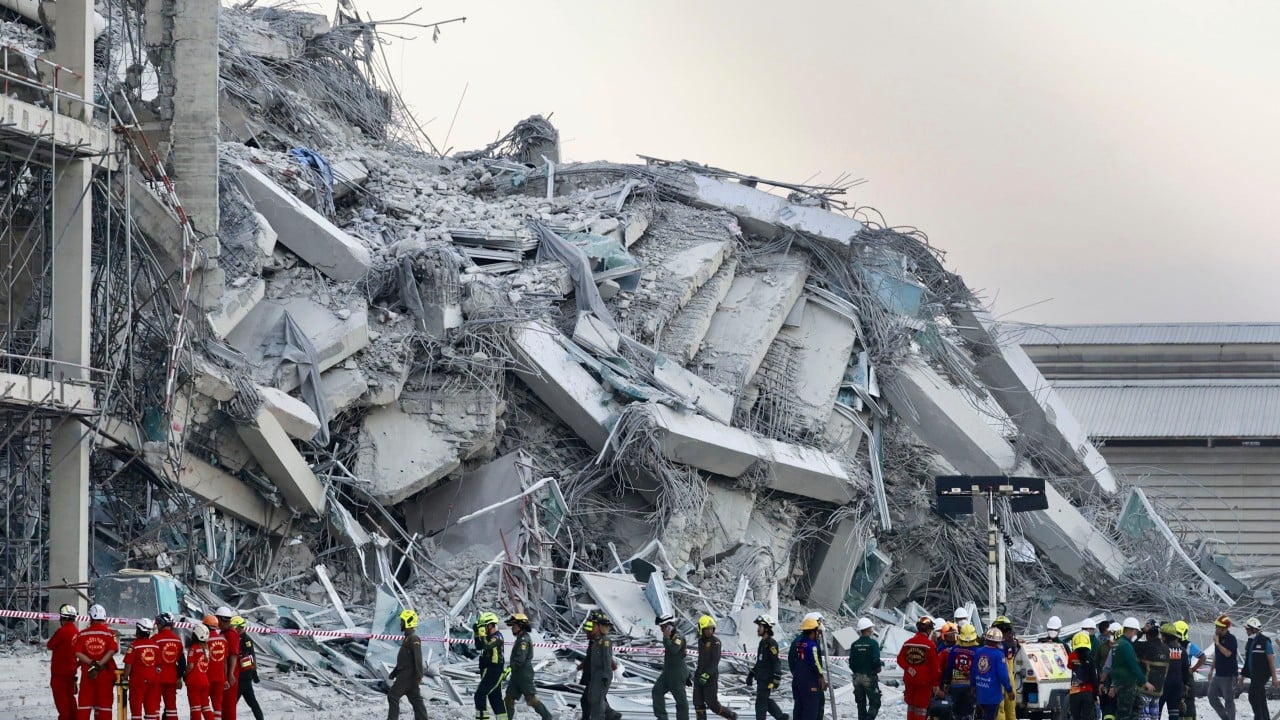
A Thai criminal court convicted a Chinese national for serving as an illegal corporate nominee in a construction joint venture tied to the deadly collapse of Bangkok's State Audit Office tower, exposing how foreign contractors bypass Thailand's strict ownership laws through local proxies. The ruling targets Zhang Chuanling, a director linked to China Railway No. 10 (Thailand), following the catastrophic structural failure during the March 2025 earthquake that radiated from Myanmar and flattened the unfinished 30-story government building. Rather than ending the accountability debate, the conviction cracks open a far deeper systemic failure in Southeast Asian infrastructure procurement, where shell companies, diluted equity rules, and fragmented subcontractor chains routinely obscure who actually controls high-risk public works.
The dust had barely settled over Chatuchak district before engineers began asking why a modern, reinforced-concrete high-rise pancaked while neighboring structures rode out the seismic waves with superficial cracks. Investigators quickly turned their focus away from the tremor itself and toward the corporate paperwork sitting in the Department of Business Development.
How Nominee Structures Hollow Out Construction Oversight
Thailand's Foreign Business Act of 1999 strictly limits foreign ownership in domestic construction and engineering firms to 49 percent unless the entity secures special cabinet exemptions or Board of Investment privileges. The law was designed to protect local builders and ensure domestic legal accountability when things go wrong. In practice, it created a thriving shadow industry of nominee shareholders.
To bid on lucrative state contracts, foreign state-backed enterprises frequently partner with Thai citizens who hold the majority 51 percent stake on paper while exercising zero operational control. Prosecutors in the Bangkok tower case demonstrated that the local shareholders lacked the financial capital, technical background, and executive authority commensurate with owning a majority stake in a multi-billion-baht infrastructure firm.
When a joint venture operates through nominees, regulatory oversight fractures immediately.
- Capital flows become opaque. Money moves through intercompany loans and equipment leases back to the foreign parent entity, leaving the local Thai shell company undercapitalized when catastrophic liabilities arise.
- Engineering sign-offs lose clear chain-of-command. Site managers answer to overseas headquarters rather than the local Thai directors registered on the building permits, creating dangerous gaps between blueprint specifications and on-site execution.
- Procurement favors affiliated suppliers. Subcontracts for critical structural inputs—such as high-tensile rebar, ready-mix concrete, and post-tensioning cables—often route through related trading companies with minimal independent quality testing.
Prosecutors focused their initial criminal charges on nominee violations and falsified corporate filings precisely because corporate fraud leaves an indisputable paper trail. Proving criminal negligence in structural engineering takes years of forensic metallurgy and finite-element modeling; proving that a Thai shareholder never paid for their shares takes bank statements and tax records.
The Anatomy of the State Audit Office Failure
The collapsed State Audit Office headquarters was supposed to be a flagship administrative complex, jointly contracted to Italian-Thai Development and China Railway No. 10 (Thailand) with a budget exceeding two billion baht. On paper, pairing one of Thailand's oldest domestic construction giants with a subsidiary of a massive Chinese state-owned enterprise looked like a textbook risk-mitigation strategy.
It wasn't.
Joint ventures in major public procurement often divide physical scope or financial management rather than integrating quality assurance. When an earthquake strikes an unfinished frame, structural vulnerabilities reveal themselves in seconds. A building mid-construction lacks the full dead-load stabilization, completed shear wall curing, and secondary bracing of a finished tower, making strict adherence to concrete curing times and rebar splicing standards non-negotiable.
Why Seismic Distance Did Not Spare the Structure
Bangkok sits roughly 1,000 kilometers from the Sagaing Fault zone in Myanmar, yet the city's geological foundation amplifies long-period seismic waves. The Chao Phraya River basin rests on a deep layer of soft marine clay. When low-frequency tremors travel across the region, this soft soil acts like a bowl of gelatin, swaying tall, flexible structures violently while leaving low-rise masonry buildings largely untouched.
Thai building codes were updated in 2007 and tightened again in 2021 specifically to account for this basin amplification effect. Compliant high-rises rely on ductile detailing—closely spaced steel stirrups wrapped around vertical rebar columns—to allow the concrete frame to flex and dissipate energy without snapping.
When forensic teams examined the rubble in Chatuchak, they scrutinized three primary failure points common to rapid-build high-rises:
- Concrete compressive strength shortfalls: Substituting lower-grade mixes or rushing formwork stripping before concrete reaches design strength compromises column load capacity.
- Substandard steel reinforcement: Using non-compliant or improperly spliced deformed bars prevents columns from absorbing lateral shear forces during a sway cycle.
- Flat-slab punching shear: Without adequate column capitals or shear reinforcement, heavy floor plates can tear loose from vertical columns, triggering a progressive pancake collapse from the top down.
None of these flaws happen by accident on a supervised site. Every pour requires slump tests, cylinder compression checks, and sign-offs from independent site inspectors hired by the state agency.
The Procurement Trap Nobody Wants to Fix
Focusing exclusively on one convicted executive lets Thailand's public procurement apparatus off the hook far too easily. The deeper scandal lies in how government agencies award mega-contracts and monitor compliance once the groundbreaking ceremony ends.
Under Thailand's Public Procurement and Supplies Administration Act, state agencies heavily weight lowest-bid pricing alongside technical qualifications. Facing thin margins on domestic projects, large local contractors increasingly rely on foreign partners to supply cheap financing, heavy machinery, and aggressive project timelines. Government committees, eager to keep capital budgets moving and avoid administrative delays, rarely audit the underlying beneficial ownership of the bidding consortiums before awarding contracts.
Consider a hypothetical scenario common across regional infrastructure tenders. A municipal agency solicits bids for a 25-story administrative tower with a strict 30-month delivery window. Consortium A bids 18 percent below the median estimate by leveraging an overseas supply chain and an aggressive six-day floor-pouring cycle. Consortium B bids at the median estimate, factoring in conservative curing schedules and third-party metallurgical testing for every batch of steel. Under standard scoring matrices, Consortium A wins the contract before a single soil borehole is drilled.
Once the contract is signed, oversight shifts to third-party engineering consultancies hired by the state owner. Yet these inspection firms often operate under chronic staffing shortages, assigning a handful of junior engineers to monitor dozens of active work zones simultaneously. If a contractor cuts corners on a night shift pour or swaps out a steel batch to stay on schedule, under-resourced site inspectors rarely catch it until cracks appear—or until the ground shakes.
The Geopolitical Friction Behind the Verdict
The conviction of a Chinese executive in a high-profile Thai court carries unavoidable diplomatic weight. Over the past decade, Chinese state-owned enterprises have become indispensable builders across mainland Southeast Asia, constructing high-speed rail corridors, industrial estates, deep-sea ports, and government office towers from Vientiane to Bangkok.
For Beijing, these projects represent vital overseas revenue streams for domestic construction giants grappling with a prolonged property slump at home. For Bangkok, Chinese capital and engineering capacity offer a fast track to upgrading aging national infrastructure without straining sovereign debt ceilings.
That mutual dependency usually insulates foreign executives from aggressive criminal prosecution. Local authorities typically resolve construction disputes through administrative fines, quiet contract terminations, or civil settlements behind closed doors.
The Chatuchak collapse shattered that unwritten arrangement. The sheer visibility of a state audit building—the very institution tasked with policing government spending and corruption—crumbling into dust on live television made diplomatic containment impossible. Public anger forced the Department of Special Investigation, the Ministry of Industry, and the Bangkok Metropolitan Administration into rare, coordinated enforcement.
What the Conviction Actually Covers—And What It Misses
It is critical to separate the corporate crime from the engineering disaster. Zhang Chuanling's conviction addresses violations of the Foreign Business Act—specifically, operating a restricted construction business through Thai nominees and submitting false corporate registration details.
While carrying prison sentences and steep fines, a nominee conviction does not automatically establish criminal liability for the deaths of construction workers or the structural failure itself. Separate criminal negligence investigations targeting structural designers, site engineers, concrete suppliers, and state-appointed inspectors move on a much slower, more contentious legal track.
| Legal Track | Target Violation | Primary Evidence | Typical Outcome |
|---|---|---|---|
| Corporate Nominee Case | Illegal foreign majority control under the Foreign Business Act | Bank transfers, tax filings, shareholder interviews | Fines, prison terms up to 3 years, business dissolution |
| Product Standards Case | Substandard steel rebar or non-compliant construction materials | Laboratory tensile tests, factory mill certificates | Product seizures, factory license revocation, fines |
| Criminal Negligence Case | Reckless design, flawed execution, or failed inspection causing death | Forensic structural modeling, site logs, inspector sign-offs | Prolonged multi-year trials, shared civil liability |
Defense attorneys in multi-party construction disasters routinely exploit this separation. Contractors blame design engineers for under-specifying seismic tolerances; design engineers blame contractors for deviating from blueprints during construction; contractors blame material suppliers for delivering off-spec steel; and everyone blames the state client for approving design modifications mid-project.
Why Corporate Blacklisting Rarely Stops Repeat Offenders
Following the verdict, Thai regulators moved to tighten scrutiny on foreign-backed construction firms, pledging to review dozens of active state contracts involving similar joint-venture structures. Industry veterans have seen this movie before.
In Southeast Asian construction, corporate entities are disposable. When a joint venture or local subsidiary faces blacklisting, criminal fines, or massive wrongful-death lawsuits, its parent principals simply wind down the compromised entity, absorb the write-off, and incorporate a fresh company with a new roster of local nominees.
Because Thailand's corporate registry historically checked formal documentation rather than beneficial ownership trails, shell companies proliferated across real estate, tourism, and public works. Even when the Department of Business Development flags suspicious shareholding patterns—such as low-income clerks holding millions of baht in equity across multiple companies—investigators lack the automated cross-agency data sharing needed to freeze assets before executives leave the country.
Real deterrence requires piercing the corporate veil in three specific ways:
- Mandatory beneficial ownership registries tied directly to Revenue Department tax filings and bank KYC records, automatically disqualifying any bidder whose majority Thai shareholders cannot prove independent source-of-wealth documentation.
- Parent-company performance bonds backed by first-tier international banks, ensuring that if a local joint-venture shell collapses financially, the state can immediately seize liquid collateral from the parent enterprise to compensate victims and fund demolition.
- Criminal liability for inspection sign-offs, holding third-party engineering consultants and state procurement officers personally accountable when material test certificates are falsified or skipped.
The Structural Reckoning Across Bangkok's Skyline
Beyond the courtroom drama, the State Audit Office verdict has triggered an uncomfortable audit across Bangkok's commercial real estate and public infrastructure sectors. Hundreds of high-rise towers built over the past twenty years share the exact same DNA: aggressive construction timelines, layered subcontracting, and soft-soil foundations vulnerable to distant seismic events.
Private developers, facing pressure from foreign tenants and insurance underwriters, have quietly begun commissioning independent non-destructive testing—using ultrasonic pulse velocity and ground-penetrating radar—to verify that the steel inside their concrete columns matches what was drawn on the blueprints. Insurance premiums for builders' risk and catastrophic seismic coverage in Thailand are already repricing upward to reflect the reality that code compliance on paper does not guarantee structural resilience on site.
The criminal conviction of a single executive proves that Thai courts will punish the corporate deception used to win public contracts, yet until regulators dismantle the nominee system and enforce real-time metallurgical and concrete testing on every state job site, the next blueprint failure is already under construction.