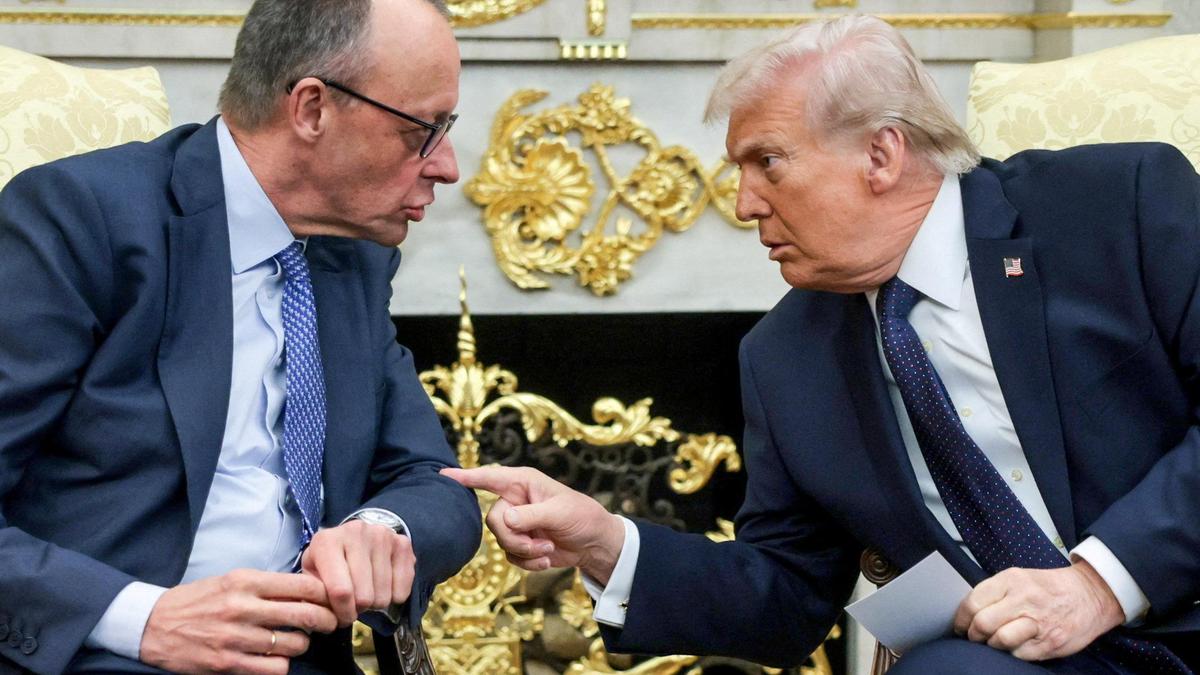
The fragile truce between the world’s most powerful economy and its most essential European ally has finally splintered. On Thursday, Donald Trump unleashed a characteristic verbal broadside against German Chancellor Friedrich Merz, ostensibly over Iran, but the reality is far more dangerous than a social media spat. By demanding Merz stop "interfering" with the U.S. strategy in the Middle East and instead focus on his "broken country," Trump hasn't just insulted a partner—he has signaled a fundamental shift in the transatlantic security architecture that has held since 1945.
This isn't merely about rhetoric. Behind the scenes, the White House is now actively reviewing the withdrawal of over 36,000 U.S. troops from German soil. What started as a disagreement over how to handle a nuclear-ambitious Tehran has morphed into a high-stakes game of geopolitical chicken where the currency is no longer just oil or sanctions, but the very presence of the American military shield in Europe. Expanding on this theme, you can find more in: Banksy Hijacks the London Skyline to Trigger a New Class War.
The Humiliation Factor
The catalyst for this week’s explosion was a moment of rare, unvarnished candor from Merz. While visiting a school in western Germany, the Chancellor remarked that the United States was being "humiliated" by the Iranian leadership. He wasn't wrong, but in the world of high-stakes diplomacy, being right is often less important than being polite.
Merz’s assessment stems from a brutal reality on the ground. The U.S.-Israeli war against Iran has entered its third month with no clear "strategic exit" in sight. For Germany, a country that has built its post-war identity on stability and predictable trade routes, the closure of the Strait of Hormuz is a slow-motion economic car crash. Analysts at TIME have shared their thoughts on this matter.
German growth forecasts have been slashed to a measly 0.5 percent. Energy prices are skyrocketing. While Trump views the conflict through the lens of a "maximum pressure" campaign to eliminate a nuclear threat, Merz sees a regional fire that is burning down the house of German industry.
Why Merz is Breaking Ranks
Friedrich Merz is no radical. He is a staunch Atlanticist and a conservative who was elected on a promise to revive the German locomotive. However, he is currently trapped between a volatile White House and a domestic crisis that threatens his political survival.
- The Energy Stranglehold: With the Strait of Hormuz effectively blockaded, Germany’s transition away from Russian gas has hit a wall of fire. The €1.6 billion subsidy package passed by Berlin this month is a mere band-aid on a hemorrhage of capital.
- The Ukraine Distraction: Merz’s advisors are increasingly worried that Washington’s fixation on Iran is siphoning off the military and political capital needed to sustain Ukraine. Trump’s counter-argument—that Merz has been "totally ineffective" in ending the Russia-Ukraine war—strikes at the heart of Berlin's insecurity about its own military relevance.
- The Rise of the AfD: Economic pain has a political price. The far-right Alternative for Germany (AfD) is now polling at 27 percent, surpassing Merz’s own CDU. For the Chancellor, the "Iran war" is no longer a foreign policy issue; it is a domestic survival issue.
The Troop Withdrawal Threat
Trump’s suggestion that he may reduce the U.S. military presence in Germany is the ultimate "nuclear option" in bilateral relations. For decades, bases like Ramstein have served as the indispensable backbone of American power projection in the Middle East and Africa.
By threatening to pull the plug, Trump is testing whether Merz will prioritize European economic stability over the American security umbrella. It is a brutal calculation. If the U.S. leaves, Germany is forced to either rapidly remilitarize—a prospect that still makes much of Europe nervous—or find a way to appease a Russian neighbor that is watching the Washington-Berlin rift with predatory interest.
The German Foreign Ministry has attempted to project a sense of "relaxation" regarding the threat, citing the irreplaceable nature of Ramstein for American operations. But this confidence may be misplaced. Trump has shown a consistent willingness to prioritize perceived "fairness" in burden-sharing over traditional strategic dogma. In his view, Germany is a "free-rider" that dares to criticize the driver while the car is in a high-speed chase.
The Strategic Void
The deeper issue, and the one Merz alluded to before the Twitter storm, is the lack of a shared Western endgame. Washington is currently operating on a "disrupt and dominate" philosophy. Berlin, conversely, is desperate for a return to the "negotiate and stabilize" status quo.
Merz has offered to send German minesweepers to the Strait of Hormuz, but only after a ceasefire. This caveat is the crux of the friction. To Trump, this is a betrayal of the alliance. To Merz, it is the only way to avoid being dragged into a "forever war" that Europe cannot afford and did not choose.
The relationship between these two leaders was once described as "good and professional." It is now anything but. As the U.S. enters a period of heightened domestic polling pressure—with Trump’s own approval ratings hitting new lows over the Iran conflict—the need for a foreign scapegoat grows. Germany, with its massive trade surplus and its vocal doubts about American strategy, is the perfect target.
We are witnessing the end of the "trusting" transatlantic era. Berlin is now preparing for a world where the U.S. is not a predictable partner, but a transactional power that views its allies' economic health as secondary to its own tactical whims. Merz may be right that the U.S. is being humiliated, but in saying it aloud, he may have cost his country the very security it relies on to survive.
Germany’s next move won’t be a public apology; it will be a quiet, desperate pivot toward a more autonomous European defense—a process that will take years the continent doesn't have.
The Trump-Merz feud explained
This video provides a detailed breakdown of how the friction between Donald Trump and Friedrich Merz is specifically impacting European-American diplomatic relations.