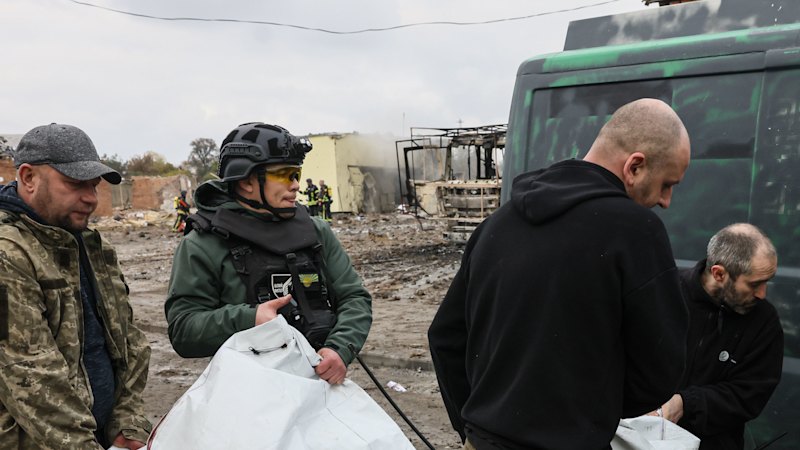
When a Russian strike flattens a civilian aid shelter, the immediate coverage focuses on the dust, the sirens, and the frantic digging of first responders. Yet the true story lies beyond the rubble. Modern siege warfare systematically targets humanitarian infrastructure to dismantle civilian resilience, sever supply lines, and force mass displacement. By examining the operational mechanics behind strikes on aid centers in Ukraine, a clear strategic doctrine emerges—one that treats relief hubs not as protected spaces under international law, but as primary military objectives.
The smoke over eastern Ukraine rarely clears before the narrative battle begins. In the wake of recent Russian strikes on civilian aid hubs—incidents that leave rescue crews pulling survivors from collapsed concrete and shredded tarpaulins—standard news dispatches follow a predictable script. They count the casualties, quote local emergency officials, and move on to the next frontline flashpoint.
That approach misses the architecture of the violence. After decades of covering conflict zones from the Balkans to the Levant, one pattern remains unmistakable. When an advanced military repeatedly hits clearly marked humanitarian distribution points, it is rarely an accident of faulty guidance systems or poor intelligence. It is a method.
The Anatomy of a Strike on Relief Infrastructure
To understand why an aid shelter becomes a target, you have to look at what a functioning relief center actually represents in a war of attrition. On paper, under the Geneva Conventions, a facility distributing food, water, and medical supplies to non-combatants is strictly off-limits. In the cold calculus of modern siege tactics, however, that exact facility is a logistical center of gravity.
War is no longer just about destroying an opposing army's tanks or artillery batteries. It is about breaking the civil society that sustains the state. When an aid shelter operates effectively in a frontline city, it anchors the local population. People stay in their homes because they know they can get clean water, bread, and basic trauma care down the street.
By obliterating that hub, the attacking force achieves multiple objectives with a single munition:
- Forced Depopulation: Without access to basic survival goods, remaining civilians are compelled to flee westward, straining the host nation's economy and administrative capacity.
- Resource Diversion: Every rescue worker, ambulance, and heavy crane pulled into the aftermath of a shelter bombing is a resource stripped away from military logistics or defensive fortifications.
- Psychological Exhaustion: Striking a place explicitly designed for safety sends a blunt message to the populace that nowhere is secure, eroding morale far faster than an attack on an empty barracks.
The weapons used in these strikes tell their own story. We are not talking about stray mortar rounds drifting off course in high winds. Investigations by open-source intelligence analysts and munitions experts consistently find fragments of precision-guided cruise missiles, ballistic projectiles, and heavy glide bombs at the sites of destroyed aid centers. These munitions require deliberate targeting coordinates, command-level sign-off, and significant financial expenditure. Nobody wastes a multi-million-dollar missile on a community center by mistake.
The Myth of Collateral Damage
Military spokespeople in Moscow routinely rely on a familiar playbook when confronted with the destruction of civilian infrastructure. First comes outright denial, followed by claims that the footage was staged, and finally the assertion that the aid shelter was secretly housing soldiers or ammunition.
It is an effective fog of war because it exploits a genuine gray area in international humanitarian law. Under the laws of armed conflict, a civilian object loses its protected status if it is used for military purposes—a concept known as dual-use infrastructure. If a battalion stores anti-tank missiles in the basement of a soup kitchen, that kitchen legally becomes a valid military target, provided the attack adheres to the principle of proportionality.
Journalists and war crimes investigators have to take this counter-argument seriously, because combatants in every conflict have occasionally blurred those lines. Yet when independent monitors examine the wreckage of bombed aid hubs in Ukraine, the physical evidence overwhelmingly contradicts the military-use excuse.
Secondary explosions are the dead giveaway. If a building is packed with artillery shells, rockets, or small-arms ammunition, a direct hit triggers a chain reaction of subsequent blasts that leave distinct blast patterns and scattered unexploded ordnance. In strike after strike on humanitarian distribution points, the crater analysis shows only the impact of the incoming warhead, surrounded by pulverized bags of flour, crushed pallets of bottled water, and civilian medical kits.
The Double-Tap Doctrine
The intent behind these attacks becomes even clearer when examining the timing of the strikes. Rescue workers operating in frontline Ukrainian cities face a lethal tactical phenomenon known as the double-tap strike.
Here is how it works. An initial missile or drone hits a populated civilian structure, such as an aid shelter or residential block. Emergency crews from the State Emergency Service rush to the scene, setting up floodlights, deploying hydraulic cutters, and clearing debris to reach trapped victims. Twenty to forty minutes later—precisely when the maximum number of first responders, medics, and volunteers are concentrated in the open—a second strike hits the exact same coordinates.
This tactic was refined extensively during the Russian intervention in Syria, where hospitals and White Helmets rescue centers in Aleppo and Idlib were systematically targeted in sequenced waves. Transferring that doctrine to Ukraine demonstrates a calculated effort to degrade emergency response capabilities. Killing a paramedic or destroying a specialized rescue vehicle removes an asset that takes years to train or replace. Over months of sustained bombardment, first responders are forced to delay their arrival at blast sites, waiting to see if a second wave is incoming while victims bleed out beneath the concrete.
Why International Law Fails at the Point of Impact
Whenever an aid shelter is reduced to rubble, diplomatic channels light up with condemnations. Officials cite violations of the Fourth Geneva Convention and Additional Protocol I, which explicitly prohibit attacks on objects indispensable to the survival of the civilian population.
The grim reality on the ground is that international humanitarian law lacks an immediate enforcement mechanism. Treaties do not intercept glide bombs. Conventions do not reinforce concrete roofs.
For international law to deter a military commander, there must be a credible threat of personal accountability. Historically, that accountability has been rare, slow, and heavily dependent on the political outcome of the war itself. While the International Criminal Court has issued arrest warrants for senior Russian officials over attacks on civilian infrastructure, those warrants carry little weight in a bunker in Rostov-on-Don during active combat operations.
Furthermore, the modern information ecosystem dulls the diplomatic blow of atrocity reporting. Decades ago, a single photograph of a bombed Red Cross facility could shift global public opinion and force an immediate ceasefire. Today, the sheer volume of daily violence, combined with coordinated state-sponsored disinformation campaigns that flood social media with conflicting narratives, creates a state of outrage fatigue. When everything is contested in real time, the political cost of violating the rules of war drops precipitously.
How Humanitarian Operations Are Adapting to Survive
Faced with the reality that a painted red cross or a prominent "CHILDREN" sign on a roof acts more as a target beacon than a shield, aid organizations have been forced to fundamentally rewrite their operational manuals. The era of large, centralized, publicly advertised distribution hubs in active conflict zones is dead.
Veteran logistics coordinators working in eastern Ukraine and other high-intensity theaters now operate using principles borrowed from covert insurgency networks rather than traditional charity models.
Decentralization and OPSEC
The most critical shift is the abandonment of massive warehouses. Instead of storing five hundred tons of food and medical supplies in a single industrial hangar, relief agencies break shipments down into dozens of small, dispersed micro-caches hidden in nondescript residential basements or rural outbuildings. If one location is compromised and struck, the overall supply chain remains intact.
Operational security, or OPSEC, has become paramount for local volunteers. Aid workers no longer post real-time photos of supply deliveries on Telegram or Facebook, as hostile intelligence units actively scrape open-source social media to geolocate gathering points. Distribution times are staggered and communicated via encrypted channels just minutes before trucks arrive.
Physical Hardening and Mobile Units
Where fixed aid centers must exist—such as trauma stabilization points or winter heating shelters—engineers are burying them. Underground parking garages, Soviet-era bomb shelters, and reinforced sub-basements have replaced ground-floor community centers.
Simultaneously, the sharpest operators have shifted toward mobile distribution models. Instead of asking three hundred elderly residents to line up outside a fixed building for four hours—creating a massive, stationary heat and visual signature for reconnaissance drones—aid teams use unmarked vans to make rapid, five-minute drop-offs directly to neighborhood coordinators. The vehicle arrives, unloads pallets into a covered alleyway, and is gone before a spotter drone can relay coordinates to an artillery battery.
The Long-Term Cost of Weaponizing Relief
The destruction of an aid shelter is not an isolated tragedy that ends when the last body is pulled from the wreckage. It triggers a cascading humanitarian crisis that outlasts the immediate military campaign.
When local relief infrastructure is wiped out, the burden shifts onto fragile regional networks that are already stretched beyond capacity. Malnutrition rises among vulnerable populations who cannot travel long distances to reach alternative distribution points. Chronic illnesses—diabetes, hypertension, heart disease—turn fatal when local clinics and pharmacies are pulverized.
Even after the frontlines stabilize or shift, the psychological and physical scars remain. Communities stripped of their civic gathering spaces struggle to rebuild social cohesion. The local school, the municipal clinic, and the community aid hub are the connective tissue of any town. When they are turned into craters, the town ceases to exist as a functioning community, even if the buildings around them remain standing.
First responders will keep digging through the concrete with bare hands and hydraulic jaws whenever the missiles fall, driven by an obligation that outstrips the fear of a second strike. Yet until military planners face tangible, immediate consequences for turning humanitarian shelters into craters, the siren will remain the only reliable warning system left for the people trying to keep civilians alive.