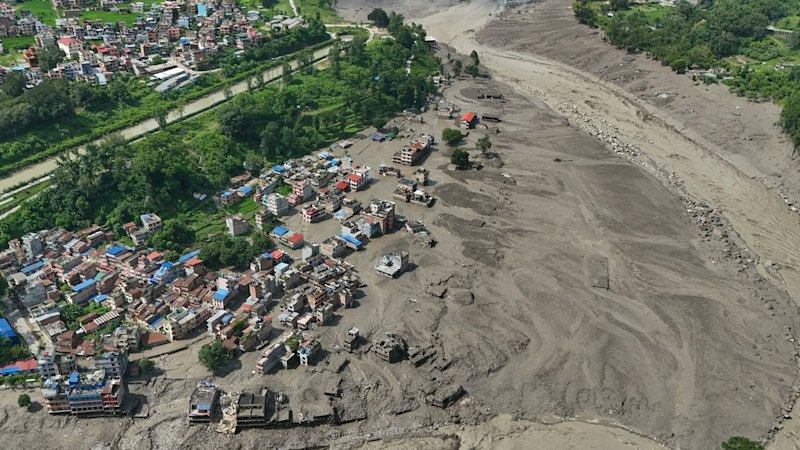
At least 160 people are dead and hundreds remain missing following a catastrophic flash flood that tore through central Nepal and the Tibet border region. The disaster unfolded with terrifying speed along the Bhote Koshi and Trishuli river corridors. Local weather stations registered no heavy rainfall in the worst-hit districts of Rasuwa and Nuwakot, leaving scientists and emergency officials scrambling to explain how a wall of water materialized out of a clear mountain morning.
Seismic monitors recorded a disturbance near the border just moments before the surge. Whether triggered by a high-altitude rockslide, a sudden glacial lake outburst, or a cascading dam effect originating on the Tibetan side, the wall of water decimated everything in its path. Entire settlements, multi-story buildings, and vital transport links vanished beneath churning brown water in seconds.
Infrastructure vulnerability in the Himalayas has long been treated as an acceptable economic risk. It is no longer sustainable.
The Anatomy of a Transboundary Crisis
Water does not recognize international borders. When an aquatic system originates upstream in the Tibetan Autonomous Region of China and spills rapidly into the steep gorges of Nepal, early warning systems must operate with absolute synchronization. That coordination failed.
The floodwaters breached vulnerable riverbanks around Timure and Syapru Besi, washing out roughly 40 kilometers of vital roadway and destroying at least 19 motorable bridges. For remote mountain communities, losing these pathways means losing access to basic survival resources. Rescue helicopters are flying continuous sorties, yet high winds and narrow valleys severely restrict operations.
Hydropower projects, heavily touted as clean economic drivers for Nepal's developing economy, proved exceptionally fragile. The Independent Power Producers' Association Nepal confirmed that multiple operational and under-construction facilities suffered catastrophic damage. When heavy sediment and violent boulders slam into multi-million-dollar turbines, the financial recovery timeline stretches into years.
Stranded Pilgrims and Global Repercussions
The human cost extends far beyond local villagers. The disaster struck during a peak window for religious and cultural tourism. Hundreds of international travelers, including pilgrims journeying toward Mount Kailash, foreign construction laborers, and independent trekkers, were caught directly in the inundation zone.
Lists of the missing compiled by the Nepal Tourism Board include citizens from India, the United States, Australia, Britain, Canada, and various European nations. Families thousands of miles away are now relying on fragmented communication networks and emergency embassy helplines to trace relatives. Security forces, including dozens of Nepal Army personnel, are among the missing, swallowed up while attempting to manage evacuations or secure border immigration checkpoints.
International assistance has begun trickling in, with neighboring governments pledging logistical and medical support. Yet relief efforts are constantly bottlenecked by geography. When a single flash flood erases the only road connecting a region to the capital, response time shifts from hours to days.
Geological instability across the roof of the world demands a radical shift in how we monitor high-altitude watersheds. Transboundary river management cannot remain an afterthought of diplomatic protocol. Until upstream telemetry data is shared transparently and instantly across national lines, the next mountain catastrophe will arrive just as silently as the last.


.png?width=1200&auto=webp&trim=0%2C0%2C0%2C0)