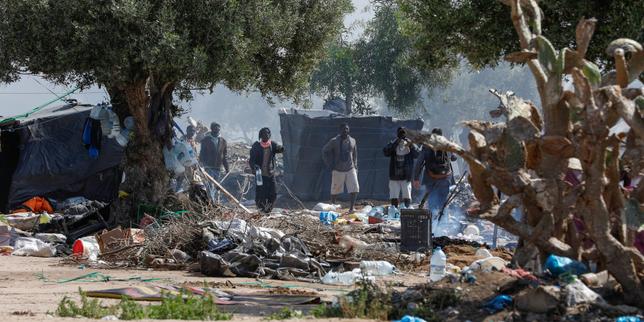
In the olive groves of El-Amra, thirty kilometers north of Sfax, thousands of sub-Saharan African migrants live in a parallel economy built entirely on desperation. There is no state presence here. No formal aid distribution, no sanitation, and no policing that protects the people sleeping under plastic sheeting. What exists instead is a self-contained market of survival—where water, phone charging, food, and passage across the Mediterranean are traded in cash, and where violence is the primary currency of enforcement.
Most coverage of Tunisia's migration crisis focuses on the boats leaving Sfax or the diplomatic handshakes in Brussels. That framing misses the real story. The El-Amra migrant camps are not a temporary transit point. They are the predictable result of a border policy that traps people in a country experiencing its own severe economic contraction, leaving both migrants and rural Tunisians to fight over dwindling resources.
How the Olive Groves Became a Containment Zone
To understand El-Amra, you have to look at what happened in Sfax in 2023. Following inflammatory political rhetoric and deadly clashes between locals and migrants in the port city, Tunisian security forces cleared urban neighborhoods. Thousands of people were pushed outward—some toward the Libyan and Algerian borders, and thousands more north into the rural delegations of El-Amra and Jebeniana.
They did not arrive in an empty desert. They arrived in working agricultural land.
For generations, small-scale farmers in this region have depended on olive harvests for their annual income. Suddenly, their orchards became makeshift cities. Tents stitched together from tarps, scrap wood, and discarded plastic now sit directly beneath the trees. When you walk through these encampments, the smell of woodsmoke and uncollected waste hangs heavy in the air.
The state's response has been sporadic and punitive. Police periodically raid the groves, dismantle shelters, and confiscate boats or engines. Yet they offer no alternative housing and no legal pathway forward. The migrants have nowhere to go. Within days of a raid, the tarps go back up, and the cycle resets.
The Anatomy of an Informal Survival Economy
When thousands of people are concentrated in one place with zero formal infrastructure, an economy forms anyway. In El-Amra, necessity has created a rigid, cash-only ecosystem.
Water, Power, and Basic Goods
Clean water is the most valuable commodity in the groves. Because there are no municipal hookups, water must be brought in from outside. Migrants pay inflated prices for jerrycans hauled in by local intermediaries or fellow migrants with access to carts.
Electricity follows the same rule. A small network of gas generators and car batteries powers charging stations where people pay to keep their phones alive—their only link to family back home and to the smugglers who control their next move. Around these charging points, small stalls sell rice, oil, sardines, and cigarettes at steep markups.
The Smuggling Supply Chain
Beneath the daily trade in food and water sits the real engine of El-Amra: the clandestine boat industry. Sfax and its surrounding coastline became the primary departure point for the central Mediterranean route because of geography—Italy's Lampedusa is roughly 130 kilometers away—and because local fishing economies were already struggling.
In the camps, brokers act as middlemen between migrants and Tunisian boat builders or captains. Prices fluctuate based on weather, coast guard patrols, and the type of vessel—from flimsy iron-sheet boats welded together in hidden workshops to wooden trawlers. Every step of this chain requires cash up front, often wired through informal transfer networks from relatives abroad.
Why Violence Is Built Into the System
Violence in El-Amra is not random. It is structural.
Without legal status, migrants cannot report theft, assault, or extortion to the police. Doing so risks detention or deportation. This legal vacuum creates an environment where armed groups, predatory smugglers, and opportunistic thieves operate with near-total impunity inside the camps.
At the same time, tension between the camps and the surrounding Tunisian villages has reached a boiling point. Local residents watch their olive trees get stripped for firewood and their harvests disrupted. Many feel abandoned by the central government in Tunis, which has failed to compensate farmers or secure the area.
When a community feels unprotected, it takes matters into its own hands. Clashes between villagers and migrants have become routine—stone-throwing, roadblocks, and retaliatory raids that leave people injured on both sides. The Tunisian National Guard intervenes only when the violence spills onto main highways, firing tear gas to push everyone back into the groves.
The European Blind Spot
You cannot separate the chaos in El-Amra from the money flowing out of Brussels. In July 2023, the European Union signed a Memorandum of Understanding with Tunisia, pledging hundreds of millions of euros in financial support, border equipment, and coast guard training to curb irregular departures.
On paper, the goal was "migration management." In practice, it outsourced Europe's border enforcement to a country with neither the institutional capacity nor the political will to manage a humanitarian crisis.
By focusing almost exclusively on interceptions at sea and dismantling departure networks, European policy created a bottleneck. Boats are stopped, but people keep arriving—or remain stuck—with no legal way to work, no asylum system that functions, and no safe way to return home.
Let's be clear about the gray area here. Europe has a legitimate interest in regulating its borders, and Tunisia has a right to enforce its laws. Nobody seriously argues that unregulated crossings on unseaworthy boats should continue. The failure lies in treating enforcement as a standalone solution. When you block the exit without addressing the intake or the conditions on the ground, you do not solve the crisis. You just concentrate the pressure until it explodes in places like El-Amra.
What Happens When a Town Breaks
The economic toll on El-Amra and Jebeniana is rarely factored into international briefings. Tunisia is already grappling with high inflation, sovereign debt pressure, and stagnant growth. Rural regions like Sfax's hinterland have historically been neglected by the capital.
Now, these small towns are absorbing the social cost of a continental border dispute. Local businesses struggle when roads are blocked during protests. Farmers lose seasonal income. Young Tunisians, watching billions of dinars' worth of geopolitical attention focus on border security while their own job prospects shrink, grow increasingly bitter.
That resentment is easily weaponized. Politicians in Tunis have used anti-migrant rhetoric to deflect from domestic economic failures, framing sub-Saharan Africans as a demographic threat rather than people trapped in a broken system. Once that narrative takes hold, de-escalation becomes nearly impossible.
The Myth of the Simple Fix
Humanitarian organizations—the few that still operate near Sfax under heavy restrictions—often call for immediate reception centers and legal protections. Those are necessary steps, but they are not magic wands.
Even if Tunis opened formal camps tomorrow, the deeper problem would remain. Migrants in El-Amra do not want to stay in Tunisia, where racism, lack of work permits, and economic stagnation offer no future. They are trying to reach Europe. Conversely, Tunisia's government refuses to become a permanent holding pen for Europe's unwanted arrivals.
This deadlock is why the camps persist. Europe pays Tunisia to stop the boats. Tunisia pushes migrants out of cities and into rural groves to keep them out of sight. Smugglers exploit the desperation created by both policies. And in the middle of it all, thousands of people live under plastic tarps, paying extortionate prices for a liter of water while waiting for a calm night at sea.
Until policy shifts from pure containment to shared responsibility—creating legal labor pathways, funding genuine local economic relief in regions like Sfax, and establishing functional asylum processing—the olive groves of El-Amra will remain what they are today. A lawless, violent waiting room where nobody wins, and everyone pays the price.


