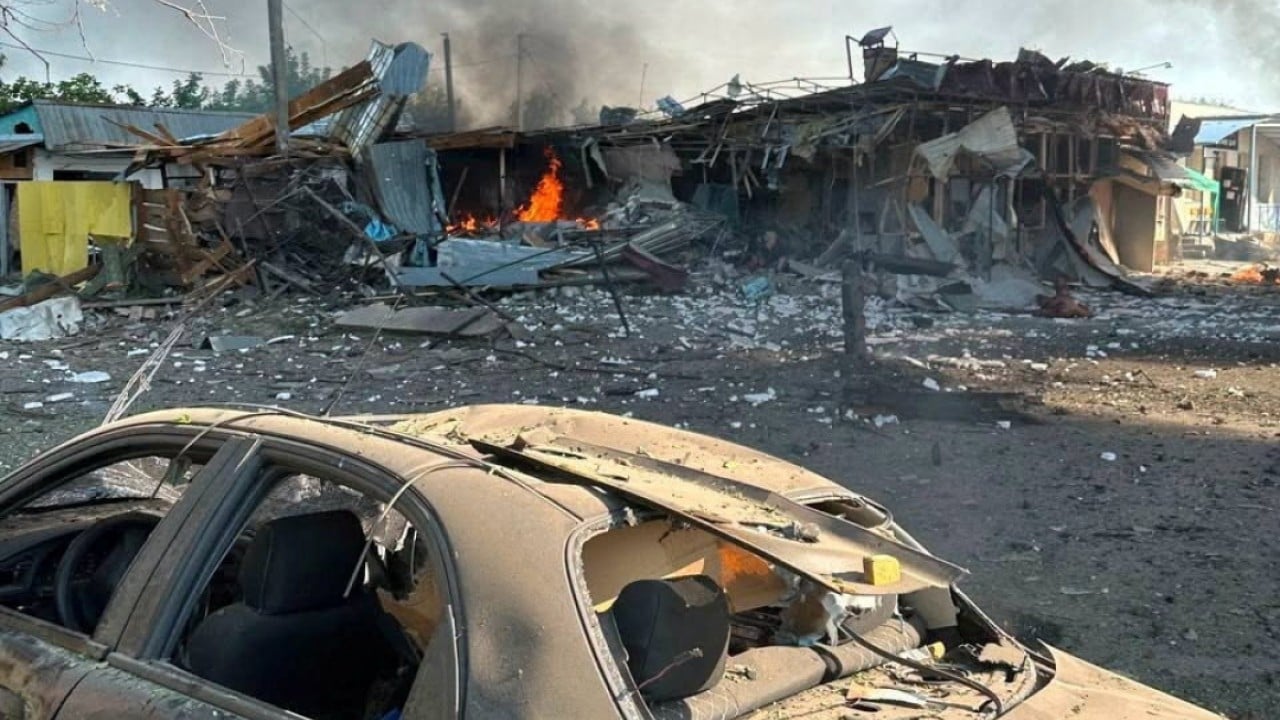
Ten civilians are dead in the northeast corner of Ukraine following a precise missile strike that tore through residential blocks, marking another bloody escalation in a war that refuses to stall. Ukrainian leadership has vowed a direct response, shifting the diplomatic posture from defensive resilience to active retaliation as the casualty count mounts in towns ill-equipped to absorb such devastation.
The immediate aftermath of the strike reveals a chilling operational shift by Russian forces. Rather than targeting heavily fortified military logistics hubs in the east, the command structures behind these bombardments are increasingly punishing population centers in border regions. This pattern suggests a calculated strategy of attrition. Make life unlivable near the front lines. Force mass displacement. Strain an already exhausted civil defense network to its absolute breaking point. For a closer look into similar topics, we recommend: this related article.
Military analysts tracking the trajectory of these munitions point to an escalation in strike frequency over the past quarter. Air defense systems, stretched thin across a thousand-mile front, simply cannot provide blanket coverage for secondary cities. When a ballistic missile or an upgraded glide bomb drops on a residential neighborhood, the warning time is often measured in seconds.
President Volodymyr Zelenskyy addressed the latest casualties with sharp urgency, signaling that the promised response will not be purely symbolic. Behind closed doors in Kyiv, military planners are weighing how to strike back against the launch sites inside Russian territory without violating the fragile, heavily scrutinized parameters set by Western allies regarding weapon usage. For additional details on this development, extensive reporting can also be found on The Washington Post.
The Logistics of Terror
To understand why a strike killing ten people commands such intense geopolitical focus, one must examine the broader architecture of this war. It is not merely a clash of armored columns across muddy fields. It is a war of economic and psychological exhaustion.
When a regional center is hit, the shockwaves ripple far beyond the immediate blast radius. Hospitals in neighboring districts flood with wounded civilians. Power grids, already battered by systematic winter campaigns, absorb additional structural damage. Emergency services operate under the constant threat of a double-tap strike, a brutal tactic where a second missile hits the exact same location minutes after the first responders arrive to pull survivors from the rubble.
Every single one of these attacks chips away at the social fabric holding wartime communities together. Local administrations face an impossible choice. Evacuate families to safer western provinces where housing is scarce and employment is virtually nonexistent, or watch them live in cellars beneath the constant screech of incoming artillery.
Yet, despite the mounting human toll, the resolve on the ground remains defiant. Interviews with local residents in the northeastern sector reveal a grim fatigue, but remarkably little appetite for territorial concessions. They have seen what occupation brings. Bucha, Izyum, and Mariupol are not distant historical events for these people; they are blueprints of subjugation that every family is determined to avoid.
Shifting Strategic Horizons
The vow to respond carries immense operational risk. Ukraine lacks the strategic depth of its adversary. Every drone sent across the border or artillery shell fired in counter-battery operations must be accounted for against a backdrop of fluctuating foreign aid packages and domestic manufacturing bottlenecks.
Defense sector insiders note that domestic production of long-range strike drones has scaled significantly over the past year. Kyiv is no longer entirely dependent on Western-supplied missile systems to project power beyond its borders. These homegrown platforms offer a workaround to export restrictions, allowing operators to target oil refineries, logistics depots, and airfields deep within Russian territory.
However, retaliation breeds escalation. Each successful Ukrainian drone strike inside Russia provides the Kremlin with fresh propaganda material to justify mobilization waves and sustained missile campaigns against Ukraine's civilian infrastructure. It is a vicious, self-perpetuating cycle with no diplomatic off-ramp in sight.
International partners watch these developments with growing anxiety. Capitals in Washington and European capitals walk a tightrope, wanting to see Ukraine defend its sovereignty effectively while desperately trying to avoid a direct military confrontation between NATO and Moscow. The restrictions on using Western-provided weapons for deep strikes remain a point of bitter contention between Kyiv and its benefactors.
The Human Cost Behind the Statistics
Numbers sanitize tragedy. Ten dead. Dozens wounded. Buildings reduced to jagged concrete skeletons. Behind each of those figures is a shattered family, a derailed career, a lifetime of accumulated memories incinerated in a fraction of a second.
In the local morgue, volunteers sort through personal belongings recovered from the wreckage. A child's schoolbook. A wedding ring. A half-packed suitcase by the door. These artifacts tell the true story of a population caught in the crosshairs of geopolitical ambition.
The psychological burden borne by emergency workers is equally staggering. Firefighters and paramedics who pull children from collapsed masonry day after day do not have the luxury of political debate. They work in the smoke and dust, acutely aware that the next siren could herald a second incoming warhead designed specifically to kill them.
As the smoke clears over the northeast, the rhetoric from Kyiv is clear. The response will come. Whether it alters the strategic balance on the battlefield or merely triggers another round of retaliatory strikes remains the defining question for a region trapped in the grinding gears of modern total war.