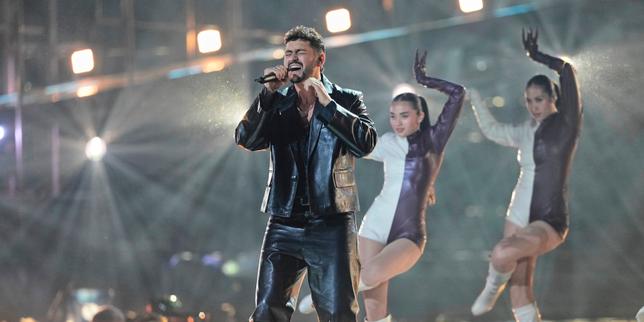
The European Broadcasting Union is facing an existential reckoning at the 70th edition of the Eurovision Song Contest in Vienna. While organizers intended for the event at the Wiener Stadthalle to be a grand celebration of European unity under the banner "United by Music," Israel’s continued participation has instead triggered an institutional crisis that threatens the very survival of the world's largest live music competition. More than 1,100 musicians and cultural workers have launched a fierce boycott campaign, exposing deep fractures within public broadcasting and revealing that the contest's long-claimed political neutrality has become entirely untenable.
This is no longer a temporary PR headache. It is an operational and structural collapse. The inclusion of Israel amid the ongoing conflict in Gaza has shattered the delicate illusion that a massive cultural broadcast can exist in a vacuum, isolated from global geopolitics.
The Neutrality Illusion Under Siege
For decades, the European Broadcasting Union (EBU) has shielded itself behind a strict interpretation of its rulebook. The official stance remains firm: Eurovision is a non-political competition between public broadcasters, not governments.
That defense is failing. The scale of the current backlash from artists, fans, and internal staff has stripped away the organization's diplomatic armor. By insisting that the stage remains strictly artistic, the EBU has inadvertently amplified the political noise it desperately sought to avoid.
The boycott movement is gaining momentum, drawing signatures from high-profile cultural figures across the continent who argue that allowing Israel to compete normalizes actions that are currently under intense international scrutiny. For these artists, a performance on the Vienna stage is not just entertainment. It is an implicit endorsement of the status quo.
Public broadcasters are caught directly in the crossfire. Management teams in several participating nations are facing severe internal pressure from their own creative staff, many of whom are demanding that their networks pull out entirely or risk permanent reputational damage.
A Double Standard in Public Broadcasting
The core of the frustration among critics lies in a glaring historical precedent. In 2022, following the invasion of Ukraine, the EBU moved swiftly to expel Russia from the competition.
The decision was hailed at the time as a moral victory. Today, it serves as a compounding logistical and ethical nightmare for the executive committee. By banning Russia, the EBU shattered its own foundational rule of absolute political neutrality, creating a clear precedent that critics are now using as a weapon.
When pressed on why the two situations are viewed differently, the EBU points to the specific institutional independence of the Israeli broadcaster, Kan, contrasted against the state-controlled nature of Russian television networks. To the average viewer and the protesting artists, this nuance feels like legalistic hair-splitting.
The defense is technically accurate according to the EBU charter, but it fails entirely in the court of public opinion. It portrays an organization that is willing to rely on bureaucratic loopholes to avoid making difficult, high-stakes moral determinations.
The Broken Mechanics of the Voting Public
The political tension is fundamentally altering how the competition operates on a structural level. Eurovision has always had regional voting blocks and predictable political alliances, but the current atmosphere has turned the voting process into a high-stakes battleground.
Consider how the audience voting system functions. The introduction of the "Rest of the World" online vote was designed to expand the global reach of the brand. Instead, it has created an easy pathway for organized, highly motivated groups to mobilize mass voting campaigns that have very little to do with musical merit.
A country’s entry can be pushed to the top of the televote leaderboard through targeted digital campaigns, rendering the traditional musical critiques of the national juries completely irrelevant.
This voting dynamic creates a deep operational paradox for the host broadcaster, Österreichischer Rundfunk (ORF). If the public vote heavily favors an entry that a large portion of the live audience rejects, the live broadcast risks being dominated by boos, protests, and visible walkouts.
Managing a stadium filled with thousands of paying fans while ensuring the safety of the performers requires an unprecedented level of security infrastructure, transforming a lighthearted pop music festival into a heavily fortified international summit.
Corporate Backed Silence and Financial Risk
The financial underpinnings of the contest are also showing signs of severe strain. Eurovision relies heavily on major international corporate sponsorships to fund its massive, high-tech production values.
These brands pay premium rates for uncontroversial, family-friendly exposure. The current controversy has completely upended that value proposition.
Corporate sponsors are finding themselves targeted by consumer boycott campaigns, forcing brand managers to reconsider the wisdom of linking their logos to an event marred by geopolitical strife. While no major sponsor has publicly pulled out of the Vienna event at the eleventh hour, the behind-the-scenes conversations tell a completely different story.
Marketing executives are demanding strict assurances that their branding will not appear alongside politically charged moments during the live broadcast, putting immense pressure on directors to tightly control the television feed.
The commercial risk extends far beyond corporate sponsorships to the long-term viability of the Eurovision brand itself. If the contest becomes synonymous with bitter political division rather than musical entertainment, its value as a premier broadcasting property will drop significantly.
Public broadcasters, already facing severe budget constraints and political scrutiny at home, cannot easily justify spending millions of Euros on an annual event that alienates large segments of their national audiences.
No Clean Exit for the EBU
There is no simple policy fix or quick administrative solution that can resolve this crisis. If the EBU yields to the pressure and disqualifies Israel, it faces immediate legal action for violating its own charter, alongside accusations of giving in to political blackmail.
If it maintains its current course, it faces a slow, agonizing erosion of its cultural authority, marked by artist defections, public protests, and declining television viewership.
The institutional machinery of the EBU was built for a different era, a time when European public broadcasters could maintain a monopoly on cultural narratives. In a highly fragmented, politically polarized media ecosystem, that control has vanished.
The crisis in Vienna has proven that the EBU can no longer manage the intense geopolitical forces that its platform attracts, leaving the future of the 70-year-old contest hanging in a precariously balanced uncertainty.