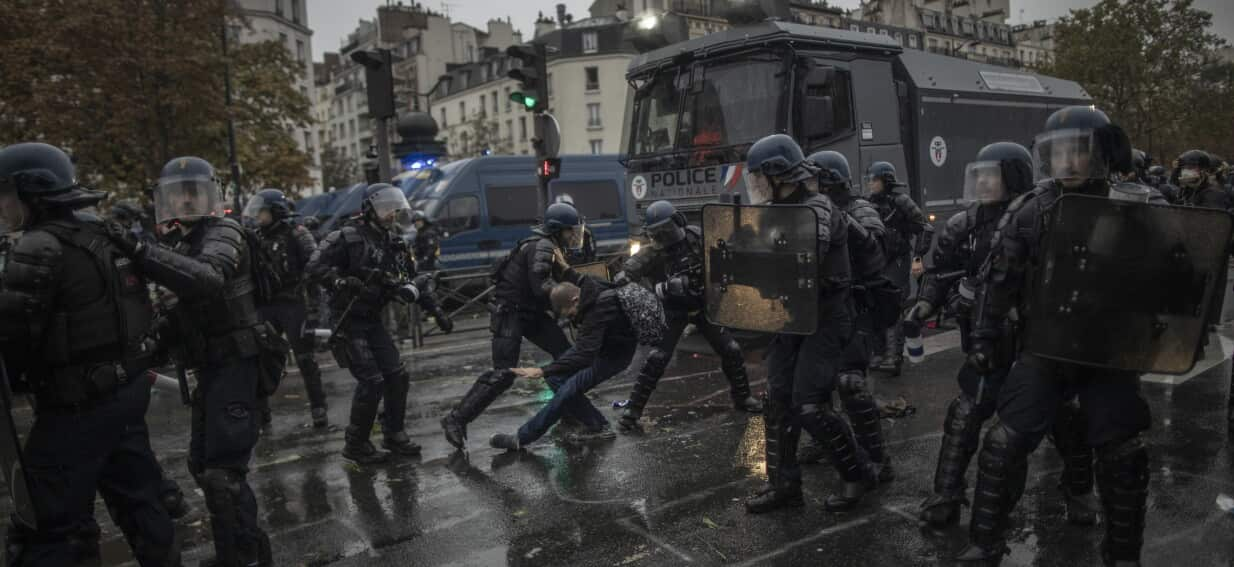
Nearly 1,000 people were taken into custody across France as fresh clashes tore through major cities, turning commercial boulevards into scorched corridors of shattered glass and tear gas. The arrests represent an aggressive tactical escalation by the Ministry of the Interior, deploying tens of thousands of riot police and specialized units to choke off demonstrations before they coalesce. Yet, looking strictly at the arrest tally misses the broader mechanical failure at play. Street-level containment treats a systemic rupture as a simple policing problem, guaranteeing that the underlying volatility will resurface the moment the curfews lift.
When breaking news headlines focus entirely on the raw number of detainees, the public gets a distorted picture of civil unrest. In France, a mass arrest figure is rarely a metric of restored order. More often, it is a symptom of preventive policing strategies that sweep up demonstrators, bystanders, and opportunists alike in wide-net kettling operations.
To understand why French cities repeatedly erupt into nights of burned vehicles and looted storefronts, you have to look past the immediate spark—whether it is a contested piece of legislation, an economic squeeze, or a fatal police encounter—and examine the machinery of French protest itself.
The Anatomy of Modern French Street Policing
French crowd control doctrine has undergone a quiet, controversial transformation over the last decade. Historically, the Compagnies Républicaines de Sécurité (CRS) and the Gendarmerie Mobile operated on a philosophy of distance. Their primary objective was to keep protesters and officers physically separated, absorbing the energy of a march while protecting key state institutions.
That doctrine is largely dead. Today, the state relies heavily on rapid-intervention motorized units, most notably the BRAV-M (Brigades de Répression de l'Action Violente Motorisées). Operating in pairs on motorcycles, these officers are designed for speed, direct contact, and immediate dispersion.
The shift from containment to aggressive contact changes the physics of a demonstration.
When police move in quickly to fracture a crowd, they eliminate the buffer zone that traditionally allowed peaceful marchers to separate themselves from militant factions. A hypothetical example illustrates this dynamic clearly: imagine a plaza holding five thousand peaceful demonstrators alongside two hundred individuals intent on property destruction. Under older containment models, police ringed the perimeter, isolating the plaza until the crowd dispersed. Under modern rapid-intervention tactics, tear gas and baton charges hit the center of the plaza simultaneously, triggering panic among the five thousand peaceful participants while giving the two hundred agitators chaotic cover to scatter into side streets and target unguarded storefronts.
The Legal Dragnet
The surge toward 1,000 arrests in a single wave of unrest relies on specific provisions within the French penal code, particularly laws targeting groupements en vue de commettre des violences—gathering with the intent to commit violence.
This statute gives law enforcement broad latitude. Officers do not need to catch an individual throwing a projectile or smashing a window to make an arrest. Merely being present in an area where violence is occurring, or carrying items deemed potential weapons—which can range from actual incendiaries to swimming goggles worn to protect against tear gas—is sufficient grounds for detention.
- Preventive Custody: Individuals are frequently held for 24 to 48 hours in garde à vue without formal charges ever being filed.
- Administrative Deterrence: The primary goal of mass detention during peak unrest is often simply to keep people off the streets for the next forty-eight hours, effectively breaking the momentum of consecutive nights of rioting.
- Judicial Bottlenecks: Fast-track court hearings, known as comparutions immédiates, process detainees within days, frequently resulting in swift prison sentences that critics argue prioritize deterrence over individualized justice.
Why Traditional Unions and Political Parties Lost Control
For decades, French civil unrest followed a predictable choreography. Major trade unions like the CGT or CFDT organized the route, deployed their own internal security marshals, negotiated with the local police prefecture, and ensured the march ended at a designated square. Even when tensions ran high, the state had an identifiable leadership structure to negotiate with behind closed doors.
That intermediary layer has eroded.
The modern wave of French unrest is largely leaderless, horizontal, and organized through encrypted messaging apps and ephemeral social media networks. When calls to gather circulate on Telegram or Snapchat, there are no union marshals keeping the march on a predetermined boulevard. There is no central committee the Élysée Palace can invite to a roundtable to call off the strikes.
This decentralization creates a profound vulnerability for the state. Without recognized leaders, protests do not have an off-switch. A single night of heavy policing might clear the streets of Paris, Lyon, or Marseille by 3:00 AM, only for decentralized groups to coordinate entirely new flashpoints in suburban commercial zones the following evening.
The Geography of Grievance
To reduce these clashes to simple criminality is to ignore the stark spatial divide that defines modern France. While international television cameras inevitably gravitate toward burning barricades near iconic Parisian landmarks, the most sustained damage and highest arrest rates frequently occur in the banlieues—the working-class suburbs ringing major cities—and in mid-sized regional towns that rarely make global headlines.
These areas share a specific set of economic and social pressures that predate the latest news cycle by decades.
Chronic underinvestment in public transit leaves suburban residents physically isolated from urban job centers. High youth unemployment runs parallel to aggressive, everyday identity checks by local police, creating a generational reservoir of resentment toward state uniforms. When a national crisis hits, the police station, the municipal library, and the local tram line become immediate targets because they are the only visible representatives of a state perceived as punitive rather than supportive.
The Commercial Toll
The economic fallout of sustained street clashes extends far beyond the immediate cost of municipal repairs. Small business owners, independent pharmacies, and local grocers bear the brunt of the physical destruction.
Unlike multinational luxury brands on the Champs-Élysées, which possess deep insurance reserves and private security infrastructure, a neighborhood shopkeeper in a working-class district faces existential financial ruin when a storefront is gutted. Insurance premiums in high-risk zones have climbed steadily following repeated waves of unrest over the past several years, leaving many merchants underinsured or unable to secure coverage against civil commotion altogether.
The Media Feedback Loop and Tactical Escalation
Modern civil unrest does not happen in an information vacuum. Every baton swing, burning barricade, and shattered storefront is filmed from dozens of angles and uploaded within seconds. This real-time documentation drives an escalation cycle between protesters and the state.
For militant factions, viral footage of burning police vehicles or overwhelmed officers serves as both propaganda and a recruitment tool, signaling that the state's monopoly on force is fragile. For the government, those exact same images represent a political crisis.
French presidents and interior ministers live in perpetual fear of looking weak. In a polarized political environment where hard-right and hard-left opposition figures weaponize every image of disorder, the executive branch feels compelled to respond with overwhelming visual force. Deploying armored vehicles, helicopters, and thousands of heavily armed officers is as much a political performance for anxious voters watching the evening news as it is a tactical necessity on the ground.
This dynamic traps both sides in an escalating spiral. The state increases officer deployments and lowers the threshold for arrests to project strength; demonstrators adopt more mobile, hit-and-run tactics to evade the dragnet, shifting the conflict away from fortified government buildings and into softer, unguarded residential and commercial neighborhoods.
What the Arrest Numbers Actually Hide
When the Ministry of the Interior releases a figure approaching 1,000 arrests, it presents a clean, quantifiable metric of state action. Numbers provide the illusion of control. Yet, if you examine the judicial aftermath of past mass-arrest events in France, a very different picture emerges.
A substantial percentage of individuals swept up in mass detentions are ultimately released without charge due to insufficient evidence linking them to specific criminal acts. The arrests serve a short-term tactical purpose—clearing the streets for the night—while creating long-term legal and social blowback.
- Radicalization of Bystanders: A young person with no prior criminal record who spends forty-eight hours in a cramped holding cell after being caught in a police kettle rarely emerges with greater respect for state institutions.
- Resource Exhaustion: Processing nearly a thousand detainees requires pulling thousands of judicial police officers, prosecutors, and court clerks away from investigating violent crime, fraud, and organized trafficking.
- Erosion of Public Trust: Independent human rights monitors, including the Council of Europe and France's own Defender of Rights (Défenseur des droits), have repeatedly warned that disproportionate force and mass preventive arrests erode democratic norms.
The Structural Deadlock
France is caught in a repeating cycle where street confrontation has become the primary language of political negotiation. When parliamentary mechanisms feel unresponsive—particularly when major reforms are pushed through using constitutional bypasses like Article 49.3—citizens increasingly view extra-parliamentary disruption as the only lever capable of forcing the government to listen.
Meanwhile, the state views any concession made in the face of street violence as a fatal blow to republican authority.
This standoff leaves almost no room for de-escalation. Police unions demand even broader legal protections and heavier equipment, arguing their officers are being used as human shields to absorb the failures of decades of social policy. Civil liberties groups demand the dismantling of aggressive motorized units and a return to community policing, arguing that current tactics pour gasoline on every spark.
Until the underlying mechanisms driving this alienation are addressed—from policing doctrine and judicial accountability to economic isolation in the suburbs—mass arrests will remain a temporary sedative administered to a chronic condition. The streets will eventually be swept, the burned-out cars will be towed away, and the arrest totals will fade from the front pages, leaving the exact same combustible conditions waiting quietly beneath the asphalt for the next match.



