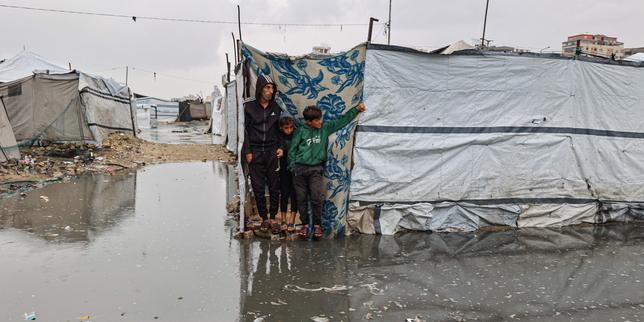
Torrential seasonal rains have submerged tens of thousands of makeshift shelters across the Gaza Strip, leaving displaced families standing in freezing water mixed with raw sewage while humanitarian logistics remain gridlocked. What standard news dispatches frame as a sudden weather emergency is actually a predictable engineering and supply-chain failure months in the making. When an urban environment loses its municipal drainage grid, strips away its absorbent topsoil, and forces over a million people into thin nylon tents on compacted coastal sand and rubble, winter storms do not merely wet the ground. They turn displacement camps into toxic retention basins.
The numbers tell a stark story, though precise field assessments remain notoriously difficult amid ongoing security restrictions and damaged communications networks. Aid agencies operating on the ground estimate that hundreds of thousands of people live in temporary encampments that fail basic winterization standards. Canvas tarpaulins, plastic sheeting salvaged from agricultural greenhouses, and scrap wood frames were never engineered to withstand Mediterranean squalls. Water pools on flat roofs until the fabric tears. Wind gusts rip stakes out of loose sand.
The Anatomy of a Man-Made Drainage Collapse
To understand why a few days of heavy rain can paralyze entire displacement zones, you have to look beneath the mud. Before the war, Gaza already struggled with chronic stormwater management issues due to rapid urbanization, aging pipes, and dense coastal construction. Every winter, low-lying neighborhoods like Sheikh Radwan in Gaza City experienced seasonal flooding.
Today, that fragile municipal infrastructure is largely gone.
Heavy bombardments, ground operations, and the constant movement of armored vehicles have crushed subsurface storm drains and severed main collector lines. Rubble from collapsed concrete buildings now blocks natural surface runoff paths that once channeled rainwater toward the Mediterranean Sea or inland collection lagoons. Instead of draining away, water hits mounds of pulverized concrete and steel rebar, pooling into stagnant lakes directly inside tented encampments.
Consider what happens in coastal areas like Al-Mawasi, a narrow strip of sand dunes designated as a humanitarian zone where hundreds of thousands of displaced residents have crowded together. Sand drains well under normal conditions, provided the water table sits low enough and the surface remains permeable. When hundreds of thousands of people pack into a tight corridor, foot traffic compacts the sand into a hard, nearly impermeable crust. Add plastic groundsheets, trenches dug around individual tents, and tons of domestic waste, and the natural absorption capacity of the dunes drops dramatically.
When rain falls under these conditions, it follows the path of least resistance—straight through the floor flaps of makeshift shelters.
The Sewage Factor and the Public Health Clock
Water alone ruins blankets, mattresses, and meager food supplies. Water mixed with untreated human waste triggers an immediate epidemiological emergency.
Gaza’s wastewater treatment plants and sewage pumping stations rely on continuous electrical power, replacement parts, and fuel. Without consistent grid electricity or sufficient diesel deliveries, raw sewage overflows from damaged manholes and overwhelmed cesspits into the streets. During dry months, this waste dries into dust or collects in localized puddles. Heavy rainfall acts as a massive hydraulic equalizer, lifting raw sewage out of trenches and spreading pathogens evenly across entire camps.
Families are forced to wade barefoot or in worn plastic sandals through ankle-deep water contaminated with fecal matter. Children sleep on damp foam mattresses soaked in runoff. Epidemiologists and field physicians have repeatedly warned about what follows these exact conditions:
- Acute watery diarrhea and cholera risks: Contaminated water supplies and saturated living quarters accelerate the fecal-oral transmission of enteric bacteria and viruses, posing lethal dehydration risks to infants and the elderly.
- Hepatitis A outbreaks: Overcrowding combined with flooded latrines creates textbook conditions for viral liver infections, which spread silently before symptoms appear.
- Severe respiratory infections and hypothermia: Wet clothing, plummeting nighttime temperatures along the coast, and a lack of dry heating fuel leave malnourished populations vulnerable to pneumonia and cold-weather exposure.
- Skin infections and trench foot: Prolonged immersion in cold, dirty water breaks down the skin barrier, leading to bacterial cellulitis, scabies, and fungal infections that become dangerous without basic antibiotics.
Medical clinics operating out of tents face the exact same flooding. Sterile supplies get ruined. Generators sputter when fuel tanks take on water. Patients arriving for wound care bring mud and contaminated water into treatment areas, complicating infection control for doctors already working without basic surgical consumables.
Why Winterization Aid Keeps Stalling at the Border
Every autumn, humanitarian logistics planners prepare winterization packages. On paper, the solution to seasonal flooding is straightforward: distribute heavy-duty thermal tents, elevated wooden pallets, waterproof groundsheets, drainage piping, sandbags, and cold-weather clothing before the November rains arrive.
In practice, almost every component of a functional winter shelter faces severe bottlenecks.
The core issue comes down to dual-use restrictions, inspection protocols, and severe limitations on commercial and humanitarian truck entries. Items essential for flood mitigation—such as timber beams for framing, metal tent poles, concrete blocks, heavy-duty water pumps, and plastic piping—frequently face delays or outright rejections during border security screenings because authorities classify them as materials that could potentially be diverted for military tunnel reinforcement or rocket fabrication.
Even when shelter materials receive clearance, they compete for limited cargo space against immediate survival priorities. Logistics coordinators face an impossible triage equation every single day. If an agency has clearance for ten trucks, does it load them with wheat flour, trauma kits, and insulin, or does it load them with bulky wooden pallets and rolls of heavy tarpaulin? Food and medicine almost always win that slot.
Meanwhile, the local market inside Gaza has been stripped bare. In previous years, residents could buy plastic sheeting, lumber, or replacement tent canvas from local hardware merchants or agricultural suppliers. Months of blockade conditions, destroyed warehouses, and hyperinflation mean that even when a roll of plastic sheeting surfaces on the informal market, its price exceeds what displaced families who have lost all income can pay.
The Tarpaulin Trap
Many families rely on standard humanitarian tarpaulins distributed months ago during earlier displacement waves. Standard woven polyethylene sheeting degrades rapidly under intense Mediterranean ultraviolet radiation. After six months of summer sun, the plastic fibers become brittle.
The first heavy downpour shreds them.
Replacing degraded tarpaulins across an entire population requires continuous, high-volume supply chains that simply do not exist under current access constraints. Aid workers describe patching torn roofs with duct tape, flattened cardboard boxes, and scraps of clothing—temporary fixes that collapse within hours of sustained rainfall.
The Structural Vulnerability of Repeated Displacement
To grasp the human toll of these floods, you have to account for the cumulative exhaustion of repeated forced evacuations. Very few families in Gaza are experiencing their first displacement. Many have moved five, eight, or ten times over the course of the conflict, fleeing from Gaza City to Khan Younis, from Khan Younis to Rafah, and from Rafah to Al-Mawasi or Deir al-Balah.
Each move strips away assets.
During the first evacuation, families often packed warm winter coats, heavy wool blankets, cooking stoves, and cash reserves into cars or donkey carts. By the fifth or sixth evacuation—often undertaken on foot under active fire—people carried only what they could hold in their arms. Heavy winter bedding and sturdy tools were abandoned along the road.
When the rains hit this winter, families had zero buffer. There were no spare dry clothes packed away in waterproof bags. There were no backup blankets stored at a relative's house across town, because the relative's house had already been reduced to rubble. Once a family's single set of bedding gets soaked by floodwater, they have no way to dry it. High humidity, overcast skies, and a total lack of indoor heating mean wet blankets stay damp for weeks, breeding mold and radiating cold through the night.
What Actually Works in Flooded Displacement Zones
When high-level diplomatic negotiations over ceasefires and border crossings drag on, field engineers and local community leaders are left to improvise flood mitigation with whatever tools remain on the ground.
Traditional humanitarian camp management manuals assume agencies have access to excavators, gravel, geotextile membranes, and municipal waste disposal sites. None of those exist at scale inside Gaza today. Instead, surviving engineers and residents rely on labor-intensive micro-interventions to keep water out of individual living spaces.
Digging perimeter trenches around tents remains the primary defense, though it creates immediate friction in overcrowded camps. When tents sit inches apart, the dirt excavated from one family's drainage ditch often piles up against a neighbor's tent wall, redirecting runoff straight into the adjacent shelter. Without coordinated site-wide grading—which requires heavy machinery and open space—individual trenches simply push water from one desperate family to another.
Rubble clearing offers another partial fix, though it carries severe physical risks. Volunteers and municipal workers use hand tools and buckets to clear crushed concrete from storm drain grates and natural gullies. Yet disturbed rubble frequently conceals unexploded ordnance, unstable concrete slabs, and sharp rebar. Clearing a blocked drainage channel by hand can trigger a collapse or detonate buried munitions.
Sandbagging around low-lying tent clusters helps deflect surface sheets of water, provided families have access to empty flour sacks and dry sand. Even then, without diesel-powered dewatering pumps to move collected water out of low-lying basins and over coastal dunes into the sea, the water eventually seeps back through the sandbags.
The Realities Beneath the Headlines
International coverage of the Gaza floods tends to surge whenever dramatic footage of submerged tents hits broadcast networks, then fades as soon as the skies clear. That news cycle misses the fundamental reality on the ground.
In a standard emergency, a storm passes, sun dries the ground, and recovery begins. In Gaza, the storm merely exposes a permanent structural deficit. The municipal infrastructure required to absorb winter rainfall has been physically obliterated. The commercial supply chains required to import shelter materials remain tightly restricted. The civilian population has been stripped of the financial reserves and physical belongings needed to weather a seasonal climate event.
Until heavy engineering equipment, construction timber, high-capacity drainage pumps, and massive volumes of winterized shelter materials enter the territory without obstruction, every storm system moving off the Mediterranean will produce the exact same result—tens of thousands of families standing in freezing wastewater, watching the last of their dry possessions float away.


