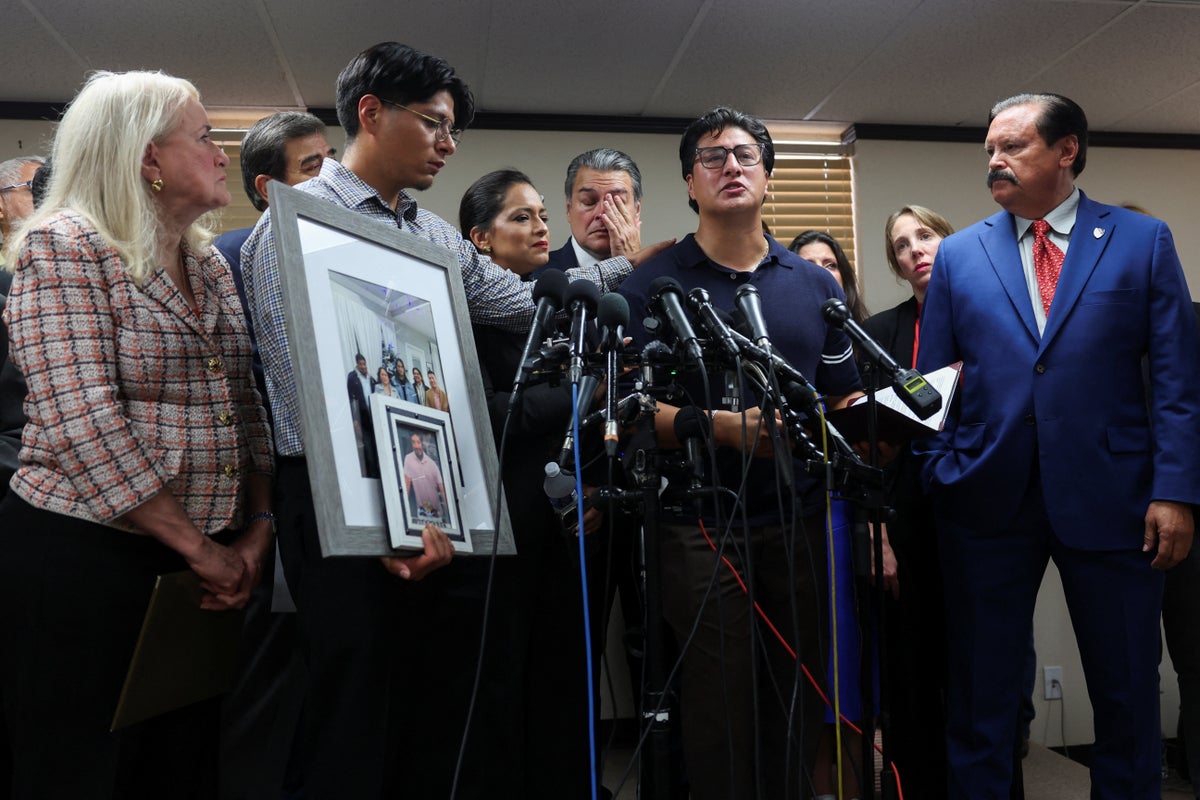
Federal immigration agents shot and killed Lorenzo Salgado Araujo, a 52-year-old homebuilder and father of three, in the middle of a Houston street during what authorities called a routine enforcement operation. The Department of Homeland Security immediately claimed the undocumented Mexican national weaponized his vehicle against officers. Yet, the official narrative rapidly disintegrated as local lawmakers, civil rights groups, and eyewitnesses pointed to a systemic pattern of unaccountable federal violence. This killing marks at least the eighth death in a aggressive federal immigration crackdown, exposing a dangerous lack of transparency, a refusal to deploy body-cameras, and the frequent use of lethal force by federal agents operating with near-total immunity in local communities.
The incident occurred on a Tuesday morning in Magnolia Park, a historic Latino neighborhood in Houston. Salgado Araujo was driving his white work van, picking up his construction crew for a day of building homes in the suburbs. He had lived in the United States for 35 years. He had no criminal record. In fact, he was actively working to secure a legal work permit, having already submitted his biometric scans and fingerprints earlier in the year.
According to federal officials, officers were in the area looking for a different target when they spotted Salgado Araujo's van. They claimed he ignored commands and attempted to ram an officer with his vehicle, prompting the officer to fire in self-defense.
His family tells a completely different story. They believe he was terrified. When unmarked SUVs with tinted windows block a construction worker's van at dawn, the immediate assumption is not federal law enforcement. The assumption is armed robbery. Crew leaders in Houston frequently carry thousands of dollars in cash to pay day laborers and purchase expensive power tools. Salgado Araujo's oldest son, Ronaldo, noted that his father had carefully studied immigration laws and knew exactly how to comply with legitimate law enforcement officers. If he fled or maneuvered his vehicle, it was because he thought he was about to be hijacked by criminals.
The Architecture of the Unmarked Trap
Federal tactical operations in immigrant neighborhoods rely heavily on surprise and anonymity. Officers wear tactical vests that often feature small, easily obscured patches rather than clear, visible insignia. They drive rental-grade, unmarked civilian vehicles. This deliberate lack of visibility creates an environment of intense panic.
A bystander's cell phone video captured the immediate aftermath of the Houston shooting. The footage shows a black SUV angled sharply toward a white van with its doors thrown open. Salgado Araujo is visible on the hot asphalt, handcuffed and bleeding from a gunshot wound to the abdomen, groaning in pain. Surrounding him are federal agents standing over three other handcuffed crew members, including Salgado Araujo's brother.
The three workers were quickly loaded into vehicles and whisked away to federal detention centers. They remain cut off from their families, unable to provide statements to local investigators. This rapid removal of eyewitnesses ensures that the federal government maintains absolute control over the initial narrative.
Local police forces are entirely cut out of the loop during these operations. Harris County District Attorney Sean Teare publicly acknowledged that the community deserves the truth, but noted that federal authorities maintain exclusive jurisdiction over the investigation. This jurisdictional wall prevents local homicide detectives from processing the scene, interviewing the shooters, or securing immediate physical evidence.
The Vehicle Weaponization Blueprint
The justification of an immigrant "ramming" officers is becoming a standard operational defense. Department of Homeland Security statements across multiple states use near-identical language to justify lethal outcomes.
Just six days before the Houston shooting, an ICE agent fired a weapon during an enforcement action in Harrisburg, Pennsylvania, claiming the suspect weaponized his car. Exactly six months prior, an agent fatally shot Renee Good in Minneapolis under remarkably similar circumstances. In March 2025, Ruben Ray Martinez was killed during a traffic stop in Texas, an incident federal authorities managed to keep hidden from the public for nearly a year.
The repetition of this defense points to a structural loophole. Under federal use-of-force guidelines, a moving vehicle can be classified as a deadly weapon, which legally permits an agent to use lethal force. By claiming a driver attempted to ram them, agents establish an immediate legal shield against criminal prosecution.
Independent investigations into past federal operations show that these claims frequently collapse under scrutiny. In several previous shootings across the country, dash-cam footage or private security video eventually revealed that vehicles were either stationary, attempting to slowly maneuver away from unidentified armed men, or moving at speeds that posed no plausible threat to human life. In Houston, however, there is no such footage.
Accountability in the Dead Zone
The Department of Homeland Security confirmed that the officers involved in the Houston shooting were not wearing body-cameras. The agency blamed the lack of equipment on past budget fights and government shutdowns. Local leaders find this explanation entirely unacceptable.
U.S. Representative Christian Menefee noted that if federal agents are entering major American cities to execute high-risk operations without recording devices, it represents a deliberate policy choice rather than a financial constraint. Without video documentation, any investigation becomes a matter of internal review, where the agency effectively grades its own paper.
The Department of Homeland Security has refused to release the name of the officer who fired the fatal shot. They have refused to disclose his disciplinary history, his years of service, or whether he has been placed on administrative leave. This absolute secrecy breeds immense distrust within the community.
On Wednesday night, hundreds of Houston residents marched through the streets of Magnolia Park, starting at the exact spot where Salgado Araujo was shot. They carried signs with his face and chanted for an independent probe. The government of Mexico has also intervened, announcing its intention to seek criminal charges over the deaths of its citizens linked to these aggressive enforcement actions.
The Systemic Fracturing of Trust
The broader fallout of these unchecked operations extends far beyond the tragic loss of a single life. It fundamentally breaks the relationship between immigrant communities and all forms of authority.
When federal agents act like street crews, immigrant families stop reporting actual crimes to local police. Victims of domestic abuse, wage theft, and violent extortion choose silence over the risk of encountering unidentified federal agents. The strategy of aggressive, visible enforcement in residential neighborhoods destroys decades of community policing efforts.
Salgado Araujo was not a fugitive hiding from the law. He was a business owner who had successfully put his three sons through American universities, producing a teacher and two engineers. His case highlights the bitter irony of the current enforcement strategy. The individuals most vulnerable to these aggressive tactics are often those who are actively participating in the formal tax base and attempting to navigate the backlogged legal immigration system.
The family is currently struggling simply to claim Salgado Araujo’s body from the medical examiner. Federal administrative hurdles have turned a period of intense grief into a bureaucratic nightmare. His son Ronaldo stated that the family refuses to let his father be reduced to a simple headline about an undocumented casualty. They want the federal government to answer a fundamental question. Why did a man with no criminal record, who was actively seeking legal status, end up dead on a Houston street for simply going to work?
The investigation remains entirely internal. The Department of Homeland Security has given no timeline for its review, and historical precedent suggests that the findings will remain sealed from public view. Local authorities are powerless to intervene, leaving the family to rely on public protests and congressional pressure to uncover the truth about what happened in the early morning hours in Magnolia Park.