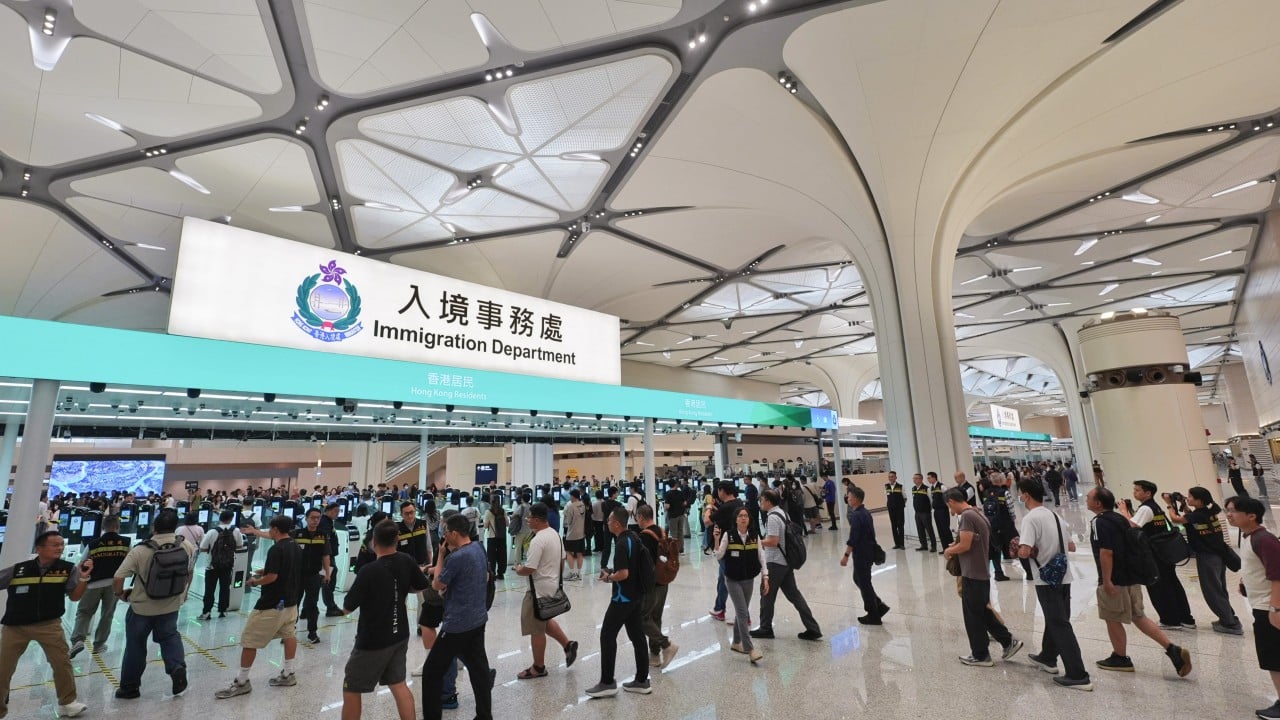
The newly reconstructed Huanggang Port between Shenzhen and Hong Kong has entered its final pressure-testing phase, featuring a massive cross-border simulation involving ten thousand participants to validate a system designed to slash crossing times from thirty minutes down to five. For decades, the old facility stood as a congested bottleneck for bilateral commerce and weary commuters. The modern replacement introduces a radical shift in regional transit architecture. By adopting a co-location model backed by cooperative automated channels, the facility aims to handle up to three hundred thousand daily passengers at peak capacity.
The Mechanics of Co-Location
Under the old operational framework, travelers faced a tedious, multi-step ordeal. Commuters cleared Hong Kong exit immigration, boarded a shuttle bus to cross the Shenzhen River, and queued again to enter the mainland side. That redundancy is gone. The new multi-story terminal building in Futian District merges both jurisdictions under one roof through a legal framework granting the Hong Kong Special Administrative Region operational jurisdiction inside a designated port area. You might also find this similar article insightful: The Death of Just-In-Time: Why Global Supply Chains are Breaking and How Nations are Responding.
Passengers pass through an integrated three-gate automated system. Information verification happens sequentially within a single channel. Once credentials clear at the first checkpoint, subsequent physical gates open simultaneously. This "one queue, one data collection, one release" protocol eliminates duplicate queues and minimizes human intervention.
Vehicle processing receives an equally radical overhaul. Traditional checkpoints required commercial trucks and private cars to stop multiple times for separate agency inspections. The rebuilt crossing implements twenty-eight "Five-in-One" joint inspection lanes. These lanes collect driver and vehicle data simultaneously for five distinct regulatory bodies, allowing vehicles to clear the border in a single stop without occupants needing to disembark. As reported in latest reports by NPR, the effects are worth noting.
Stress Testing the Concrete Reality
Skeptics point out that architectural ambition frequently clashes with operational friction during rush hour. To preempt bottlenecks, regional authorities mobilized ten thousand civil servants in a large-scale operational dry run. Participants tested arrival sequencing via interconnected subway lines, evaluated crowd dispersal from underground transport interchanges, and simulated concentrated surges of foot traffic across the terminal's upper inspection levels.
These trials exposed minor data-handshake delays between backend servers operated by mainland and Hong Kong agencies. Technicians used the exercise windows to recalibrate the network switches governing the synchronization of the three-gate e-channels. Maintaining twenty-four-hour clearance requires absolute redundancy in these digital handoffs. If a single server drops a packet during a midnight shift change, queues quickly spill backward into the concourse.
Economic Gravity and the Greater Bay Area
The architectural footprint reflects deeper economic imperatives. Spanning nearly seven hundred thousand square meters, the facility acts as a physical anchor for the Guangzhou-Shenzhen-Hong Kong Science and Technology Innovation Corridor. Faster transit changes corporate migration patterns. Venture capitalists in Central can reach research laboratories in Futian within minutes, blurring municipal boundaries into a functional daily working circle.
Real estate values and labor markets along the northern New Territories are already reacting to the anticipated opening. Yet, capacity upgrades alone do not solve systemic imbalances in cross-border staffing. Customs authorities must continuously balance automated throughput speeds with security mandates, ensuring that administrative expediency does not compromise regulatory oversight. The success of the rebuilt Huanggang Port ultimately depends less on its sleek stone-and-glass facade and more on how reliably its digital infrastructure holds up under sustained, unyielding pressure.