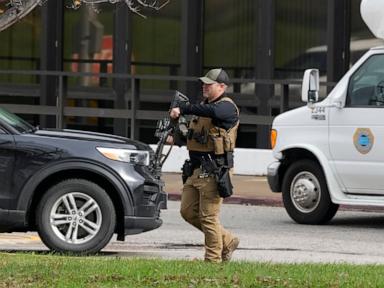
Two United States Postal Service workers were shot inside a facility in Iowa before local law enforcement apprehended the suspect, a fellow postal employee. The incident, confirmed by local police authorities, reignites an uncomfortable examination of workplace violence inside one of America's largest public institutions. While breaking news reports treat the event as an isolated criminal act, the reality inside federal sorting and distribution centers points to deeper systemic vulnerabilities that have persisted for decades.
Breaking news coverage of workplace violence follows a predictable script. Police establish a perimeter. A suspect is taken into custody. Victims are transported to regional trauma centers, and public information officers issue brief statements confirming there is no ongoing threat to the community. What those initial dispatches miss is the operational environment that precedes a crisis. Discover more on a related issue: this related article.
The Anatomy of an Incident in the Heartland
The mechanics of an active shooter event inside a federal postal facility differ sharply from those in public retail spaces. Most people picture a post office as a quiet lobby with a counter, a row of brass P.O. boxes, and a clerk weighing parcels. That is only the storefront. Behind the double doors lies an industrial floor operating on unforgiving deadlines, heavy machinery, and strict federal jurisdiction.
When a shooting occurs in an Iowa post office, the immediate response involves a complex overlap of authority. Municipal police departments and county sheriffs are almost always the first boots on the ground because they patrol the surrounding neighborhoods. However, the moment officers cross the threshold of a postal facility, they enter federal property. Additional analysis by Associated Press delves into comparable perspectives on this issue.
The United States Postal Inspection Service holds primary investigative jurisdiction over crimes committed on postal property or against postal employees. In the critical minutes during and immediately after a shooting, local patrol officers focus on neutralizing the threat and securing medical evacuation for the wounded. Once the suspect is captured, the investigation shifts into a joint federal-local framework. Evidence collection, employee interviews, and digital forensics fall under federal protocols that rarely release granular details to the public until indictments are unsealed.
This jurisdictional handoff explains why early reports often feel sparse. Local police can confirm the basic facts—two coworkers shot, one employee captured—while withholding motive, weapon specifics, and internal disciplinary history. Those details belong to federal prosecutors and postal inspectors.
Why Federal Security Protocols Often Fail the Insider Threat
Every post office in the United States displays prominent signage warning that bringing a firearm onto the property is a federal felony. Under 18 U.S.C. § 930, possessing a dangerous weapon in a federal facility carries strict criminal penalties. Yet signs do not stop bullets.
The core vulnerability in postal facilities is not the angry customer walking in from the street. It is the insider threat.
Processing plants, regional distribution hubs, and local carrier annexes rely on badge access, keypad locks, and employee-only entrances to keep the public out. Those measures are designed to protect the mail stream from theft and external tampering. They do almost nothing to screen the workforce entering the building at 4:00 AM for a sorting shift.
Unlike federal courthouses, military bases, or airport security checkpoints, standard post offices do not operate magnetometers or X-ray screening for employees. Installing airport-style screening at more than 31,000 retail post offices and hundreds of processing centers across the country would require billions of dollars in capital expenditure and thousands of armed security personnel. It would also bring mail delivery to a grinding halt.
Because physical screening is absent, the Postal Service relies almost entirely on behavioral prevention and threat assessment. When an employee brings a weapon onto the work floor, it signals a failure in that human intelligence network long before the first shot is fired.
The Historical Shadow That Never Completely Lifted
You cannot analyze violence inside a postal facility without addressing the phrase that entered the American lexicon in the late twentieth century. The term "going postal" was born out of a string of high-profile shootings between 1986 and 1997, beginning with the Edmond, Oklahoma tragedy where a part-time letter carrier killed fourteen coworkers before taking his own life.
For nearly four decades, management, unions, and independent commissions have studied why postal facilities became flashpoints for workplace violence. The findings have remained remarkably consistent.
In 2000, the National Center on Addiction and Substance Abuse at Columbia University published a landmark commission report on the Postal Service. The commission debunked the myth that postal workers were statistically more violent than workers in other large industries. When adjusted for workforce size, the rate of homicide inside the USPS was actually lower than the national average for other sectors.
However, the commission identified a unique cultural pressure cooker inside postal operations. The organization combined a rigid, quasi-military management structure with an increasingly automated, high-volume workload. Supervisors were often promoted from the craft ranks without adequate training in conflict resolution or human resource management. Grievances piled up by the tens of thousands. Workers felt trapped in jobs with strong federal pensions they could not afford to leave, yet subjected to daily micromanagement they could not escape.
In response to those findings, the USPS overhauled its threat assessment procedures. The agency established Threat Assessment Teams across its districts, bringing together labor relations specialists, medical personnel, postal inspectors, and union representatives to evaluate red flags before they escalated.
For years, those reforms appeared to suppress the frequency of mass-casualty events. Yet the underlying operational stressors never vanished. In many ways, they mutated.
The Modern Pressure Cooker Inside Postal Operations
Walk onto the workroom floor of a mid-sized postal facility in the Midwest today, and the job looks vastly different than it did twenty years ago. First-class letter volume has plummeted, replaced by an avalanche of e-commerce parcels.
Carriers and clerks are no longer just handling envelopes. They are lifting heavy boxes, navigating longer routes, and operating under relentless algorithmic tracking. Every scan, every stationary minute on a street route, and every sorting rate on the floor is measured by handheld scanners and automated tracking software.
Chronic understaffing compounds the strain. Across rural and mid-sized states like Iowa, postal facilities have struggled to retain non-career employees—such as City Carrier Assistants and Postal Support Employees—who often work six or seven days a week with unpredictable schedules before converting to career status. When a facility operates short-handed, mandatory overtime becomes routine. Exhaustion sets in. Minor interpersonal friction between coworkers or disputes over route assignments can quickly turn volatile when everyone on the floor is running on a deficit of sleep.
Management faces its own squeeze. District managers are under constant pressure from headquarters to cut overtime hours, meet strict service standards, and execute sweeping network consolidation plans. When supervisors pass that pressure down the chain without empathy or emotional intelligence, the workroom floor becomes brittle.
The Gap Between Policy and Practice
On paper, the Postal Service maintains a strict zero-tolerance policy toward threats, intimidation, and bullying. Employees are instructed to report concerning behavior immediately, and the Employee Assistance Program offers free, confidential counseling for workers dealing with financial stress, mental health crises, or substance abuse.
In practice, reporting a coworker carries heavy social and professional friction.
Postal facilities often operate like small, insular towns where employees work side by side for twenty or thirty years. Reporting a colleague for erratic behavior or veiled threats can make the reporting employee a pariah on the workroom floor. Furthermore, union stewards and management frequently clash over how disciplinary actions are handled. If management moves too aggressively against an employee based on ambiguous behavior, the union may file a grievance alleging harassment or due process violations. If management moves too slowly out of fear of a grievance, warning signs go unaddressed until violence erupts.
Consider a hypothetical scenario common across industrial workplaces. An employee begins exhibiting sudden mood swings, muttering threats under their breath during morning sorting, and clashing aggressively with a neighboring clerk over bin placement. Coworkers notice the shift, whisper about it in the breakroom, and decide to stay out of the person's way rather than file a formal report. Supervisors, preoccupied with clearing the morning dispatch trucks on time, attribute the behavior to a bad mood. Without a formal trigger, the district Threat Assessment Team never even learns the employee's name.
What Local Law Enforcement Confronts on Scene
When prevention fails and shots ring out, the burden shifts immediately to local police and emergency medical services. In Iowa, as in much of the Midwest, law enforcement agencies train extensively for active shooter scenarios, regardless of whether the target is a school, a manufacturing plant, or a federal building.
Since the Columbine shooting in 1999, police doctrine across the United States has abandoned the old "contain and wait for SWAT" model. Modern patrol officers are trained to enter the building immediately, move toward the sound of gunfire, and stop the shooter as quickly as possible.
Postal facilities present unique tactical hazards during an active response:
- Acoustic distortion: High ceilings, concrete floors, and rows of steel sorting cases cause gunfire to echo unpredictably, making it difficult for entering officers to pinpoint the shooter's exact location.
- Sightline obstructions: Tall mail hampers, rolling wire cages, and stacked pallets create a maze of blind corners where an armed suspect can hide or ambush responding units.
- Lockdown confusion: Exterior doors that automatically lock behind exiting employees can inadvertently lock responding officers out if keycards or master keys are not immediately available at the perimeter.
- Evacuation bottlenecks: Loading docks and narrow administrative corridors can become congested as terrified workers attempt to flee while tactical teams push inward.
Capturing a suspect alive inside such an environment requires disciplined tactical movement and rapid communication between dispatchers, fleeing employees, and arriving officers. When police successfully apprehend a shooter on scene without further loss of life, it reflects rigorous local tactical training—not the adequacy of the building's physical defenses.
The Aftermath Nobody Covers
Once the crime scene tape comes down and the news vans pack up their satellite dishes, the hardest phase begins for the surviving workforce.
Unlike a private corporation that can shut down an office branch for weeks or relocate staff to a nearby high-rise, the United States Postal Service cannot stop delivering the mail. Universal service is a federal mandate. Within days—sometimes within hours—operations at an affected facility must resume, or routes must be absorbed by neighboring offices.
Workers are asked to walk back onto the exact floor where their colleagues were shot. They walk past the same sorting cases, clock in at the same timecards, and load the same trucks. While the agency deploys crisis counselors to the site immediately following a shooting, the long-term psychological toll often surfaces months later. Post-traumatic stress does not follow a neat fiscal schedule.
Meanwhile, the legal process grinds forward at a federal pace. Prosecutors build cases around felony assault, attempted murder, or homicide charges, alongside federal weapons violations. The defendant undergoes competency evaluations, pretrial motions stretch across calendars, and the public's attention moves on to the next headline.
Unanswered Questions That Demand Scrutiny
Every workplace shooting leaves behind a trail of institutional questions that extend beyond the criminal guilt of the individual pullng the trigger. As federal investigators reconstruct the timeline of the Iowa shooting, accountability hinges on what was known before the weapon was brought through the doors.
Did the suspect have a prior disciplinary record or documented disputes with the two injured coworkers? Were supervisors aware of any escalating behavior, and if so, was the district Threat Assessment Team activated? Were staffing shortages or mandatory overtime schedules contributing to heightened tension inside that specific facility in the weeks leading up to the attack?
Answers to those questions rarely surface in press releases. They emerge only through persistent oversight, Freedom of Information Act requests, union safety audits, and congressional scrutiny.
A federal badge or a postal uniform should never come with the unspoken risk of dodging gunfire on the workroom floor, yet until the operational pressures and reporting blind spots inside these facilities are confronted directly, warning signs will continue to slip through the cracks until sirens are the only response left.