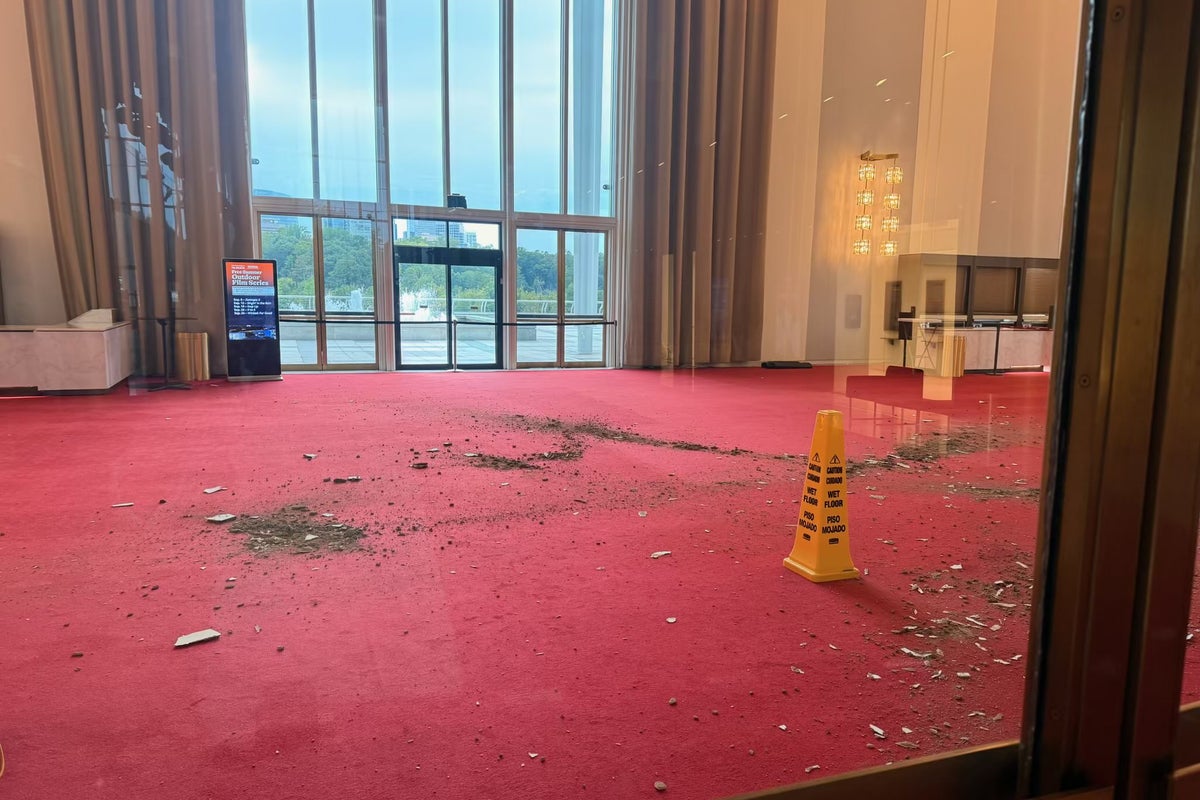
A sudden fracture in the plaster of the Grand Foyer at the John F. Kennedy Center for the Performing Arts did more than just litter a red carpet with debris. It blew open a high-stakes political and legal brawl. When a section of the ceiling gave way during a Washington rainstorm, it provided the institution's Trump-aligned board with immediate ammunition. They are using the structural failure to argue for an immediate two-year shutdown and a $250 million overhaul championed by President Donald Trump.
This incident is not merely an engineering mishap. It serves as a tactical flashpoint in an ongoing war over institutional control, architectural legacy, and executive power in the nation's capital.
The Anatomy of the Collapse and the Immediate Spin
The collapse occurred on a Friday evening. Heavy storms battered the District of Columbia, and moisture found its way into vulnerabilities within the building’s aging envelope. A chunk of the high ceiling in the main hallway connecting the venue's three primary auditoriums crashed down. Miraculously, no one was walking the red carpet at that precise moment, and injuries were averted.
Within hours, the public relations machinery surrounding the venue's leadership mobilized. Roma Daravi, the vice president for public relations, pointed directly to the incident as proof that a multi-year shutdown is non-negotiable. Public statements blamed the failure on decades of deferred maintenance and neglect by prior leadership.
Yet, community groups and legal watchdogs view the timing with intense skepticism. Critics suggest that an isolated water-intrusion event is being weaponized. The goal? To force the hand of federal judges who have previously pump-braked the administration's aggressive physical and administrative restructuring of the landmark.
The Legal Quagmire Surrounding the Monument
To understand why a fallen piece of plaster triggers a federal standoff, one must look at the courtroom battles unfolding just blocks away. The Trump-backed board has been aggressively pushing a twofold agenda: shuttering the facility for extensive reconstruction and embedding the president’s name permanently into the monument's exterior fabric.
Earlier in the year, U.S. District Judge Christopher Cooper ruled that the administration added Trump’s name to the facility illegally. The court ordered the text removed and blocked the planned closure. Undeterred, the board voted in August to reintroduce an inscription framing the multi-million dollar overhaul as a personal gift of restoration from the executive branch. Justice Department attorneys have maintained a blunt economic argument in court. They claim private donations earmarked for the facility will dry up entirely unless the president’s name remains emblazoned on the facade.
Against this backdrop of injunctions and legal briefs, a ceiling failure becomes more than maintenance. It transforms into a convenient evidentiary exhibit for a board eager to prove that the judiciary is endangering public safety by delaying construction.
Decades of Deferred Maintenance Meet Executive Ambition
Federal cultural properties occupy a precarious financial ecosystem. They rely on a hybrid model of congressional appropriations, ticket sales, and philanthropic endowments. When budgets tighten or political priorities shift, preventive maintenance is often the first expenditure quietly deferred.
The Kennedy Center opened its doors in 1971. More than five decades of thermal expansion, heavy foot traffic, and Washington's notoriously humid climate have taken a heavy toll on its concrete, stone, and plaster systems. Engineers note that flat roofs and expansive glass facades, iconic signatures of mid-century brutalist and formalist architecture, are notoriously difficult to waterproof permanently.
When a severe storm hits, minor vulnerabilities in aging flashing or sealant fail quickly. Water migrates behind decorative surfaces, weakening plaster bonds until gravity takes over.
The current administration's proposal seeks a radical $250 million transformation. But preservationists and local neighborhood associations worry that the sweeping architectural adjustments go far beyond fixing leaks. They argue the renovation is a pretext for ideological rebranding. The recent sudden removal of external art installations, such as the late sculptor Joel Shapiro’s prominent stick-figure piece "Blue," has only heightened anxiety that the center's cultural identity is being systematically scrubbed.
The Broader Landscape of Capital Redesigns
This fight does not happen in a vacuum. It forms a single tile in a much larger mosaic of physical restructuring across Washington.
The second-term agenda for the administration has made reshaping the federal city a primary objective. Initiatives include the demolition of the White House East Wing to construct a massive state ballroom, plans for a colossal triumphal arch near Arlington National Cemetery, and major alterations to golf properties along the Potomac River corridor. Each project follows a similar playbook. Executive vision clashes with historical preservation laws, local municipal oversight, and federal court resistance.
For the Kennedy Center, the stakes involve the nation's living memorial to a slain president. Turning a routine structural failure into a political referendum on executive leadership guarantees that every leak, crack, and crumbling tile will be parsed through a partisan lens.
As the legal teams return to federal court and judges weigh whether to honor the board's latest resolutions, the Grand Foyer remains partially cordoned off. The debris has been swept from the red carpet, but the underlying fractures within the institution's governance remain wide open.