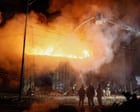
When Russian missiles hit Ukraine’s energy grid, the lights in Kyiv go out instantly, yet the real crisis begins minutes later when the taps run dry. Blackouts and water shortages in Kyiv are not two separate emergencies caused by random collateral damage. They are the predictable result of a deliberate military strategy targeting the thermodynamic and hydraulic choke points of a Soviet-built metropolis. By destroying centralized thermal power plants and high-voltage substations, Moscow is exploiting the hidden dependency of modern urban infrastructure on continuous electrical frequency. Without megawatts to drive massive municipal pumping stations, gravity takes over, draining high-rise apartments and crippling district heating loops before a single pipe freezes.
Most coverage of the strikes on Ukraine’s energy grid treats the loss of electricity and the loss of running water as parallel inconveniences. That framing misses the engineering reality on the ground. Water does not flow through a city of three million people by magic or simple elevation. It moves because industrial-grade electric motors push millions of gallons through hundreds of miles of aging cast-iron and steel mains every hour. When a cruise missile or a drone swarm takes a 330-kilovolt substation offline, the grid loses its ability to balance load and generation. Automated protection relays trip across the region to prevent catastrophic transformer burnouts, and the municipal water utility loses its heartbeat in less than sixty seconds.
The Invisible Tether Between Megawatts and Municipal Pipes
To understand why a strike miles outside the city center leaves a resident on the sixteenth floor of a Kyiv apartment block without water, you have to look at hydraulic head and urban elevation. Kyiv sits on hilly terrain along the Dnieper River, with significant elevation changes between the riverbanks and the residential districts on the right bank. The city’s water utility, Kyivvodokanal, relies on a tiered system of intake stations, treatment facilities, and booster pumping stations to maintain pressure across these gradients.
Consider a hypothetical example of a standard twenty-story Soviet-era residential tower in the Obolon or Pozniaky district. Municipal water pressure at street level might be sufficient to push water up to the fourth or fifth floor under residual gravity pressure from elevated reservoirs. Everything above that relies entirely on local booster pumps located in the basement of the building or at a neighborhood distribution hub. Those pumps run on three-phase alternating current. The moment the grid drops, those pumps stop spinning. The water column inside the building’s vertical risers immediately loses upward momentum. Within minutes, anyone on the lower floors who opens a tap drains the remaining water trapped in the upper pipes, creating a vacuum that empties the building from the top down.
The engineering problem goes far beyond mere inconvenience. When municipal water mains lose positive pressure, they become vulnerable to contamination. Groundwater and soil bacteria can seep into aging pipes through microscopic cracks and degraded joints that normally stay sealed by outward water pressure. Once power is restored, utility crews cannot simply flip a switch and tell residents to drink from the tap. They must slowly repressurize the network to avoid water hammer—a destructive pressure surge that ruptures weakened pipes—and then flush and chlorinate the lines to prevent waterborne disease outbreaks.
Why Centralized Soviet Infrastructure Is a Double-Edged Sword
Kyiv’s vulnerability is rooted in the mid-twentieth century. Soviet urban planners built cities for maximum industrial efficiency, relying on massive, centralized combined heat and power plants known as CHPs. Facilities like CHP-5 and CHP-6 in Kyiv were designed to burn natural gas or coal to generate electricity while simultaneously pumping superheated water through insulated underground mains to warm hundreds of thousands of apartments.
In peacetime, this centralized model is remarkably efficient. In wartime, it presents a small number of high-value, immobile targets. You do not need to destroy every power line in Kyiv to plunge the city into darkness and cold; you only need to hit the transformers and turbine halls at a handful of major generation and transmission nodes.
The Cascading Failure of District Heating
The link between electricity, water, and heat creates a terrifying winter countdown for Ukrainian engineers. District heating systems are closed-loop hydraulic networks. Water is heated at a central plant and pushed through miles of pipes by massive circulation pumps. If the electricity fails during sub-zero temperatures, those pumps stop. Static water inside above-ground pipes and poorly insulated building risers begins to cool rapidly.
If engineers do not drain the entire heating system before the water reaches freezing point, the water expands as it turns to ice, splitting radiators, valves, and underground mains open. Draining a district heating loop saves the pipes from destruction, but it means the building cannot be reheated quickly when power returns. Refilling, venting air locks, and reheating a massive municipal loop takes days of painstaking manual labor by overstretched utility crews.
Inside the Battlefield of Grid Restoration
While the public sees the blackouts, an invisible war of attrition is fought inside Ukraine’s energy control rooms. Operating a damaged power grid is vastly more difficult than operating an intact one. An electrical grid must maintain a precise frequency of 50 Hertz at all times. Generation must match consumption down to the second.
When Russian strikes knock out a major power plant or sever a high-voltage transmission line, the sudden loss of supply causes the grid frequency to plummet. If the frequency drops too far, generators across the country will automatically disconnect to protect themselves from physical damage, triggering a nationwide total blackout. To prevent this, grid operator Ukrenergo executes emergency load shedding—deliberately cutting power to specific districts in Kyiv and surrounding regions to keep the core grid alive.
The Transformer Bottleneck
The most critical piece of equipment on the battlefield is not a tank or an artillery piece; it is the autotransformer. These massive, oil-filled steel structures step ultra-high-voltage electricity down to levels that regional distribution networks can handle. A single unit can weigh over two hundred tons, costs millions of dollars, and takes months to manufacture in specialized factories.
Russian targeting analysts know this. Rather than wasting missiles on easily repaired power lines, they aim directly for the transformer yards at 330-kilovolt and 750-kilovolt substations. When a missile warhead punctures a transformer tank, the cooling oil ignites, creating an intense fire that melts the internal copper windings. You cannot patch a melted transformer with spare wire. It has to be hauled away on specialized heavy-rail cars and replaced entirely, assuming a replacement even exists in global stockpiles.
The Human and Economic Toll on the Ground
For residents in Kyiv, the rhythm of daily life is dictated by outage schedules and water conservation routines. Every apartment becomes a miniature survival depot. Bathtubs are kept filled with gray water for flushing toilets. Five-liter plastic jugs of drinking water line hallways and balconies. High-capacity lithium power stations and inverter batteries sit wired into apartment breaker boxes, humming quietly during the hours when the municipal grid goes dead.
Small businesses bear a crushing financial burden. Cafes, grocery stores, pharmacies, and dental clinics cannot operate without power and running water. Diesel and gasoline generators line the sidewalks of central Kyiv, creating a constant, low-frequency roar and filling street canyons with exhaust fumes. Running a commercial generator costs roughly three to four times more per kilowatt-hour than buying electricity from the grid. Those costs are passed directly to consumers through higher prices for basic goods, compounding the economic strain of a prolonged war.
High-rise residential buildings have had to form impromptu micro-utilities. Homeowners’ associations pool money to buy industrial diesel generators solely to power the building’s water booster pumps and at least one elevator. Without those pumps, elderly residents and parents with strollers are trapped on upper floors, unable to carry heavy water containers up dark stairwells.
Why Air Defense Alone Cannot Solve the Equation
A common misconception among outside observers is that supplying Ukraine with more surface-to-air missile batteries will completely stop the blackouts. Air defense is essential, and Western systems like the Patriot and IRIS-T have saved countless lives and preserved critical infrastructure. Yet no air defense network on earth is one hundred percent impenetrable against saturated, multi-vector strikes.
Russia uses a layered attack doctrine designed to exhaust Ukrainian interceptor stockpiles. They launch waves of cheap, long-range one-way attack drones—such as the Shahed-136—hours before firing ballistic and cruise missiles. The drones force Ukrainian air defense crews to turn on their radars, reveal their positions, and expend expensive missiles or anti-aircraft ammunition. By the time high-speed ballistic missiles arrive on terminal trajectories, local air defenses are often reloading or overwhelmed. Even if ninety percent of incoming targets are destroyed, the ten percent that get through are aimed at massive, unarmored energy infrastructure that cannot be moved or easily hidden.
Physical Fortification and Its Limits
Ukrainian engineers have responded by building elaborate physical fortifications around surviving substations. They construct massive gabion walls filled with sand, erect steel anti-drone netting canopies, and pour thick reinforced concrete sarcophagi over critical transformers.
These measures work remarkably well against drone fragments and blast waves, turning what would have been a catastrophic fire into minor surface damage. However, concrete shelters cannot stop a direct hit from a heavy ballistic missile carrying a half-ton warhead. Physical hardening buys time and raises the cost of an attack for the adversary, forcing them to use their scarcest, most expensive munitions rather than cheap drones. It mitigates the damage, yet it does not make the grid invulnerable.
The Strategic Pivot Toward Distributed Generation
Recognising that giant Soviet-era power plants are permanent targets, Ukraine’s energy sector is undergoing a forced, rapid transformation toward distributed generation. Instead of relying on a few massive thermal plants producing thousands of megawatts each, energy companies and municipalities are installing dozens of smaller, decentralized power units across the country.
Gas-piston engines, small modular gas turbines, and industrial solar-plus-storage arrays are being deployed in dispersed, concealed locations. A network of fifty small gas-fired generators scattered across an industrial zone is vastly harder to destroy than a single massive power plant. If a missile hits one unit, the remaining forty-nine continue feeding electricity into the local distribution grid, keeping municipal water pumps and hospitals running.
This decentralization faces severe logistical hurdles. Integrating dozens of small, fluctuating power sources into a grid built for centralized one-way power flow requires sophisticated automated control systems and upgraded local substations. Securing the financing, shipping the heavy equipment across European borders, and training technicians to maintain diverse fleets of Western-made turbines takes months of relentless effort under wartime conditions.
The Winter Attrition Calculus
Moscow’s campaign against Ukraine’s electricity and water infrastructure is a calculated exercise in coercive warfare. The military objective is not to capture territory directly, because dark cities do not advance front lines. The goal is to make major urban centers uninhabitable during winter, triggering a massive wave of internal displacement and new refugee flows toward Western Europe. If Kyiv’s water and heating systems fail completely during a prolonged deep freeze, millions of civilians would have no choice but to evacuate, straining Ukraine’s wartime economy and testing the political resolve of its international partners.
At the same time, this strategy carries diminishing returns for the attacker. Ukrainian grid operators have become the most experienced battlefield electrical engineers in the world. They have stripped down bureaucratic procurement rules, standardized emergency repair protocols, and built unprecedented interconnections with the European continental power grid, allowing Ukraine to import emergency electricity from neighboring countries like Poland, Slovakia, and Romania when domestic generation drops.
Every blackout in Kyiv triggers an immediate, practiced response from thousands of utility workers who climb damaged pylons and splice high-voltage cables while air raid sirens wail overhead. The pipes are drained, the generators are fired up, the mobile water tankers roll into residential courtyards, and the grid is stitched back together piece by piece before the frost sets in.