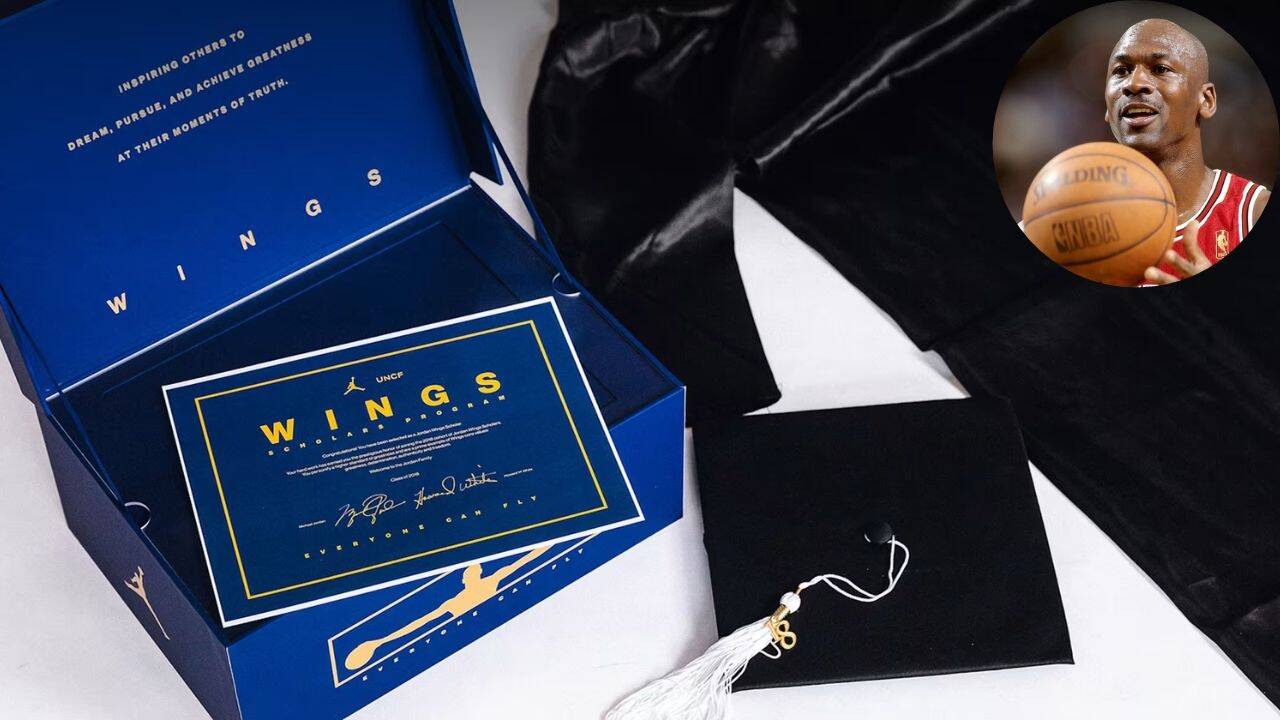
Michael Jordan’s Wings initiative reached a major milestone in 2025 by awarding 350 new scholarships, bringing its total number of supported students to more than 4,000 globally. While corporate philanthropy often relies on inflated projections and vague pledges, the Jordan Brand program operates as a multi-year financial pipeline covering tuition, mentorship, and career placement for underserved youth. Understanding how this machinery actually works requires looking past the press releases and examining the capital allocation, selection criteria, and structural realities of athlete-backed foundations.
Celebrity charity is notoriously messy. For every sustained effort that alters life trajectories, dozens of tax-advantaged vanity projects quietly fold once the initial press cycle fades. When Jordan Brand launched the Wings program in 2015, skepticism from industry observers was entirely warranted. Footwear giants routinely use community outreach as a marketing shield while generating billions in revenue from the exact demographics they claim to uplift.
Yet a decade into its run, the Wings initiative presents a different operational model. It is not a standalone 501(c)(3) begging for public donations at gala dinners. Instead, it functions as an embedded corporate social responsibility engine directly funded by Jordan Brand, a subsidiary of Nike, Inc., alongside personal commitments from Michael Jordan himself. That structural distinction changes everything about its longevity and financial stability.
How the Financial Engine Actually Works
Most scholarship funds fail their recipients at the finish line. They hand out a one-time check of $2,500, pose for a photo op, and leave a first-generation college student to figure out how to pay for sophomore, junior, and senior year. When the money dries up, the student drops out, saddled with debt and no degree.
The Wings program was designed specifically to prevent that attrition trap. Rather than scattering micro-grants across tens of thousands of applicants, the initiative commits to last-dollar funding and comprehensive multi-year support. In higher education finance, last-dollar funding means the program steps in after federal grants, state aid, and institutional scholarships are applied, covering the remaining gap so a student can graduate debt-free.
Consider a hypothetical example to see how this plays out on a university balance sheet. Suppose a student from Chicago is accepted into a four-year university with an annual cost of attendance—tuition, room, board, and books—totaling $32,000. Federal Pell Grants and university merit aid cover $22,000. A traditional charity might offer a $2,000 stipend, leaving the family to scramble for $8,000 every year in high-interest private loans. Under a last-dollar model, the scholarship absorbs that entire $8,000 annual deficit across all four years, turning an impossible financial burden into a zero-debt graduation path.
This approach requires immense capital reserves. Supporting 4,000 scholars over a ten-year span, with 350 new entrants added in the 2025 cohort alone, represents tens of millions of dollars in deployed capital. Because the funding is tied directly to the commercial performance of Jordan Brand—which routinely pulls in over $6 billion in annual revenue—the scholarship endowment does not suffer from the fundraising volatility that plagues independent nonprofits during economic downturns.
The Geography of Selection and Global Expansion
A common misconception about the Wings program is that it operates exclusively in Chicago, where Jordan won six NBA championships, or North Carolina, where he grew up and played college basketball. While those two regions remain the domestic bedrock of the initiative, the 4,000-scholar figure reflects an aggressive international footprint.
Jordan Brand has systematically mirrored its commercial expansion with its philanthropic footprint. As the brand established dominant market share in Greater China, Western Europe, and select Latin American markets, Wings chapters opened in tandem. Today, the program operates in cities ranging from Portland and Los Angeles to Paris, Shanghai, and Manila.
Selection into the program is rarely open to the general public via a cold web portal. Instead, Jordan Brand relies on intermediary grassroots partnerships. The brand embeds itself within established local organizations that already possess deep community trust and vetting infrastructure.
- United States: Partners include the Boys & Girls Clubs of America, the Jackie Robinson Foundation, and UNCF (United Negro College Fund), alongside specialized local high school networks in Chicago and Charlotte.
- Greater China: The program works closely with the China Foundation for Rural Development to identify high-performing students from under-resourced provinces, providing not just university tuition but also high school boarding stipends.
- Europe: In cities like Paris, the initiative aligns with local youth sports and arts collectives, bridging the gap between secondary education and vocational or university tracks.
By outsourcing the initial identification of candidates to hyper-local nonprofits, Jordan Brand avoids the bureaucratic bloat of building its own global field offices. Local youth workers know which students are caring for younger siblings after school, which ones are maintaining a 3.8 GPA despite housing instability, and which ones simply need capital to unlock their potential.
Beyond the Checkbook and Into the Corporate Pipeline
Money solves the tuition problem, but it does not solve the network problem. A first-generation college graduate entering the job market without industry connections faces a steep climb compared to peers whose parents sit on corporate boards.
Recognizing this blind spot, Jordan Brand integrated an internal talent pipeline directly into the Wings architecture. Scholars are not merely funded; they are recruited. Throughout their college years, Wings recipients gain access to paid summer internships at Nike’s world headquarters in Beaverton, Oregon, as well as regional offices in New York, Chicago, and Shanghai.
This is where corporate self-interest and genuine social impact intersect. Footwear and apparel companies have historically struggled with diversity in their upper design, marketing, and executive ranks. By training, mentoring, and hiring Wings scholars directly out of college, Jordan Brand secures a loyal, deeply vetted workforce that understands the brand's cultural DNA from the ground up.
The mentorship component pairs students with mid- and senior-level executives inside the company. These are not ceremonial quarterly phone calls. Mentors review resumes, conduct mock interviews, and help students navigate the unwritten rules of corporate environments. Furthermore, Jordan Brand frequently taps its roster of endorsed athletes and cultural collaborators—ranging from NBA stars to visual artists and fashion designers—to host workshops and design labs for the scholars.
The Design Program and Cultural Capital
One of the most distinct arms of the initiative is the Wings Design Program. While the broader scholarship fund supports students pursuing everything from mechanical engineering to pre-med, the design track targets young creatives interested in footwear, apparel, and industrial design.
Students selected for this track work alongside Jordan Brand’s elite design teams to create actual retail products. These are not theoretical school projects. Over the past several years, Wings scholars have designed limited-edition iterations of iconic silhouettes—including the Air Jordan 1, Air Jordan 5, and Air Jordan 12—that were manufactured and sold globally.
The financial loop here is tightly closed. A portion of the retail proceeds from these scholar-designed sneakers goes directly back into funding future cohorts of the Wings program. It is a self-sustaining cycle where student creativity generates the exact revenue required to educate the next wave of applicants. For a nineteen-year-old aspiring designer, having a commercially released Jordan sneaker in their portfolio before they even graduate from college is an unmatched career accelerant.
Scrutinizing the Numbers and Corporate Reality
To evaluate the Wings initiative fairly, one must strip away the glossy marketing films and look at the friction points. Supporting 4,000 scholars over a decade is an undeniable achievement, and adding 350 in 2025 proves the program is scaling rather than stagnating. However, several structural realities warrant critical examination.
First, scale versus demand. While 350 annual scholarships is substantial for a single corporate brand, it represents a fraction of a percent of the eligible low-income students living in the cities where Jordan Brand generates its highest profit margins. In Chicago alone, tens of thousands of public high school students graduate each year facing severe financial barriers to higher education. A cohort of 350 distributed across the entire globe means the program remains an elite, highly selective intervention rather than a broad systemic fix.
Second, transparency in reporting. Because Jordan Brand is a subsidiary of a publicly traded corporation rather than an independent private foundation, it is not legally required to file public IRS Form 990 disclosures detailing the exact dollar-for-dollar breakdown of the Wings budget. Observers know the headcount—4,000 total scholars, 350 in 2025—and they know the stated commitments regarding tuition and internships. Yet the precise administrative overhead, the average dollar amount awarded per student, and the exact four-year graduation rate of Wings cohorts are not published in audited annual reports.
Third, the brand halo effect. Corporate philanthropy never exists in a vacuum. The goodwill generated by the Wings initiative provides immense reputational value to Nike, Inc. and Michael Jordan. When critics question the retail pricing of $220 sneakers or scrutinize global supply chain labor practices, the Wings program serves as an immediate, tangible counter-narrative. The philanthropy is real, and the degrees earned by these students are permanent, but the strategic marketing benefit to the parent corporation is equally concrete.
The Shift in Athlete Philanthropy
Historically, star athletes handled charity through personal foundations named after themselves, funded by annual golf tournaments and celebrity auctions. Many of those organizations suffered from severe inefficiency, spending up to forty or fifty cents of every dollar on administrative salaries and event production rather than direct aid.
Michael Jordan’s approach with Wings—alongside his separate $100 million commitment with Jordan Brand to organizations fighting for racial equality and social justice—illustrates a sharper, more institutional blueprint. By leveraging the operational infrastructure, legal teams, and global supply chains of a multi-billion-dollar corporation, the administrative drag is absorbed by the business rather than deducted from the scholarship pool.
When a Wings scholar steps onto a college campus, they are backed by the full weight of a global enterprise. They have laptops, paid tuition, summer housing stipends for internships, and direct access to hiring managers. That level of wraparound infrastructure is virtually impossible for a standalone athlete foundation to replicate on its own.
The true measure of the 2025 cohort will not be found in press releases celebrating the 4,000-scholar milestone. It will be visible in 2029 and 2030, when those 350 students walk across graduation stages without student loan debt, enter the workforce with established professional networks, and begin building generational wealth in communities that have been systematically locked out of capital for decades.