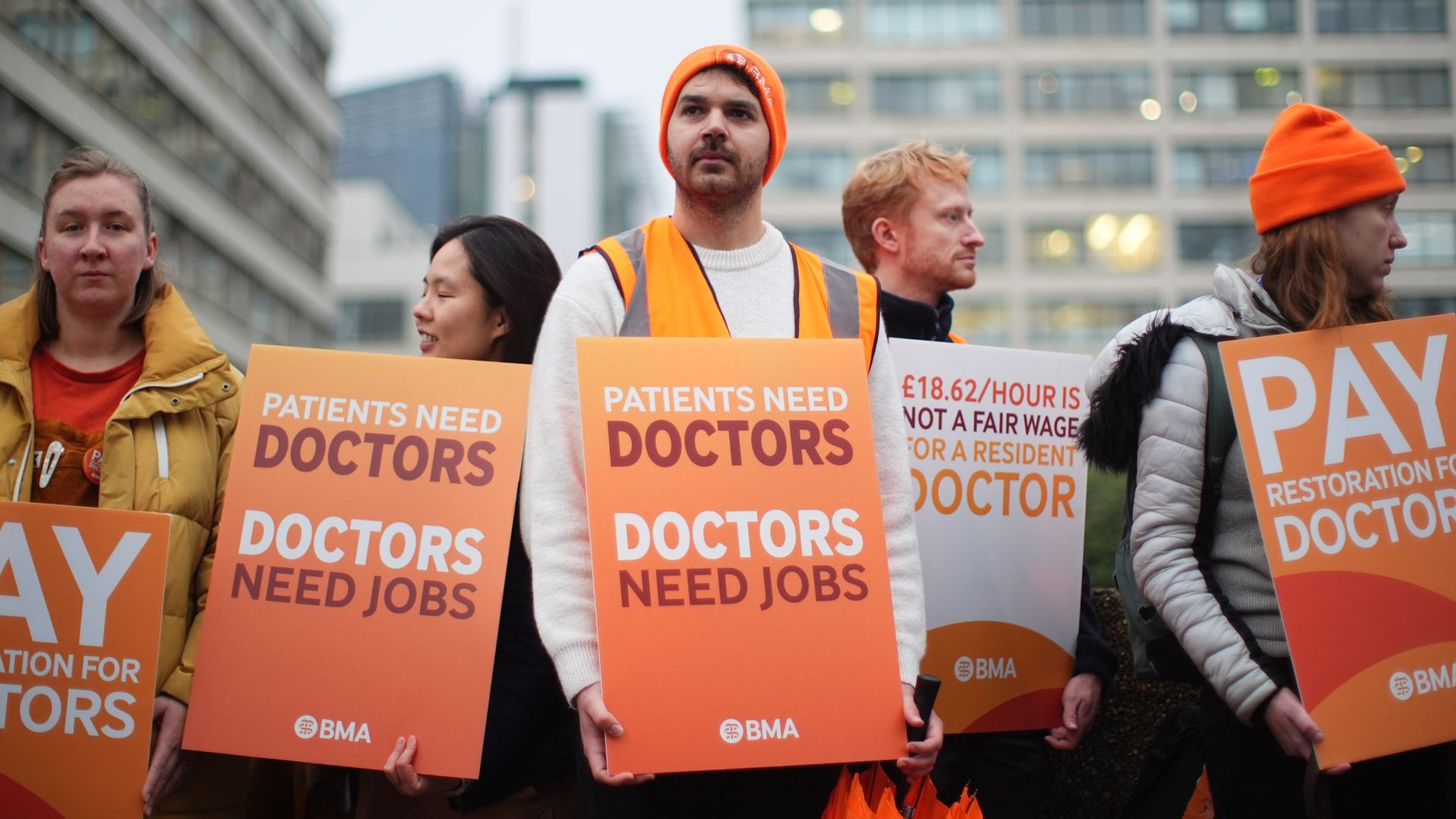
Senior doctors across England are preparing for coordinated industrial action this November, a move that threatens to bring planned hospital care to a standstill and force the cancellation of tens of thousands of outpatient appointments and elective surgeries. When NHS consultants—the most senior, experienced clinicians in the British healthcare system—walk off the job, hospitals shift immediately to "Christmas Day" staffing levels. Emergency departments stay open, and life-saving trauma care continues, yet the vast machinery of routine diagnostics, cancer follow-ups, and joint replacements grinds to an abrupt halt.
To the casual observer, this dispute looks like another chapter in a familiar public-sector tug-of-war over inflation and annual pay settlements. That reading misses the structural rot beneath the surface. The November walkouts are not merely about a single year's percentage bump; they are the boiling point of a fifteen-year erosion in real-terms pay, a broken independent pay review mechanism, and a workplace reality where senior doctors are actively losing money by taking on extra shifts to clear surgical backlogs. Learn more on a similar topic: this related article.
The Anatomy of a Christmas Day Walkout
When junior doctors (now formally known as resident doctors) strike, consultants step down from their specialist duties to cover the wards and emergency rooms. When consultants themselves strike, there is no senior tier left above them to absorb the shock.
Hospital trusts are forced to implement Christmas Day cover, a clinical protocol reserved for bank holidays and extreme emergencies. Under this arrangement, emergency care, maternity services, and critical inpatient wards remain staffed, but almost all non-urgent activity is stripped back. On the surface, a 48-hour or 72-hour strike sounds contained. In practice, the disruption ripples across the health service for months. More analysis by Mayo Clinic highlights comparable views on this issue.
Consider how hospital scheduling actually operates. Preparing a patient for a complex operation requires pre-operative assessments, blood work, imaging, bed allocation, and surgical theater slots booked weeks in advance. Canceling a single day of elective surgery does not just delay the patients scheduled for that Tuesday; it triggers a domino effect that displaces dozens of others down the line, consumes administrative hours that should go toward booking new patients, and forces senior managers to spend millions on locum cover to ensure emergency safety floors are met. Ironically, paying external or internal emergency rates to cover a strike day frequently costs an NHS trust more than paying the striking doctors their normal salary.
Follow the Math Behind the Pay Erosion
To understand why conservative, traditionally risk-averse senior clinicians are standing on picket lines, you have to look at the numbers without political spin. Over the past decade and a half, doctors' pay in England has failed to keep pace with inflation.
Using the Retail Prices Index (RPI)—the metric historically favored by unions—consultants have experienced a real-terms pay cut exceeding 30 percent since 2008. Even if you use the government’s preferred Consumer Prices Index (CPI), the drop remains substantial, sitting well into double digits. While private-sector wages fluctuated and eventually rebounded alongside inflation, public-sector clinical salaries were repeatedly capped, frozen, or awarded below-inflation increases under successive governments.
A common counter-argument from Treasury officials is that NHS consultants are already among the highest earners in the public sector, with base salaries starting around £100,000 and rising with seniority and Clinical Excellence Awards. On paper, that puts them comfortably in the top few percent of UK earners. Yet the reality of how senior doctors are compensated reveals a sharp disconnect between headline figures and take-home value.
| Factor | Headline Government Narrative | Reality on the Hospital Floor |
|---|---|---|
| Base Salary | Over £100,000, placing consultants in top UK tax brackets. | Represents 10 to 12 years of post-medical school training, massive student debt, and high indemnity costs. |
| Extra Shifts | Overtime rates exist to help clear waiting lists. | Marginal tax traps and pension tapering often leave doctors earning less per hour for extra work than their base rate. |
| Pay Review | An independent body recommends fair annual increases. | Government ministers set the remit and budget constraints before the review body even begins calculating. |
| Retention | Headcount is slowly rising across the NHS. | Experienced senior doctors are cutting hours, retiring early, or emigrating to Australia, Canada, and New Zealand. |
Why the Review Body Lost Its Credibility
At the heart of the dispute is the Review Body on Doctors' and Dentists' Remuneration (DDRB). Established decades ago as an independent buffer between doctors and politicians, the DDRB was meant to prevent industrial action by offering objective, evidence-based pay recommendations. In exchange for this independent arbitration, doctors effectively gave up the habit of striking.
That social contract has collapsed. Senior clinicians argue that the DDRB is no longer genuinely independent because the Department of Health and Social Care and the Treasury dictate the financial parameters before the panel even hears evidence. When ministers submit evidence stating that anything above a specific percentage is "unaffordable," the review body operates inside a predetermined cage.
Reforming the DDRB—changing how its members are appointed, stripping out government-imposed affordability caps, and tying its baseline metrics explicitly to inflation and international market comparators—is just as central to the British Medical Association's (BMA) demands as the immediate pay figure. Without fixing the mechanism, union leaders argue, any pay deal signed this autumn will simply dissolve into another dispute two years down the road.
The Hidden Tax Traps Killing Waiting List Initiatives
If you want to know why NHS waiting lists remain stubbornly high, look at what happens when a hospital asks a consultant to work a Saturday to clear a backlog of cataract surgeries or colonoscopies.
In any normal industry, working overtime results in a higher hourly rate. In the senior tiers of the NHS, the interaction between UK income tax thresholds and the NHS pension scheme has historically created punitive financial cliffs. While recent changes to the Pension Annual Allowance and the abolition of the Lifetime Allowance removed some of the worst distortions—where doctors were literally billed tens of thousands of pounds by HMRC for working extra hours—significant friction remains.
A consultant earning over £100,000 enters the notorious 60 percent effective marginal tax trap, where every £2 earned strips away £1 of their tax-free personal allowance. Add higher-tier pension contributions, student loan repayments, and National Insurance, and a senior surgeon giving up their weekend to operate on NHS patients can see nearly 70 percent of that extra pay evaporate before it hits their bank account.
Faced with that math, thousands of consultants have made a rational economic choice. They drop from working 11 or 12 Programmed Activities (the four-hour blocks that make up a consultant's week) down to the standard 10, or they drop to part-time contracts entirely. You cannot clear a record backlog of millions of appointments when your most experienced specialists are actively penalized by the tax system for picking up extra shifts.
The International Brain Drain is No Longer a Threat
For years, warnings that British doctors would leave for better pay abroad were dismissed by Whitehall as empty rhetoric. That is no longer the case.
Healthcare systems in Australia, New Zealand, Canada, and the Middle East are aggressively recruiting UK-trained consultants. British medical training is regarded globally as a gold standard, meaning UK specialists can often transition into overseas posts with minimal bureaucratic friction. The pitch from overseas recruiters is straightforward: double the take-home pay, a lower cost of living, modern hospital infrastructure, and a fraction of the administrative burnout.
To understand the scale of the leak, look at the Certificate of Good Standing requests processed by the General Medical Council (GMC)—the mandatory paperwork a doctor needs to register and practice abroad. Thousands of UK-licensed doctors apply for these certificates every year. When a seasoned consultant leaves the NHS at age 45, the health service does not just lose one pair of hands; it loses a clinical educator who trains the next generation of resident doctors, runs complex multidisciplinary cancer boards, and absorbs the highest-risk surgical cases that junior staff cannot safely manage. Training a replacement from medical school to consultant accreditation takes over a decade and costs the public purse hundreds of thousands of pounds.
The Government Dilemma and the Treasury Veto
Why does the government not simply settle the dispute? The answer lies in Treasury orthodoxy and the fear of public-sector contagion.
Ministers point out, with some justification, that public finances are stretched thin, borrowing costs remain elevated, and agreeing to inflation-busting pay rises for senior doctors immediately triggers demands from nurses, teachers, civil servants, and transport workers. In the eyes of Treasury economists, conceding ground to a high-earning group like consultants is politically toxic and fiscally dangerous. If you find an extra £1 billion for senior doctors, every other public-sector union will immediately ask why their members are being told the cupboard is bare.
There is also a genuine philosophical divide over productivity. Ministers repeatedly tie pay discussions to workforce reform, arguing that the NHS has received record funding and headcount increases since 2019 without a corresponding surge in hospital output. From the government's perspective, pouring more money into salaries without modernizing working practices, expanding seven-day elective surgery, and cutting administrative waste simply inflates the wage bill while leaving patients stuck on waiting lists.
The Brutal Cost to Patients Caught in the Middle
Between the BMA's spreadsheets and the Treasury's fiscal rules sit millions of ordinary patients who have no say in the dispute.
Every strike day forces hospitals to reschedule hundreds of thousands of appointments across England. While urgent cancer care is theoretically protected under Christmas Day protocols, the reality on the ground is far messier. Cancer pathways rely heavily on diagnostics—biopsies, MRI scans, endoscopies, and pathology reviews—many of which are classified as routine or non-urgent until a malignancy is actually confirmed. When routine outpatient clinics shut down, early-stage cancers sit undiagnosed for weeks longer.
For patients waiting 18 months for a hip replacement or spinal surgery, a strike cancellation is not a minor administrative inconvenience. It means months more of chronic pain, reliance on strong painkillers, inability to work, and physical deterioration that makes their eventual surgery riskier and their recovery slower. Doctors argue, with fierce conviction, that allowing the NHS workforce to hollow out through low pay is far more dangerous to patient safety in the long run than a few days of planned industrial action. Both arguments hold truth, which is precisely why the standoff has proven so intractable.
How This Standoff Actually Ends
History shows that public-sector strikes rarely end with a knockout blow from either side. They end when the political pain of continuing the dispute outweighs the financial pain of a compromise.
For the November strikes to be the last, three concrete shifts have to happen behind closed doors. First, the government must offer a multi-year pay deal that provides certainty rather than kicking the can down the road to next spring. Second, both sides need to negotiate a structured reform of the DDRB so that future pay rounds do not automatically trigger strike ballots. Third, NHS England and the unions must separate emergency strike cover from routine rates, establishing transparent, nationally agreed rate cards for extra-contractual work so trusts are not held hostage by wildly fluctuating locum prices every time a backlog initiative is launched.
Until those structural flaws are addressed, November's walkouts will not be an isolated disruption. They are simply the visible tremor of a healthcare workforce deciding that goodwill can no longer subsidize a broken pay model.