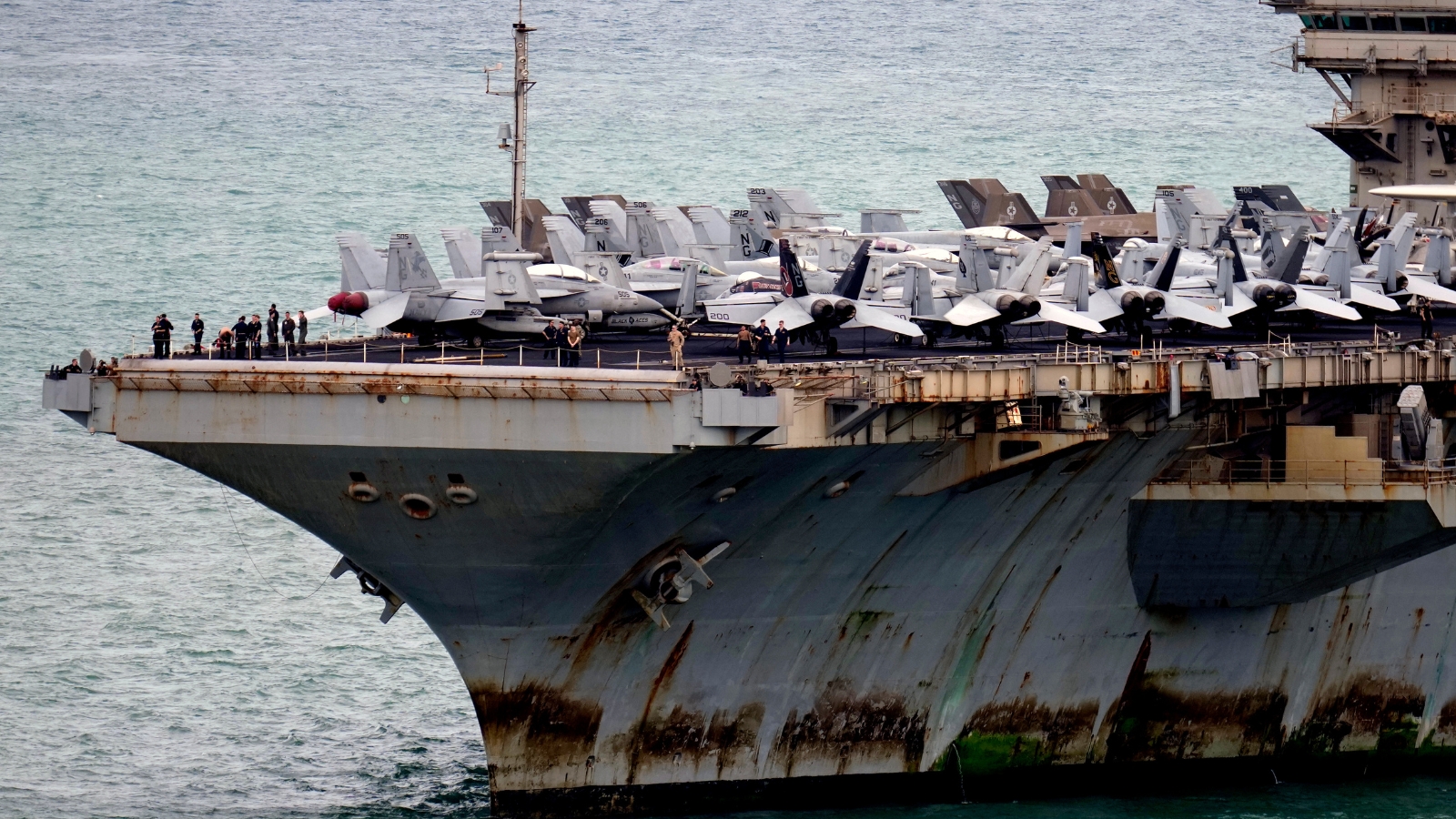
Kuwait faced a barrage of hostile missiles and drones launched from Iran, marking a dangerous escalation in the ongoing regional war involving the United States. Air defense systems over Kuwait lit up the morning sky as military authorities intercepted incoming projectiles. This direct assault on a key American ally came hard on the heels of renewed U.S. aerial bombardments across southern Iran, shattering a fragile month-long lull in hostilities and dragging the entire Persian Gulf deeper into an unmanageable security quagmire.
The immediate trigger for the latest salvo involved U.S. Central Command strikes targeting Iranian rocket launchers positioned near the Strait of Hormuz. Washington claimed these positions posed an imminent threat to international shipping lanes. Tehran viewed the action as an unprovoked violation of its sovereign territory. What followed was a predictable yet terrifying cycle of kinetic retaliation. Iran expanded its target parameters beyond immediate military assets, choosing instead to exert maximum pressure on Washington's regional partners. Gulf nations that spent decades hosting American installations now find themselves occupying the frontline of a conflict they tried desperately to avoid.
The Vulnerability of Gulf States
Kuwait and neighboring monarchies operate under a severe geographic and strategic handicap. They lack the territorial depth required to absorb or deflect sustained regional blowback. While Washington can calibrate its operational tempo from thousands of miles away, Kuwait sits directly across the water from an adversary capable of blanketing its airspace with low-cost munitions within minutes.
Consider a hypothetical defensive scenario to understand the math of modern air defense. A battery utilizing interceptor missiles costs millions of dollars per defensive round, whereas the incoming swarm of asymmetric drones often costs a fraction of that amount. This economic asymmetry creates a long-term sustainability crisis for local defense forces. When Tehran unleashes repeated waves of unmanned aerial vehicles, the defender faces an exhausting financial and logistical attrition war. Every intercepted drone drains specialized stockpiles that cannot be replenished overnight.
The Economic Chokehold
The confrontation extends far beyond military facilities and air defense batteries. The Strait of Hormuz functions as the jugular vein of the global energy architecture. Roughly a fifth of the world's traded oil supply historically flowed through this narrow maritime corridor. Today, that artery is severely constricted.
Tanker traffic has slowed to a fragile trickle. Maritime insurance rates have skyrocketed to prohibitive levels, and shipping companies increasingly refuse to risk multi-million-dollar vessels in a combat zone. International benchmark Brent crude climbed past ninety-seven dollars a barrel following the latest round of strikes, reflecting acute market anxiety. Tehran understands this dynamic completely. By threatening to choke off energy exports entirely, Iranian leadership aims to inflict economic pain on Western consumers, hoping domestic political pressure will eventually force Washington to alter its strategy.
Washington, meanwhile, continues to exert counter-pressure through financial isolation. Treasury officials are actively warning international trade partners to sever remaining economic ties with Tehran. Yet, this maximum-pressure approach risks backing an isolated regime into a corner where leadership calculates it has nothing left to lose.
The Cost of Asymmetric Retaliation
Tehran's military planners have signaled a permanent shift toward multi-layered, asymmetric responses. Rather than engaging in conventional naval or air battles where U.S. technological dominance is absolute, Iran relies on proxy networks, ballistic missile barrages, and regional disruptions.
This strategy places neighboring capitals in an impossible position. Kuwaiti officials condemned the latest incursions as a flagrant violation of national sovereignty, emphasizing their right to self-defense under international law. Yet diplomatic protests do little to stop descending missiles. As long as Washington maintains its current posture and Tehran refuses to capitulate to economic demands, the minor states situated between these two superpowers will continue absorbing the shockwaves of a war with no clear exit strategy.
International energy markets react instantly to every flash of light over the Persian Gulf, and local populations bear the psychological weight of perpetual sirens. The conflict has evolved past a simple exchange of retaliatory strikes into a grinding structural crisis that threatens to reshape the political landscape of the Middle East permanently.
US-Iran conflict: What UAE residents need to know tonight
This video details the regional impact of the recent missile and drone attacks on Gulf allies and the ongoing disruptions faced by residents.
http://googleusercontent.com/youtube_content/1