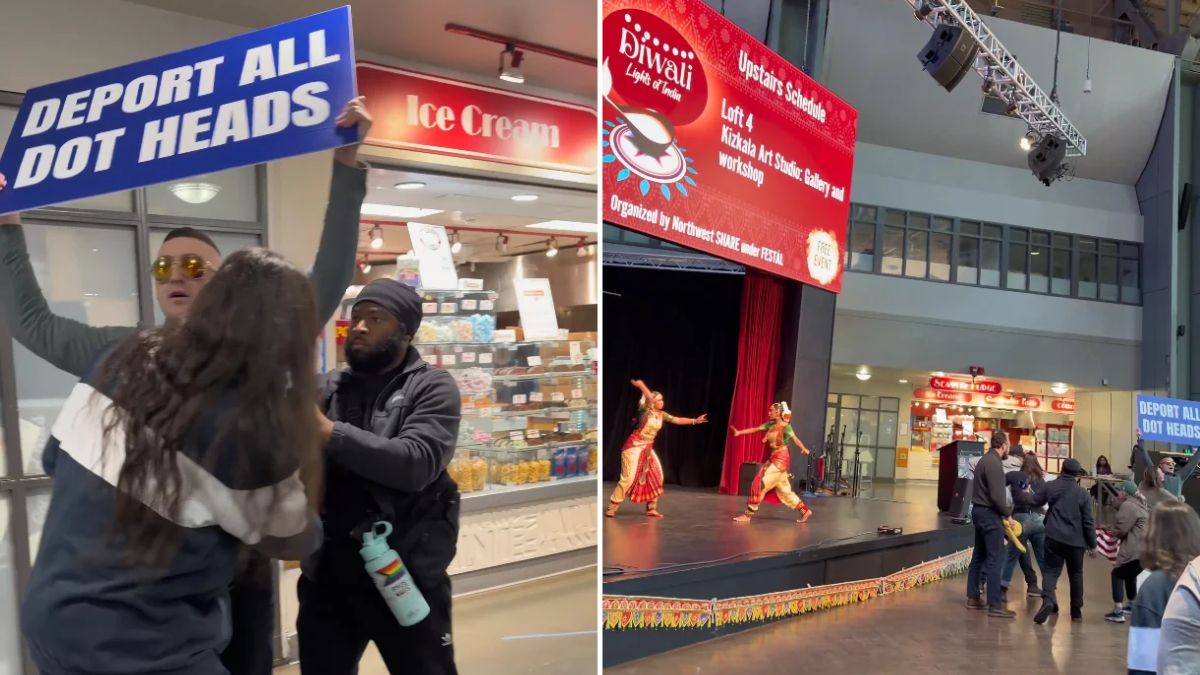
Jake Lang is a far-right political agitator from New York who gained national notoriety as a January 6 Capitol riot defendant and later reinvented himself as a traveling street provocateur, disrupting a November 2026 Diwali celebration in Seattle with anti-Hindu placards and megaphones. His presence at a local cultural festival was not an isolated outburst of bigotry. It was a calculated content-creation exercise designed to monetize outrage, harvest algorithmic engagement, and exploit legal gray zones around public assembly.
To understand why a New Yorker facing severe federal felonies ended up thousands of miles away shouting at families celebrating the Festival of Lights, you have to stop looking at these incidents as traditional political protests. Traditional protests aim to persuade the public or pressure lawmakers. The modern provocation economy operates on an entirely different set of incentives, where the target audience isn't the crowd on the street, but the anonymous viewers watching vertical video clips on social media platforms hours later.
The Anatomy of a Manufactured Confrontation
Street-level political theater has existed for centuries, yet the mechanics changed permanently once smartphones and live-streaming platforms merged. In the old model, an agitator needed a crowd large enough to attract legacy television news crews. Today, a single individual with a GoPro, a directional microphone, and a provocative sign can generate millions of impressions by engineering a ten-second confrontation.
At the Seattle Diwali event, the operational playbook was textbook. Choose a peaceful, family-oriented cultural gathering where attendees are dressed in traditional attire and expecting a celebratory atmosphere. Introduce starkly offensive messaging—in this case, anti-Hindu placards and amplified rhetoric framing a major world religion as an existential threat. Wait for the inevitable human reaction.
When a bystander steps forward to argue, block a camera, or tear down a sign, the provocateur wins. The resulting footage is immediately clipped, stripped of its preceding context, and uploaded to sympathetic digital ecosystems under captions claiming the agitator was "attacked for exercising free speech."
It is a closed-loop grievance machine. If nobody reacts, the provocateur claims victory for "exposing" the event unopposed. If someone reacts angrily, the provocateur plays the victim and uses the clip to solicit legal defense donations or subscription revenue.
Who Is Edward Jacob Lang
Before becoming a fixture of viral street confrontations, Edward Jacob Lang was a twenty-something entrepreneur from Narrowsburg, New York, running a fledgling social media marketing business. That background matters. Lang did not enter the political arena as a policy wonk, a grassroots community organizer, or a traditional party operative. He entered it with an intuitive grasp of digital attention metrics.
On January 6, 2021, Lang traveled to Washington, D.C., where federal prosecutors later documented him at the forefront of the violent breach at the Lower West Terrace tunnel of the U.S. Capitol. According to Department of Justice filings and extensive video evidence presented in court proceedings, Lang was charged with multiple felony counts, including assaulting, resisting, or impeding certain officers using a dangerous weapon—specifically a baseball bat and a stolen riot shield—alongside civil disorder and obstruction of an official proceeding.
Following his arrest by the FBI in January 2021, Lang spent years in pretrial detention, largely at the D.C. Jail, as his legal team mounted prolonged challenges to the charges and the conditions of his confinement. Rather than fading from public view behind bars, Lang turned his incarceration into a brand.
Turning Pretrial Detention Into a Media Platform
From inside jail, using monitored phone lines and intermediaries on the outside, Lang conducted dozens of interviews with fringe podcasts, launched fundraising campaigns, and attempted to organize militias and support networks from his cell. He styled himself as a political prisoner, adopting the rhetoric of martyrdom that became currency in certain corners of the post-2020 right.
This period revealed a crucial shift in how extremist influencers operate. Historically, arrest and incarceration ended a political agitator's momentum. In the fragmented media ecosystem of the 2020s, federal indictments became credentials. Every court filing, every disciplinary infraction in detention, and every legal delay served as fresh fodder for newsletters and crowdfunding appeals.
When legal shifts and executive clemency actions altered the landscape for January 6 defendants, Lang emerged onto the streets not chastened by years of confinement, but armed with a pre-built audience and a desperate need to stay relevant in a crowded attention market.
Why Target a Diwali Celebration in Seattle
To an outside observer, targeting a Hindu cultural event in the Pacific Northwest might seem random. A closer look at extremist narratives and local civic dynamics shows why Seattle and Diwali were chosen.
First, there is the shifting geography of American political theater. Cities like Seattle, Portland, and Minneapolis have long functioned as symbolic punching bags in conservative and far-right media. Staging an action in Seattle guarantees immediate polarization; local progressive officials and residents are reliably outraged, while online audiences in other parts of the country view the city as hostile territory where "brave" agitators are confronting liberal orthodoxy.
Second, anti-immigrant and white nationalist rhetoric in the United States has increasingly expanded beyond its traditional post-9/11 focus on Muslim communities to target South Asian and Hindu Americans. Driven by online conspiracy theories surrounding high-skilled immigration, H-1B visas, and demographic change in tech hubs like the greater Seattle area, agitators have begun testing anti-Hindu messaging to see if it generates the same engagement spikes as older tropes.
Diwali, the five-day Festival of Lights celebrated by millions of Hindus, Sikhs, Jains, and Buddhists worldwide, represents visibility and civic integration. When municipal leaders issue proclamations or public spaces host Diwali festivities, extremists view it not as benign cultural sharing, but as evidence of what they call "cultural replacement." Disrupting the event is a deliberate attempt to signal to minority communities that their presence in public spaces will not go uncontested.
The Legal Gray Zone of Public Harassment
One of the most frustrating realities for event organizers and attendees at the Seattle disruption was the apparent hesitation of law enforcement to immediately remove Lang from the vicinity. Understanding why requires looking at the collision between First Amendment jurisprudence and modern harassment tactics.
Under United States constitutional law, the government has extremely narrow authority to restrict speech in traditional public forums like sidewalks, parks, and plazas. The Supreme Court has repeatedly affirmed that offensive, hateful, and deeply distressing speech is protected unless it crosses specific legal thresholds, such as:
- True threats: Statements where the speaker means to communicate a serious expression of an intent to commit an act of unlawful violence to a particular individual or group.
- Incitement to imminent lawless action: Speech explicitly directed at inciting or producing immediate violence and likely to produce such action.
- Fighting words: Face-to-face insults so inherently inflammatory that they are likely to provoke an immediate violent retaliation from an average person—a doctrine courts have narrowed almost to the point of obsolescence over the past eighty years.
- Physical obstruction or trespass: Blocking ingress and egress to a permitted event, refusing to leave private property, or violating municipal noise ordinances regarding amplified sound.
Provocateurs like Lang study these boundaries meticulously. They know that holding a placard denouncing a religion on a public sidewalk adjacent to a permitted festival usually falls under protected expression, even when the intent is transparently to ruin a family event and intimidate attendees.
Police departments in major cities, frequently facing intense scrutiny and potential civil rights lawsuits over crowd-control tactics, often adopt a hands-off posture until a physical altercation occurs or a specific noise or permit boundary is breached. For community members trying to protect children and elderly relatives from verbal abuse, this legal reality feels like institutional abandonment. For the provocateur, it is an operational shield.
The Financial Engine Behind Street Provocation
You cannot analyze individuals like Jake Lang solely through the lens of ideology. Ideology provides the script, but cash flow keeps the tour bus running.
Travel across the country, lodging, camera gear, legal fees, and living expenses require steady capital. Because mainstream payment processors, banks, and crowdfunding platforms routinely deplatform individuals associated with violent extremism or hate speech, the provocation economy relies on an alternative financial stack.
| Revenue Channel | Mechanism | Vulnerability |
|---|---|---|
| Crypto Donations | Direct wallet transfers via Bitcoin or privacy coins displayed on live streams. | High price volatility; requires technical literacy from donors. |
| Alternative Crowdfunding | Platforms branding themselves around "free speech" that take a percentage of legal defense funds. | Periodic pressure from payment rails and banking partners. |
| Subscription Paywalls | Exclusive behind-the-scenes footage and uncensored commentary hosted on independent video sites. | High churn rate; forces creator to constantly escalate stunts to retain subscribers. |
| Merchandise Drops | Print-on-demand apparel featuring slogans tied to recent viral confrontations. | Low profit margins unless volume spikes after a major news cycle. |
This financial structure creates an escalation trap. A quiet week means declining subscription renewals and fewer tips. To keep the money flowing, the agitator must continuously seek out new targets, travel to new cities, and push closer to the edge of physical confrontation. Yesterday's stunt quickly loses its shock value, forcing tomorrow's appearance to be louder, cruder, and more invasive.
What Media Outlets Get Wrong When Covering Agitators
Legacy newsrooms and local television stations frequently fall into a predictable trap when covering incidents like the Seattle Diwali disruption. Driven by the need for quick turnaround and sensational headlines, coverage often amplifies the exact imagery the provocateur wanted distributed.
Printing the exact wording of hate-filled placards in headlines or airing unedited clips of an agitator screaming into a megaphone hands a fringe figure millions of dollars in earned media. In Seattle, a handful of individuals with signs managed to hijack the media narrative around an event attended by thousands of peaceful community members.
Experienced investigative reporters look past the spectacle to examine the network. Who funded the trip? Who held the secondary camera? Which online accounts coordinated the amplification of the footage within minutes of the incident? When journalism treats a traveling provocateur as a spontaneous local news story rather than a coordinated digital marketing campaign, it inadvertently becomes a distribution partner for the stunt.
The Community Dilemma Respond or Ignore
For marginalized communities and event organizers, the presence of an agitator forces an impossible choice in real time.
If attendees confront the disruptor, shout back, or attempt to physically block the signs, they provide the dynamic visual conflict required for viral video clips. Online algorithms reward high-arousal emotions—anger, fear, and indignation—far more heavily than calm indifference. A video of a peaceful festival continues quietly in the background while a ten-second scuffle dominates social feeds for a week.
Conversely, ignoring verbal harassment while standing next to your children or grandparents asks an extraordinary amount of emotional restraint from ordinary citizens. Silence can also be misconstrued by observers as acquiescence, leaving community members feeling vulnerable and unprotected in their own neighborhoods.
Security consultants who advise cultural and religious organizations increasingly recommend a structured third approach: designated de-escalation teams. Rather than leaving untrained attendees to react emotionally, organizers deploy trained volunteers wearing high-visibility vests to form a physical buffer zone, use umbrellas or banners to block cameras without touching the agitator, and document every interaction from a safe distance for law enforcement. Deprived of direct eye contact, arguments, and dramatic camera angles, the provocateur's raw footage becomes unusable.
The Broader Consequences for Civic Life
The real damage caused by the disruption in Seattle extends far beyond a single afternoon in November. The persistent threat of manufactured confrontations acts as a quiet tax on civic participation.
Small cultural associations, neighborhood volunteers, and local nonprofits—the exact groups that organize community festivals, heritage parades, and public holiday celebrations—now have to budget thousands of dollars for private security, perimeter fencing, and legal consultations. Many smaller organizations simply cannot afford the overhead. Rather than risk exposing families to aggressive filming and online doxxing, they retreat from public parks into private banquet halls.
When public squares become too expensive or too hostile for minority communities to celebrate their traditions, the agitators achieve their strategic objective without ever winning an election or passing a law. They shrink the boundaries of who feels safe occupying shared civic space.
Jake Lang's journey from a Capitol riot defendant to a street-level disruptor in Seattle illustrates how modern extremism has adapted to survive legal pressure and platform bans. It no longer needs mass rallies or formal organizational charters to exert pressure on democratic norms. All it requires is a camera, a megaphone, a willingness to target peaceful gatherings, and an ecosystem ready to reward the resulting outrage with clicks and cash.