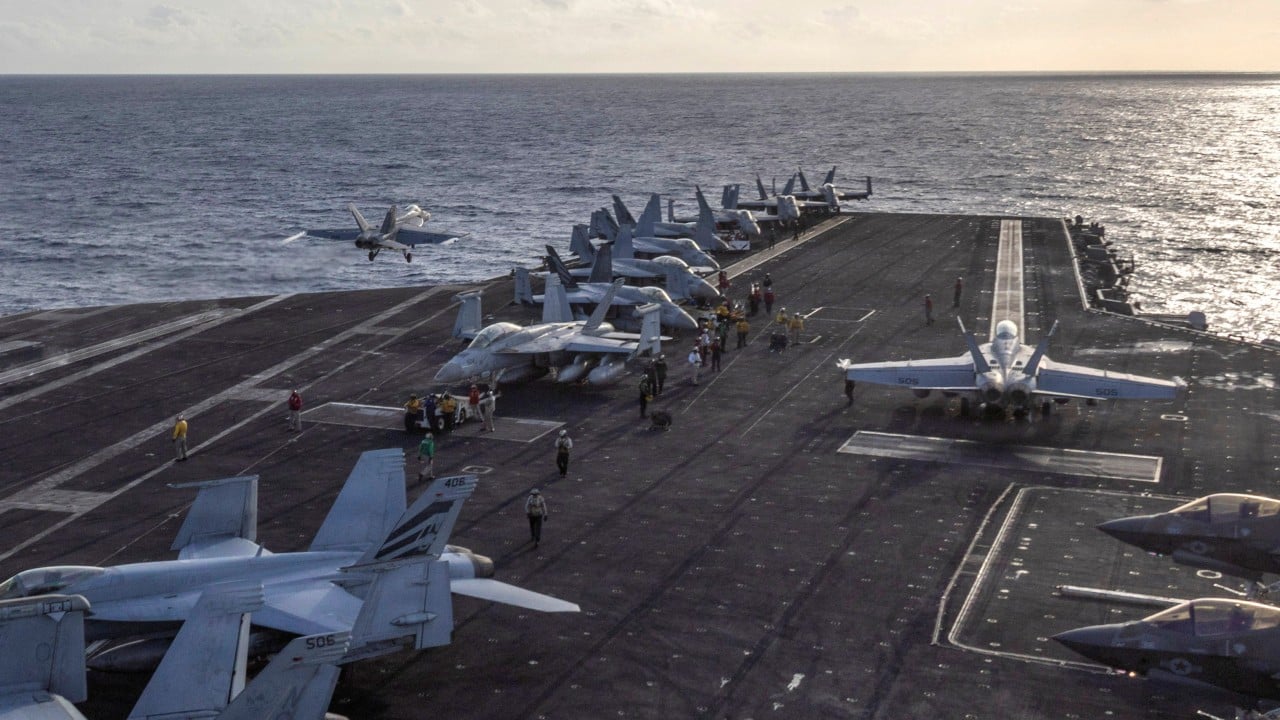
The maritime conflict in the Middle East has crossed a dangerous threshold with the United States military explicitly targeting and incapacitating three Iranian oil tankers. This direct escalation followed an unprovoked ballistic missile attack by the Islamic Revolutionary Guard Corps targeting two U.S. Navy warships, including an aircraft carrier and a guided-missile destroyer. U.S. Central Command confirmed that the retaliatory airstrikes permanently disabled two tankers—the M/T Downy near Kharg Island and the M/T Stark 1 near Jask—while completely destroying a third, the M/T Kylo, in the Gulf of Oman.
The explicit warning issued by Admiral Brad Cooper—that firing on two American ships results in the economic elimination of three of theirs—signals a fundamental shift in Washington's operational calculus. This is no longer merely a defensive containment strategy or a routine enforcement of maritime blockades. It is a calculated campaign to dismantle the financial lifeblood of Tehran’s regional proxy network by targeting the very vessels that form Iran's clandestine petroleum export apparatus.
Anatomy of the Shadow Network
To understand why these specific tankers were targeted, one must look past standard commercial shipping registries and examine the complex architecture of Iran's shadow fleet. For years, international sanctions forced Tehran to construct a parallel maritime infrastructure. This system relies on aging Very Large Crude Carriers changing flags, turning off transponders, and utilizing ship-to-ship transfers in clandestine waters to bypass Western restrictions.
The vessels struck by U.S. forces were not innocent commercial carriers caught in the crossfire. According to intelligence assessments shared by coalition authorities, these ships operated as floating bank accounts for the Islamic Revolutionary Guard Corps. Every barrel of crude moved through this network directly funds ballistic missile development and proxy militias operating across the Levant and the Gulf.
By hitting ships like the M/T Downy near Kharg Island—the crown jewel of Iran’s export infrastructure handling roughly ninety percent of its outward petroleum flow—the Pentagon is attacking the structural vulnerabilities of a regime already buckling under severe macroeconomic strain. The geographic spread of these operations, stretching from the western Persian Gulf out to the Gulf of Oman, demonstrates that no component of this illicit transit web remains shielded from aerial interdiction.
The Escalation Trap and Global Economic Fallout
Every military action carries a corresponding economic reaction. As the theater of operations expands closer to critical Iranian export terminals, the broader energy market absorbs the shockwaves. Prior to the outbreak of hostilities, approximately a fifth of the world's petroleum and liquefied natural gas transited the Strait of Hormuz. Today, that vital artery operates at a fraction of its historical capacity, with traffic slowed to a defensive trickle.
The consequences are visible at fuel pumps worldwide. Domestic diesel prices in the United States recently reached historic highs, creating immediate inflationary pressures that ripple through supply chains, agriculture, and manufacturing. Energy economists point out that localized military retaliations against tankers provide short-term deterrence against naval harassment, but they simultaneously institutionalize supply uncertainty.
Tehran’s response to these maritime losses has historically relied on asymmetric retaliation, including increased strikes on regional commercial shipping and infrastructure in neighboring states. The Iranian Armed Forces have publicly warned that future counter-strikes will expand in scope and severity should the naval blockade and interdiction operations persist. This tit-for-tat dynamic creates an escalating loop where each military correction by Washington invites further regional instability, driving insurance premiums for commercial transit sky-high and making a return to normal maritime commerce virtually impossible in the near term.
The Limits of Maritime Deterrence
Strategic enforcement at sea has inherent limitations. Sinking or disabling shadow fleet tankers reduces the immediate volume of revenue-generating oil leaving Iranian ports, but it does not alter the fundamental political objectives of the leadership in Tehran. As diplomatic channels remain completely frozen following the collapse of earlier ceasefire frameworks, both sides are trapped in an attritional logic where inflicting pain becomes its own justification.
The human and material costs of this protracted conflict continue to mount. Billions of dollars in direct expenditures, dozens of casualties among service members, and thousands of regional casualties paint a grim picture of a war that political leaders frequently downplay even as operational intensity escalates. When the head of Central Command promises to systematically dismantle what remains of Iran's exposed oil fleet, he is describing an open-ended campaign with no clean exit strategy.
The smoke rising from burning supertankers off the coast of Jask and Kharg Island illuminates a harsh reality. Force projection can disrupt a shadow economy, but it cannot burn away the underlying geopolitical impasse driving the conflict. As long as Washington insists on complete economic suffocation and Tehran responds with asymmetric naval defiance, the waters of the Persian Gulf will remain a volatile frontier where every strike brings the market closer to a breaking point.