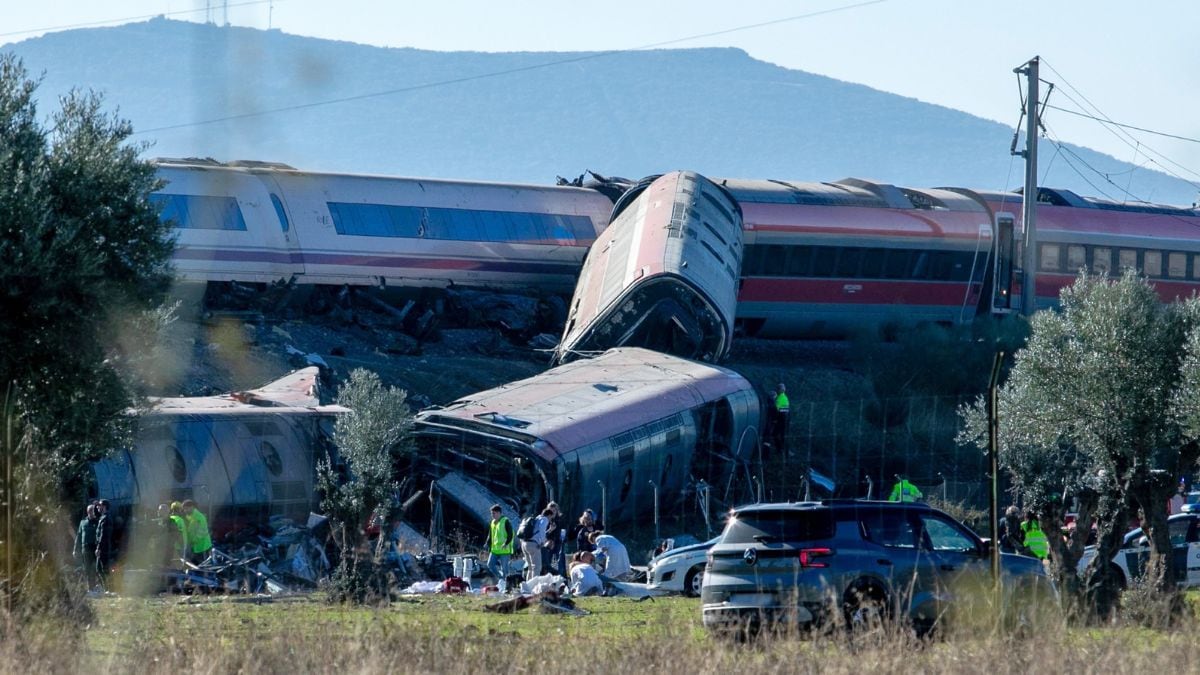
Sixty-nine people died on a morning commute near Urda, Spain, after a high-speed Renfe train slammed into a stationary Iryo train on the same track. Officials pointed quickly to human error by an operator. That diagnosis is lazy. It lets an overstretched rail network, aging signaling hardware, and bureaucratic inertia off the hook while pinning a catastrophic design failure on a single desk or cab.
Anyone who has covered transport disasters for decades knows the script by heart. A computer falters. A human makes a fatal call under pressure. Press briefings immediately reach for the simplest moral label, treating a complex engineering breakdown like a single bad apple. In Spain, where high-speed rail long stood as a symbol of state competence and modern engineering, the October 28 collision in Toledo province shattered a comfortable illusion. It was the second fatal rail disaster on that corridor in 2026, following the Adamuz crash in January that killed 46 people. When two major tragedies strike the same artery in less than a year, calling it a simple mistake stops being an explanation and starts looking like an alibi. Also making news lately: The Question Every Pilot Fears And The Ruler Who Refused To Forget.
Why Calling It Human Error Misses the Real Fault Line
Blaming an operator is convenient because it draws a neat line around the catastrophe. It implies that if one person had spoken differently on a radio or paused before giving an instruction, sixty-nine lives would still be intact. In high-speed rail operations, safety is supposed to be layered so that one slip cannot turn into a mass-casualty event.
When an automated supervision system fails, human controllers and drivers are suddenly forced into manual workarounds. According to government accounts of the Urda disaster, the LZB signaling system suffered a computer malfunction around 8:30 a.m. across a 63-kilometer stretch, bringing trains to a halt. Minutes later, an instruction went out from central control allowing a following Renfe service to resume running without speed restrictions, setting up the collision with the stopped Iryo train around 8:53 a.m. Transport Minister Óscar Puente called the decision to restart normal movement under those conditions "inexplicable," even as questions swirled over speeds reaching up to 200 kilometers per hour—or higher—before impact. Further information on this are detailed by USA Today.
When safety depends on a person never making a mistake after a machine fails, the system is already broken.
Rail engineers and safety investigators look at that sequence very differently than political soundbites do. Why did a manual override allow high-speed travel while another train remained stationary ahead? Why were there no hard technical interlocks preventing a following train from accelerating unchecked into an occupied or unverified section? In rail safety engineering, human error is rarely a root cause. Usually, it is a symptom of brittle procedures, confusing degraded modes, or interfaces that make the dangerous choice too easy to execute.
Aging Signaling Meets a Crowded Corridor
Spain built the world's second-largest high-speed rail network, behind only China, and earned global respect for punctual, sleek travel between major cities. For more than three decades, that reputation rested on an enviable record without fatal high-speed crashes. Success can breed complacency. Systems that work reliably day after day start feeling permanent long after newer standards have overtaken them.
Union representatives and rail observers have pointed directly to the LZB signaling system, a technology with roots stretching back to 1970s Germany that many argue should have been replaced earlier. Upgrading core signaling across a busy trunk line is expensive, disruptive, and slow. Yet when legacy hardware stays in place while train volumes climb, the margin for error shrinks.
Consider a hypothetical example to see how degraded mode pressure builds. Suppose a dispatcher handles a stretch of track where automated block protections drop out twice in a single month. Each time, trains stack up, schedules slip, and phone lines light up with crews asking how to move passengers safely. Under repeated routine disruptions, normalization of deviance creeps in—workers adapt by improvising faster workarounds because strict textbook delays feel unsustainable. That pattern is not unique to Spain. It shows up in aviation, maritime shipping, and heavy rail whenever operational tempo outpaces system resilience.
Rail liberalization added another layer to the equation. Opening long-distance routes like Madrid–Seville and Madrid–Barcelona to competing operators—such as Renfe and Iryo—brought lower fares and more choices for passengers. Between 2019 and 2024, daily trips between Madrid and Barcelona jumped from 56 to 89, according to union figures cited in wire reports. More trains mean tighter headways, denser schedules, and less slack when something goes wrong on the line.
Competition itself does not cause collisions. Plenty of multi-operator networks run safely around the world. Problems emerge when infrastructure capacity and oversight do not keep pace with higher traffic density. If tracks, switches, signaling upgrades, and dispatch staffing lag behind schedule growth, every glitch ripples farther and faster.
Investigations, Probes, and Political Fallout
A crash of this magnitude triggers parallel investigations that rarely move at the same speed or ask the same questions. Technical investigators examine event recorders, signaling logs, track geometry, and radio transcripts to reconstruct the exact chain of events. Prosecutors and oversight bodies look for criminal negligence or regulatory breaches.
In the wake of the Urda collision, European Union prosecutors opened inquiries into potential fraudulent misuse of funds meant for upgrading signaling on the line. That detail changes the stakes considerably. If money earmarked to modernize safety infrastructure was diverted or mismanaged, the story moves far beyond a single bad morning at a control console. It points to institutional accountability failures long before the first train left Atocha station.
The political fallout was swift. By early November, Óscar Puente announced his resignation and exit from politics, saying a transport minister in a country like Spain could not stay in office after two severe accidents in less than a year. Resignations satisfy a public demand for visible consequence. They do not automatically rewrite safety rules or fix faulty software.
What Investigators Must Scrutinize Next
To move past blame-shifting, independent investigators have to test every link in the chain without taking official timelines at face value:
- Degraded-mode protocols: When automatic supervision fails, what exact rules govern speed, visual line-of-sight, and train spacing, and were those rules clear and unambiguous under stress?
- Control room ergonomics and workload: How many trains and incidents was central control managing simultaneously when the malfunction hit, and what alerts were visible on operator screens?
- Backup protection limits: Why did fallback systems not cap speed or prevent a collision course once the primary system dropped out?
- Signaling modernization contracts: Where did planned safety upgrades stall, and who signed off on delays or fund allocations?
The Gray Areas Around Rail Safety
Honest analysis requires admitting that no transport system is immune to failure. Even modern European rail networks equipped with advanced automatic train protection still rely on human judgment during faults, construction, and weather events. Automation reduces routine mistakes. It can also create automation bias, where operators trust machines until they fail—or struggle to regain situational awareness when control suddenly shifts back to people.
There is also a real tension between cost, speed, and redundancy. Building fail-safe systems that block every conceivable human slip is costly and can slow operations if safety margins are overly conservative. Striking the right balance is hard work. Still, when high-speed trains travel at well over 100 miles per hour on shared corridors carrying hundreds of passengers, defensive engineering has to carry the heaviest load, not split-second human luck.
Passenger confidence is fragile once shaken. People who boarded high-speed trains expecting near-certainty of arrival now weigh every delay and technical fault differently. Restoring trust takes more than a press conference or a minister stepping down. It requires transparent findings, hardened technical safeguards that cannot be casually bypassed, and a candid reckoning with how a prized national asset became stretched so thin.
Demand independent, public technical reports on signaling overrides and upgrade funding before declaring the case closed.


