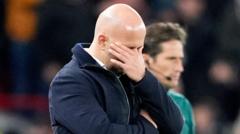
Arne Slot did not simply fail at Anfield; he was swallowed by a system designed for a completely different kind of footballing deity. When Liverpool dismissed the Dutch manager, the easy narrative became the immediate focus—a prominent tactician out of his depth, failing to replicate his Eredivisie success in the unforgiving environment of the Premier League. But blaming Slot alone ignores the structural friction that doomed his tenure from the moment he signed his contract. The reality is that his dismissal marks the collapse of an institutional gamble to replace an irreplaceable figure with spreadsheet-driven certainty.
Replacing a foundational manager is the most hazardous task in modern sports. Liverpool attempted to treat the departure of Jürgen Klopp as a corporate transition, assuming that elite data infrastructure and a robust sporting director model could plug-and-play any high-performing coach. They underestimated the sheer weight of culture.
The Illusion of Continuity
The decision to hire Slot was rooted in statistical harmony. On paper, his Feyenoord teams mirrored the intense pressing, high defensive line, and vertical aggression that defined Liverpool’s golden era. The recruitment department saw an algorithmic match.
They missed the human deficit. Football at the highest level relies heavily on psychological buy-in, and Slot inherited a squad deeply conditioned by a cult of personality. Klopp managed through emotional contagion; Slot managed through structural instruction. When results wavered, that ideological shift felt less like evolution and more like clinical austerity to a dressing room accustomed to a different type of leadership.
The tactical adjustments also backfired. While Slot sought to introduce more control and patient build-up to mitigate the chaotic transitions Liverpool suffered from in previous seasons, he inadvertently neutralized the squad’s greatest weapon. The team looked caught between two worlds—too cautious to execute the devastating counter-press of old, yet not technically secure enough to suffocate opponents through possession.
The Recruitment Disconnect and the Power Vacuum
Anfield's modern success built itself on a specific power dynamic between the coaching staff and the transfer committee. When Michael Edwards returned to the Fenway Sports Group hierarchy alongside sporting director Richard Hughes, the club reverted to a strict executive-led model. Slot was designated as a head coach, not a manager.
This structural design works perfectly when the squad is young and malleable. It fails when the roster requires immediate, heavy surgery.
- The Midfield Deficit: The failure to secure a elite, elite-level defensive midfielder left Slot’s double-pivot system exposed against physical Premier League midfields.
- The Transition Paradox: The squad lacked the specific profile of technical, press-resistant players required to execute Slot's possession phases under intense pressure.
- Contract Distractions: The looming, unresolved contract situations of senior leaders cast a persistent shadow over the training ground, eroding the manager's authority.
When results began to slip, the boundary lines between the dugout and the boardroom blurred. A head coach without absolute transfer authority becomes an easy scapegoat when the squad's flaws are exposed on the pitch. Slot found himself answering for recruitment decisions he did not control, while trying to implement a complex tactical blueprint with mismatched tools.
The Tactical Unraveling
In the Premier League, tactical flaws are exposed within ninety minutes. Opposing managers quickly realized that Slot's build-up structures relied heavily on his full-backs tucking into central areas, a strategy that Feyenoord used to dominate the Eredivisie.
Premier League wingers didn't track back; they stayed high and wide, waiting for the turnover. Liverpool’s central defenders suddenly found themselves isolated in wide areas, forced to defend massive channels without adequate cover. The data predicted control, but the reality on the grass was a series of chaotic, high-stakes defensive emergencies.
[Opponent Winger] ----> Exploiting Wide Space <---- [Isolated Center Back]
                                 ^
                   [Liverpool Full-back Tucked Inside]
The drop-off in output from key attackers further compounded the tactical strain. By slowing down the tempo of the attack to achieve the physical control Slot desired, Liverpool allowed defensive blocks to organize. The space behind opposition backlines vanished, and with it, the effectiveness of the club’s most expensive forwards.
The Weight of the Anfield Mythos
Tactics and recruitment explain the mechanics of the failure, but the emotional atmosphere of Anfield accelerated the timeline. The stadium demands a specific style of theatre—heavy metal football, emotional outbursts from the touchline, and a visceral connection between the pitch and the stands.
Slot's stoic, analytical demeanor on the touchline was frequently misinterpreted as indifference when results turned sour. European nights under the lights require a manager who can ride the wave of the crowd's energy; Slot attempted to calculate it. When a manager loses the match-going fan base, the board’s calculations change instantly. The financial risk of missing out on the Champions League outweighs any long-term commitment to a tactical project.
The ultimate failure of the Slot era is not that he is a poor coach, but that he was the wrong fit for an institution undergoing an identity crisis. Liverpool tried to prove that their system was bigger than any individual, that the metrics could sustain success regardless of who held the whistle. By dismissing Slot, the ownership didn't just admit that they chose the wrong man; they conceded that the human element of football cannot be completely solved by data.


