Iran is shifting its geopolitical chokehold from oil tankers to the fiber-optic infrastructure buried beneath the Strait of Hormuz, threatening a digital protection racket aimed directly at Western tech giants. Iranian military spokesperson Ebrahim Zolfaghari explicitly signaled this new front, stating on social media, "We will impose fees on internet cables." Lawmakers in Tehran, backed by media outlets affiliated with the Islamic Revolutionary Guard Corps (IRGC), have begun drafting proposals to force companies like Google, Meta, Microsoft, and Amazon to pay licensing fees, comply with Iranian regulations, and yield exclusive repair rights to Iranian firms. It is a calculated escalation that moves the theater of regional conflict from the surface of the sea to the seabed.
The strategy targets the literal backbone of the global economy. Over 95 percent of intercontinental data moves through submarine cables, and the narrow passage of Hormuz serves as a vital corridor linking European networks with the Middle East, India, and East Africa. By targeting this bottleneck, Tehran is testing international resolve with a mechanism designed to bypass standard naval deterrents. If Big Tech refuses to comply, the implicit threat is a coordinated disruption of regional internet infrastructure, impacting cloud computing, international banking, and consumer applications. Recently making waves in related news: The Architecture of Iterative Failure Analyzing the Technical and Operational Bottlenecks of Starship Development.
The Economics of a Subsea Protection Racket
The legislative push in Tehran demands that foreign operators pay annual permit fees for cables traversing the region. This presents an intentional legal paradox. Major tech conglomerates are legally barred by stringent U.S. sanctions from conducting financial transactions with the Iranian government or its military entities. Tehran understands this friction. The goal is not merely to extract revenue but to exploit these regulatory contradictions to create a pretext for physical interference under the guise of enforcing domestic maritime law.
Furthermore, the IRGC-linked proposals attempt to mandate that any maintenance or repair operations within the corridor be handled exclusively by Iranian enterprises. This effectively locks out international repair consortia. Alcatel Submarine Networks, the prominent cable-laying and maintenance operator, has already suspended its regional repair operations, issuing force majeure notices due to the heightened security risks in the Persian Gulf. By forcing foreign repair vessels out, Iran secures a monopoly over the physical status of the infrastructure. Additional information regarding the matter are detailed by ZDNet.
Historically, submarine cables have been governed by international treaties, chiefly the United Nations Convention on the Law of the Sea (UNCLOS). These treaties grant nations control over their territorial waters up to 12 nautical miles from the coast but preserve freedom of navigation and cable-laying within Exclusive Economic Zones (EEZs). Iran, however, has never ratified UNCLOS. Tehran views the Strait of Hormuz as a sovereign resource to be monetized and policed, a stance reinforced by parliament member Hossein Ali Hajideligani, who publicly termed the strait a "God-given treasure" equivalent to a domestic mineral reserve.
Shallow Waters and High Vulnerability
A common misconception is that disabling subsea telecommunications requires advanced, deep-sea naval capabilities that Iran possesses only in limited quantities. In the Atlantic or Pacific oceans, cables rest thousands of meters below the surface, requiring specialized deep-submergence rescue vehicles or advanced submersibles to alter or sever. The Persian Gulf defies this norm.
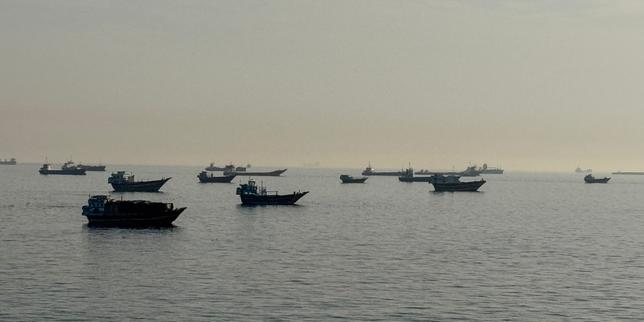
The Gulf is an exceptionally shallow body of water. Its average depth hovers around 50 meters, and even its deepest channels rarely exceed 90 meters. This unique bathymetry transforms the technical challenge of sabotage from an elite engineering feat into an accessible maritime operation.
- Commercial Divers: Commercial divers operating from ordinary fishing trawlers or commercial tugs can easily reach the seabed with standard mixed-gas diving equipment.
- Anchors and Trawlers: Heavy commercial ship anchors or modified bottom-trawling fishing nets can drag across known cable corridors to inflict catastrophic physical damage under the cover of a maritime accident.
- Unmanned Underwater Vehicles: Low-cost, commercially available unmanned underwater vehicles (UUVs) can be deployed to map, monitor, or drop explosive charges on specific coordinates.
This physical vulnerability is compounded by a lack of geographic redundancy. While international operators have historically tried to mitigate risks by routing cables through Omani waters on the southern side of the strait, the extreme narrowness of the chokepoint makes complete avoidance impossible. Major transnational cable networks, including the FALCON system—which links India to the Gulf and East Africa—and Gulf Bridge International (GBI), run directly through areas exposed to Iranian naval dominance. The Asia-Africa-Europe 1 (AAE-1) cable, stretching from Southeast Asia to Europe via landing points in the UAE, Qatar, and Oman, sits entirely within the geographical reach of the IRGC's fast-attack craft and coastal surveillance arrays.
The Broader Digital Fallout
The consequences of a coordinated, multi-cable disruption extend far beyond interrupted social media access or delayed consumer deliveries. The modern global financial sector relies entirely on these fiber-optic links to execute high-frequency trading, clear international wire transfers, and synchronize cloud databases.
A historical precedent exists for this scale of disruption. In 2008, multiple submarine cables were severed in the Mediterranean Sea near Egypt. The resulting outages caused an immediate 60 to 70 percent drop in internet and communication capacity across India and parts of the Middle East. Banking operations stalled, international call centers went offline, and stock trading was severely disrupted for days.
A similar event in the Strait of Hormuz would cause immediate economic dislocation for the Gulf Cooperation Council (GCC) states. Countries like the United Arab Emirates, Saudi Arabia, and Qatar have invested billions of dollars into diversifying their economies through technology hubs, national artificial intelligence initiatives, and localized cloud infrastructure. Data centers operated by Amazon Web Services (AWS) in Bahrain and the UAE rely on subsea cables to serve regional enterprises. Severe network degradation would instantly isolate these digital economies, freezing corporate cloud operations and interrupting critical military and government communications links used by Western allies in the region.
The Strategic Gambit Behind the Threat
Tehran’s maritime strategy has shifted into a more sophisticated phase. For decades, the primary threat was a conventional naval blockade to cut off global energy supplies. While effective at driving up crude prices, a total blockade of shipping lanes carries the immediate risk of a massive, unified military response from global superpowers.
Targeting subsea infrastructure offers a more ambiguous, asymmetrical alternative. It allows Iran to apply severe economic pressure while maintaining plausible deniability. If a cable is severed by a dragged anchor or an unexplained underwater detonation, proving state-sponsored intent is notoriously difficult. This ambiguity complicates the deployment of conventional military deterrence.
The Western alliance is poorly equipped to counter this specific threat. Naval coalitions excel at protecting surface vessels from anti-ship missiles or piracy. They are not configured to monitor thousands of kilometers of underwater cable in real-time, nor can they easily police every commercial civilian vessel navigating a busy international shipping lane. By shifting the conflict downward, Iran exploits a major blind spot in international security architecture, transforming static data infrastructure into active geopolitical leverage.