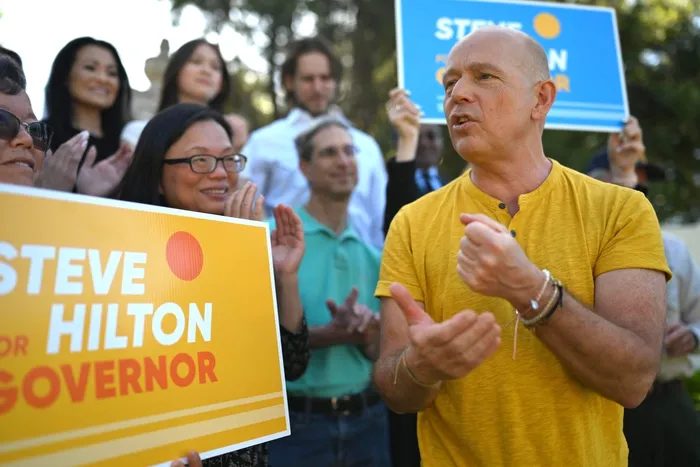
Donald Trump’s "complete and total endorsement" of former Fox News host Steve Hilton for California Governor looks like a straightforward play to solidify his grip on the Republican base. Instead, it might be the very move that locks the GOP out of the governor’s mansion for yet another decade. By throwing his weight behind Hilton, Trump has disrupted a delicate mathematical balance in California’s jungle primary that was—until Monday—the only viable path for a Republican victory in a state where Democrats hold a nearly 2-to-1 registration advantage.
The math of California politics is brutal. In the June 2 primary, the top two vote-getters advance to the general election regardless of party. With a crowded field of eight serious Democratic contenders splitting their party's vote, two Republicans could theoretically slip into the first and second spots. This "GOP lockout" of Democrats would require the two leading Republicans, Hilton and Riverside County Sheriff Chad Bianco, to remain neck-and-neck, effectively splitting the conservative vote into two roughly equal piles of 15% to 20%. Trump’s intervention threatens to destroy that equilibrium by catapulting Hilton far ahead of Bianco, likely allowing a single Democrat to consolidate enough support to grab the second-place slot and sail to an easy win in November.
The Strategy of the Sledgehammer
Steve Hilton is not your grandfather’s California Republican. The former advisor to British Prime Minister David Cameron has built a platform he calls "Cali-fordable," a populist mix of radical tax cuts and deregulation designed to appeal to the 53% of Californians who tell pollsters they have considered leaving the state due to costs. Hilton’s pitch is aggressive. He wants to make the first $100,000 of income tax-free and has pledged to take a "sledgehammer" to a state bureaucracy he describes as a bloated monstrosity.
For Trump, Hilton is a familiar face and a loyalist who defended him throughout his presidency on The Next Revolution. The endorsement, posted to Truth Social on April 6, 2026, praised Hilton as a "truly fine man" who can save a state that has "gone to Hell." This rhetoric resonates with a Republican electorate that feels under siege in Sacramento, but it alienates the very independent voters Hilton needs to win a general election.
The reality of the polling before this endorsement showed a dead heat. An Emerson College survey from February 2026 placed Hilton at 17%, with Sheriff Bianco and Democrat Eric Swalwell tied at 14%. By March, Swalwell had edged ahead to 17%, while Hilton and Bianco remained effectively tied. Trump’s endorsement acts as a massive thumb on the scale. If it pulls 5% or 10% of the GOP base away from Bianco and toward Hilton, it doesn't just help Hilton; it clears the lane for a Democrat to secure the second spot.
The Democratic Gift
Democratic strategists are likely celebrating a move they couldn't have choreographed better themselves. In 2024, Adam Schiff spent millions on ads "attacking" Republican Steve Garvey, a move widely recognized as a successful attempt to boost Garvey’s profile among GOP voters to ensure a Republican—rather than a more dangerous Democrat like Katie Porter—would be his opponent in November. Trump has effectively done that work for the Democrats for free.
By consolidating the Republican vote behind Hilton, Trump has likely saved Democratic donors tens of millions of dollars. They no longer have to worry about a "nightmare scenario" where two Republicans squeeze out their divided field. Instead, they can focus on their own internal slugfest between Eric Swalwell, Katie Porter, and Tom Steyer, knowing that whoever emerges will face a candidate in Hilton who is now inextricably linked to a former president who holds a 64% disapproval rating in the Golden State.
The Numbers Behind the Gamble
| Candidate | Feb 2026 Support | March 2026 Support | Potential Trump Shift |
|---|---|---|---|
| Steve Hilton (R) | 17% | 13% | +8% to 12% |
| Eric Swalwell (D) | 14% | 17% | Stable |
| Chad Bianco (R) | 14% | 11% | -5% to -8% |
| Katie Porter (D) | 10% | 8% | Stable |
| Tom Steyer (D) | 9% | 11% | Stable |
The table suggests a dangerous consolidation. If Hilton surges to 25% on the back of the Trump endorsement, he guarantees his spot in November. But if Bianco drops to 5%, it leaves a massive vacuum that Swalwell or Steyer will easily fill. A Hilton vs. Swalwell matchup in November is a demographic death sentence for the GOP.
The Policy Squeeze
Beyond the horse race, Hilton’s platform faces a cold reality. His "Cali-fordable" plan relies on the idea that massive tax cuts will spark an economic boom large enough to offset the loss in revenue. He has called for ending income and property taxes for veterans and drastically cutting utility bills. These are popular talking points, but they run head-long into a state legislature that will remain firmly in Democratic hands regardless of who sits in the Governor's office.
Hilton argues that his background in British "decentralization" gives him the tools to bypass Sacramento by devolving power to local communities. It is a sophisticated argument that sounds good in a policy forum but is difficult to translate into a 30-second campaign ad. Sheriff Bianco, by contrast, has run a more traditional "law and order" campaign, seizing on retail theft and public safety—issues that have historically crossed party lines in California. By picking the "ideas guy" over the "badge guy," Trump is betting that the GOP base prefers a Fox News revolutionary over a local lawman.
A Legacy of Failed Interventions
History is littered with Trump endorsements that backfired in blue or purple states. From Mehmet Oz in Pennsylvania to Don Bolduc in New Hampshire, the pattern is consistent: a Trump-backed candidate wins the primary by appealing to the base's id, only to be crushed in the general election when moderate and independent voters recoiled.
California is the ultimate test of this phenomenon. The state’s Republican Party has been searching for a way out of the wilderness since Arnold Schwarzenegger left office in 2011. The strategy of the "long game"—building a coalition of suburban parents and small business owners—requires a candidate who can distance themselves from national partisan toxicity. By accepting the Trump endorsement, Hilton has chosen a different path. He has traded the possibility of a broad coalition for the certainty of a primary victory.
The move has forced Chad Bianco into a defensive crouch. His response to the endorsement was telling, noting that the race is about the "future of California, not any one endorsement." It was a polite way of saying that the former president might not understand the local terrain. If Bianco stays in the race, he may act as a spoiler, keeping Hilton’s numbers just low enough to be interesting but not high enough to carry a second Republican into the general. If he drops out, the path for a Democrat becomes a four-lane highway.
The primary on June 2 will reveal whether Trump’s brand still has the power to dictate the terms of engagement in the country’s largest state. But for those watching the math, the conclusion is already written on the wall. A consolidated Republican vote is a losing vote in a general election in California. By helping Steve Hilton win the battle for the soul of the California GOP, Donald Trump may have ensured they lose the war for the state.
The strategy now rests on Hilton’s ability to do the impossible: convince millions of Californians that a Trump-endorsed, British-born media personality is the "common sense" choice for a state that has spent the last decade positioning itself as the headquarters of the anti-Trump resistance. It is a gamble of historic proportions, and the house—Sacramento's Democratic establishment—is already counting its winnings.