The war in Ukraine has hardened into a grinding structural stalemate defined less by sweeping territorial shifts on color-coded maps and more by an unyielding war of attrition, pervasive drone saturation, and profound economic exhaustion. Millions of viewers stare at television screens scrolling through daily map updates showing marginal advances of a few hundred meters, completely missing the real mechanics dictating the survival of both nations. Beneath the public relations narratives and diplomatic maneuvering, the battlefield operates on a merciless calculus of industrial capacity, electronic warfare, and human endurance.
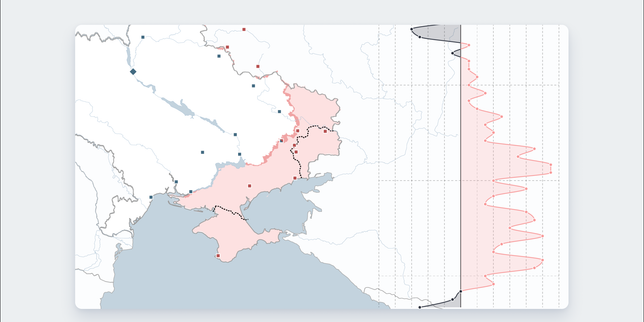
For years, mainstream coverage relied on simplified visual aids to explain a conflict that defies simple cartography. Maps show red and blue zones shifting across provinces like grain fields in a storm. These graphics create a false sense of kinetic momentum, suggesting that a few arrows drawn by analysts indicate a clear path toward military victory or collapse. The reality on the ground is infinitely more granular, brutal, and stubbornly static. A single treeline contested for weeks by infantry units does not register on a macro-level map, yet it represents the entire operational horizon for the soldiers fighting there.
The Illusion of the Static Map
To understand why the front lines refuse to break, one must look at the profound asymmetry between offensive movement and defensive fortification. Modern reconnaissance assets make massed armor formations nearly impossible to conceal. Thermal cameras, synthetic aperture radar, and autonomous aerial scouts ensure that any concentration of heavy machinery is spotted, tracked, and targeted within minutes. When a motorized column attempts a breakthrough, it runs into layered minefields, pre-sighted artillery zones, and swarms of loitering munitions. Movement equals visibility, and visibility equals destruction. This iron rule of contemporary combat explains why every tactical advance demands a disproportionate cost in blood and materiel.
The adaptation cycle on both sides has accelerated to a breakneck pace. Traditional military procurement cycles spanning decades have been compressed into weeks. Engineering teams behind the front lines constantly tweak frequencies, guidance systems, and propulsion methods to counter enemy electronic jamming. When one military introduces a new frequency hopping algorithm for its uncrewed systems, the opponent adapts its software-defined radios within days to blind them. This subterranean technological arms race happens quietly in workshops and basements far from the public eye. Equipment that worked flawlessly last month can become obsolete next week because electronic warfare units have found its signature.
Asymmetry of Offensive Movement
Human capital remains the ultimate constraint. Both combatants face severe challenges in replenishing trained personnel. The initial wave of enthusiastic volunteers has long since been exhausted, replaced by protracted mobilization efforts that strain societal fabric and test institutional resilience. High casualty rates among experienced infantrymen mean that units must constantly retrain fresh recruits under combat conditions. This dilution of experience affects tactical execution. A platoon led by veterans operates with lethal efficiency, while a unit composed entirely of recent conscripts struggles with basic coordination, communication, and discipline. The attrition of human experience is a silent drain that statistics struggle to capture.
Logistics and industrial production underpin every tactical decision made at the front. Modern warfare consumes munitions at a rate that outpaces historical peacetime manufacturing capacities by orders of magnitude. Shells, rocket motors, propellant powders, and optical sensors require vast supply chains stretching across continents. The ability to sustain high-intensity operations depends on foreign supply lines, industrial mobilization, and financial backing. When political friction or budgetary delays occur in donor capitals, front-line units immediately feel the squeeze in ammunition rationing. Logistics is not merely a support function; it is the primary determinant of strategic endurance.
Industrial Logistics and Supply Chains
Energy infrastructure has emerged as a primary target set, shifting the conflict into the economic sphere. Long-range strikes target refineries, power plants, and transit hubs with relentless frequency. These campaigns aim to degrade the opponent's capacity to generate revenue, refine fuel, and maintain civilian morale. When a major oil processing facility catches fire hundreds of kilometers from the front, the economic shockwaves ripple through domestic markets, driving up fuel prices and straining repair networks. Industrial targets require specialized components and months of heavy labor to restore, meaning that successful strategic strikes inflict long-term damage that cannot be patched overnight.
The geopolitical dimensions of the conflict add another layer of complexity. International diplomacy operates against the backdrop of shifting political tides in partner nations. As electoral cycles turn and domestic pressures mount in supporting countries, the predictability of long-term aid diminishes. Leaders in capitals far from the conflict zone weigh their own economic stability and public fatigue against strategic commitments. Diplomatic initiatives and backdoor negotiations happen intermittently, yet the fundamental positions of the warring parties remain too divergent for a neat settlement. One side demands total territorial integrity, while the other insists on structural concessions that amount to capitulation. Between these two absolutes lies a vast expanse of diplomatic paralysis.
Strategic Impact of Energy Strikes
Information warfare and public narrative management run parallel to physical combat. Both governments invest heavily in shaping how the world perceives their struggles, highlighting enemy losses while downplaying their own vulnerabilities. Social media channels and independent open-source intelligence groups dissect every piece of geolocated footage, turning the war into a hyper-analyzed spectacle consumed by millions. Yet, open-source analysts working from computer screens thousands of miles away often lack context regarding the operational intent behind specific maneuvers. They see the smoke and the wreckage, but they miss the strategic calculus driving commanders to trade space for time or abandon untenable positions.
The psychological toll on civilian populations caught in the crossfire is immeasurable. Millions have been displaced, their homes reduced to rubble, their livelihoods erased by conflict. Cities near the front lines function as ghost towns where daily life is dictated by air raid sirens, intermittent power cuts, and the constant thud of distant artillery. In regions further away, citizens adapt to a grim normalcy, attending workplaces and schools while carrying the latent trauma of periodic missile barrages. This endurance is remarkable, yet it exacts a profound psychological tax that will shape the social fabric of both societies for generations.
Psychological and Environmental Toll
Looking at the broader trajectory, the conflict has exposed the vulnerability of modern nation-states to protracted high-intensity warfare. Militaries designed for counterinsurgency operations or short, decisive campaigns found themselves catastrophically unprepared for the artillery-heavy, industrialized reality of this conflict. Stockpiles of precision-guided munitions were depleted within months. Industrial bases had to be resurrected from decades of dormancy. The lessons learned on these battlegrounds are currently being studied by military analysts worldwide, fundamentally rewriting doctrine on air defense, armored warfare, and logistics.
The environmental cost of the war receives remarkably little attention compared to tactical maps and casualty figures. Millions of hectares of agricultural land are contaminated with unexploded ordnance, heavy metals, and toxic chemical residues from shattered munitions. Forests have been pulverized into ash, water tables polluted, and critical ecosystems severely degraded. Restoring these environments will require decades of hazardous clearance operations and billions of dollars. Long after the active fighting ceases, the earth itself will continue to bear the scars of industrialized destruction, posing a persistent hazard to farmers, wildlife, and returning civilian populations.
Command structures have also undergone radical evolution. Traditional hierarchical decision-making models, where orders take hours to travel up the chain of command and back down, proved too sluggish for a battlefield saturated with real-time reconnaissance. Successful units have flattened their command structures, empowering junior officers and drone operators to make instantaneous tactical decisions without waiting for authorization from distant headquarters. This decentralization of initiative is essential for survival in an environment where hesitation measured in seconds results in immediate destruction.
Financial markets and global supply chains continue to absorb the shockwaves of the prolonged hostilities. Commodity prices, particularly for agricultural goods and energy, experience sharp volatility whenever major transport corridors or production facilities are targeted. Developing nations dependent on grain exports from the Black Sea region face acute food security pressures, demonstrating how a regional conflict can trigger global systemic instability. International trade routes have been rerouted, maritime insurance rates have spiked, and national security considerations now dictate economic policy in ways unseen since the mid-twentieth century.
As the conflict grinds forward through its grueling phases, the ultimate outcome remains obscured by layers of fog, steel, and stubborn political resolve. Neither side possesses the decisive military superiority required to impose a swift resolution on its own terms, nor are they willing to accept terms that look like defeat. The front lines stretch across hundreds of kilometers of scarred earth, held together by trenches, concrete, and unyielding human will. The maps will continue to change by fractions of a percent, the analysts will continue to debate tactical doctrines, and the soldiers in the trenches will continue to endure the relentless arithmetic of survival