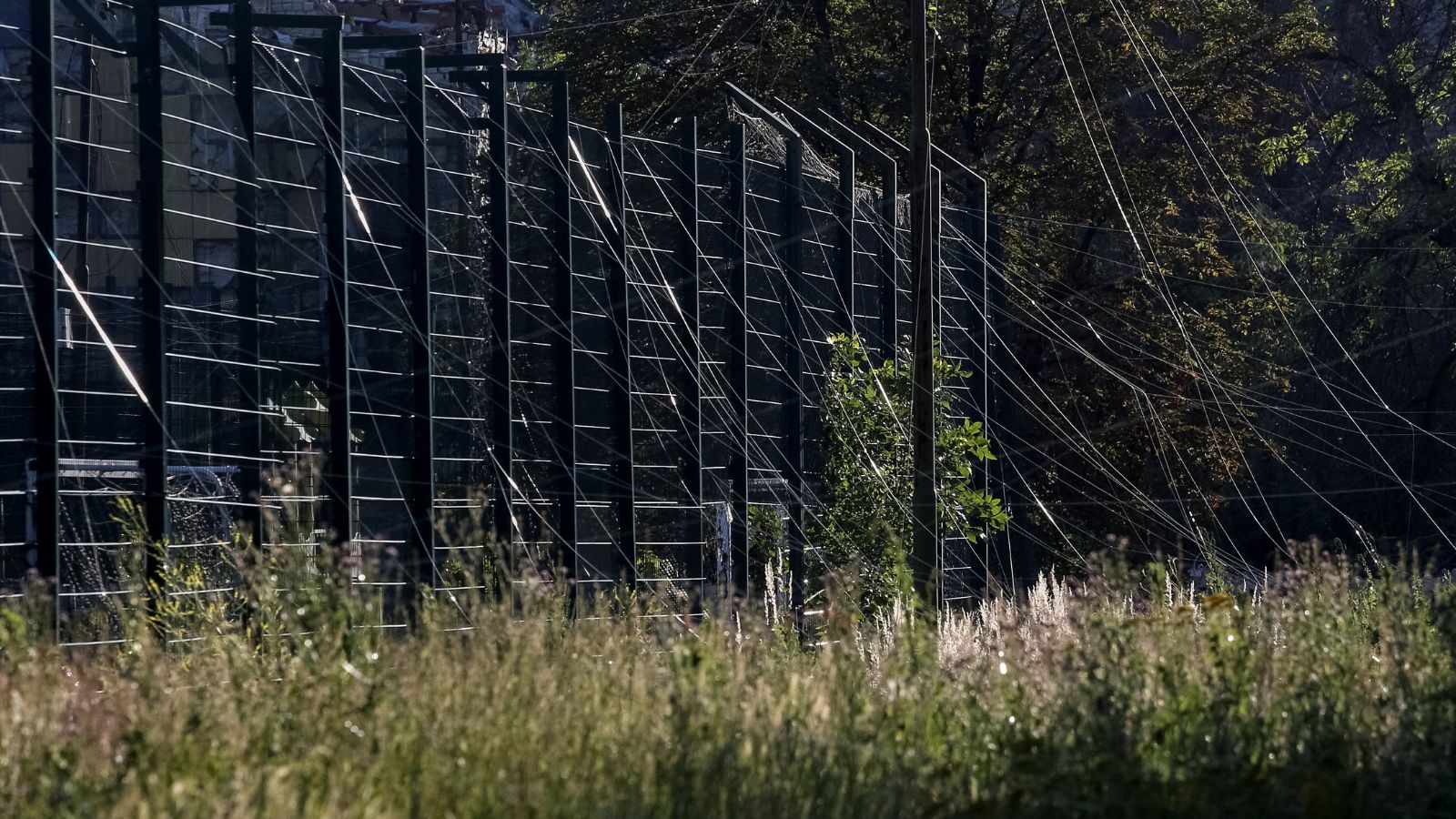
Russia has begun systematically dismantling Ukraine’s deep-rear electrical grid by deploying a weapon that completely bypasses millions of dollars of electronic warfare systems and heavy physical fortifications. In frontline provinces like Sumy, small first-person-view drones guided by ultra-thin fiber-optic cables are flying straight through ventilation shafts and holes in massive concrete sarcophagi to destroy multimillion-dollar autotransformers.
This is not a story of overwhelming missile barrages. It is an engineering chess match where a three-thousand-dollar spool of glass thread is defeating sophisticated defensive networks. While international attention remains fixed on high-altitude missile defense systems like Patriot and NASAMS, the real threat to Ukraine’s survival this winter is crawling along the ground, unjammable and virtually invisible until the moment of impact.
The immediate consequence is a looming blackout crisis that could render entire northern regions unlivable.
The Glass Thread Defeating Electronic Warfare
For the past two years, the defense of Ukraine’s energy infrastructure rested on a dual strategy. First, vast physical structures—anti-drone netting, steel cages, and massive concrete walls colloquially known as sarcophagi—were built around critical 330-kilovolt autotransformers. Second, the airspace around these substations was flooded with electronic warfare signals designed to sever the radio frequency links between drones and their pilots.
Fiber-optic drones render the second half of that strategy entirely useless.
When a drone trails a micro-thin spool of glass fiber behind it, there are no radio waves to jam. The operator sits up to twenty kilometers away, receiving a crystal-clear, uncompressed video feed that remains perfectly stable even when flying inches from a high-power electronic jammer. Traditional drone video feeds degrade, flicker, and drop out as they approach a target protected by electronic defenses. A fiber-optic drone operates with absolute clarity until the millisecond it detonates against a transformer bushing.
The technical trade-offs of this technology were initially thought to limit its utility. Glass fiber is fragile. If a cable snags on a tree branch, sharp building edge, or telephone wire, the line snaps and the drone instantly drops out of the sky. Early military assessments suggested these weapons would be restricted to open fields or specific linear strike paths.
Russian drone teams adapted by changing their flight profiles. Instead of flying high and diving down, operators fly these craft extremely low, sometimes just meters or centimeters off the asphalt, following roads and cleared paths to prevent the trailing line from catching on obstacles. They are trading speed and vertical maneuvering for absolute immunity to the electronic spectrum.
The Sarcophagus Vulnerability
The destruction of an autotransformer is a catastrophic event for an electrical grid. These massive units, often costing upwards of 3.5 million dollars each, regulate voltage between high-voltage transmission lines and regional distribution networks. They cannot be easily bypassed, and manufacturing a single replacement can take up to a year under peacetime conditions.
To protect them, Ukrainian engineers built what amounted to open-air bunkers around the units. These concrete structures shield the transformers from shrapnel and direct hits by larger loitering munitions like the Shahed-136.
Open-source intelligence teams, including the London-based Centre for Information Resilience, recently verified a series of strikes demonstrating a highly coordinated, multi-layered tactical doctrine designed to exploit these very protections. The attack sequence is methodical.
- Phase One: A standard radio-controlled drone or a low-cost quadcopter is flown directly into the protective steel netting draped over the concrete bunker. The explosion does not damage the transformer, but it tears a permanent hole in the mesh wire.
- Phase Two: The fiber-optic drone is launched. Because it is immune to the local electronic warfare umbrella protecting the substation, the pilot can take all the time they need to navigate.
- Phase Three: The pilot maneuvers the drone through the newly created breach in the netting, or threads the needle through structural ventilation gaps designed to keep the massive transformers from overheating. Once inside the concrete envelope, the drone strikes the core electrical components, igniting thousands of gallons of insulating oil.
This is a structural flaw born of necessity. Transformers require massive airflow to prevent thermal runaway. You cannot completely seal an autotransformer in a solid concrete box without melting the unit from its own internal heat. Russian operators have identified these ventilation openings and are treating them like the exhaust ports on the Death Star.
The Manufacturing Supply Chain Mirror
The bitter irony of this tactical evolution is that both sides are pulling components from the exact same factories. China remains the undisputed global capital of fiber-optic production and civilian quadcopter manufacturing.
A standard ten-kilometer spool of specialized, ultra-lightweight optical fiber costs roughly 500 to 700 dollars. When mated to a standard seven-inch or ten-inch FPV drone frame, the total cost of the weapon sits well under 2,000 dollars. This creates a deeply asymmetric economic equation. A 2,000-dollar drone destroys a 3.5-million-dollar transformer, and the defensive architecture designed to stop it is rendered inert by a piece of glass thinner than a human hair.
While Kyiv scrambles to ramp up its own domestic production of wired drones through local tech startups, it faces severe headwinds. Recent export restrictions placed by Beijing on commercial drone components have disproportionately harmed Ukrainian volunteer networks, which rely heavily on open-market procurement. Moscow, by contrast, continues to receive bulk shipments of industrial-grade components through secondary corporate entities operating across Central Asia and the South Caucasus.
This supply chain disparity means Russian forces can afford to burn through multiple spools of fiber trying to find a viable path into a Ukrainian energy facility, while Ukrainian defenders are forced to ration their own unjammable counter-strike assets.
Low Tech Solutions for High Tech Threats
When electronic warfare fails, warfare reverts to its most basic, kinetic forms. Ukrainian regional defense forces are realizing that the only way to stop a drone trailing a wire is to physically destroy either the drone or the wire.
At several critical substations, security personnel have been re-equipped with semi-automatic shotguns firing heavy birdshot or buckshot. This is a desperate, last-line-of-defense tactic. Spotting a small drone traveling at sixty kilometers per hour when it is only meters off the ground requires near-humanly impossible reaction times, especially during twilight or night attacks.
More inventive, mechanical countermeasures are beginning to emerge from frontline workshops. Some units have begun deploying experimental kinetic barriers consisting of rapidly rotating barbed wire lines. Powered by small electric motors, these spinning wires are designed to catch and wrap the trailing fiber-optic cables of incoming drones, snapping the connection before the vehicle can reach its intended target.
However, deploying these rotating traps across acres of electrical substation infrastructure is an logistical nightmare. A single substation contains hundreds of vulnerable points, from ceramic insulators to cooling fins. Protecting everything with spinning mechanical traps is simply not scalable across a national grid consisting of dozens of major nodes.
Another tactical option involves tracing the cable backward. Because the fiber-optic line remains on the ground after the flight, specialized reconnaissance teams can theoretically follow the glass thread back to the exact location where the Russian drone operator was sitting. If found quickly enough, artillery or mortar counter-battery fire can eliminate the crew. But this requires immediate access to the territory over which the drone flew, an luxury Ukrainian forces rarely have when protecting deep-rear energy infrastructure located kilometers behind the actual line of contact.
The Grid as a Weapon of Attrition
The targeting of these substations points to a broader strategic calculation by the Kremlin. Moscow is no longer trying to just temporarily knock out power to disrupt military logistics. They are attempting to permanently alter the geography of the conflict by making large swaths of northern and eastern Ukraine completely uninhabitable before the winter temperatures drop.
Without autotransformers, cities like Sumy cannot sustain water filtration, municipal heating, or basic industrial production. A civilian population without power in sub-zero temperatures inevitably becomes a refugee population, creating massive economic and social strains on western Ukrainian cities and neighboring European nations.
The international community has spent billions supplying Ukraine with advanced air defense missiles designed to shoot down cruise missiles and ballistic threats. Yet the Achilles' heel of the entire Ukrainian state may turn out to be a ventilated concrete box and an unprotected opening in a steel net.
Addressing this crisis requires shifting away from the obsession with high-tech electronic solutions. The assumption that western technology could simply code or jam its way out of the drone threat has proven false. Until a cost-effective, automated kinetic interception system—such as radar-guided rapid-fire gun turrets—can be mass-produced and deployed at every critical node, Ukraine’s energy security will remain hanging by a literal thread.