The scent of quicklime and saltwater hangs thick over the concrete docks of La Guaira. Under the brutal midday sun, hundreds of wooden coffins and heavy plastic body bags rest in long, uneven rows inside a retrofitted shipping warehouse. This is not a formal government facility. It is a makeshift mega-morgue, hastily assembled after the twin earthquakes of June 24, 2026, flattened the northern coast of Venezuela. While official state broadcasts show polished footage of military rescue crews, the stark reality on the ground reveals an entirely different story. Families are being left to excavate their own dead with bare hands and rusty shovels, forced to navigate a collapsing bureaucratic system just to claim a corpse.
The dual seismic events struck within forty seconds of each other. A magnitude 7.2 shock wave was immediately followed by a massive 7.5 mainshock, a combination that systematically dismantled the built environment of La Guaira state and sent tremors deep into Caracas. The structural failure was instantaneous. Entire high-rise apartment complexes, built under hurried state housing initiatives, pancaked into neat layers of pulverized concrete. The official death toll has climbed past 2,600, but internal estimates from local workers and international organizations suggest the true number of fatalities is vastly higher, with tens of thousands of people still officially listed as unaccounted for.
What is happening at the port of La Guaira is not merely a logistical bottleneck. It is the predictable outcome of decades of institutional decay, sub-standard construction practices, and a disaster management apparatus that exists largely on paper.
The Anatomy of an Avoidable Collapse
When the ground shook, buildings did not just sway. They shattered. Foremost among the ruins are the multi-story towers of the Hugo Chavez social housing complex, a flagship public works program designed to provide affordable housing to thousands of low-income families. These structures were meant to represent modern state engineering. Instead, they became tombs.
Civil engineers who examined the debris before military cordons blocked access pointed to a glaring lack of structural reinforcement. The concrete used in many of these state-funded complexes lacked the necessary steel rebar density to withstand even moderate lateral forces, let alone back-to-back major earthquakes. In many cases, the aggregate mix contained too much sand and insufficient cement, rendering the walls brittle. When the 7.5 magnitude shock wave hit, the ground floors simply dissolved, dropping the upper stories directly onto the residents below.
The state response was marred by immediate paralysis. For the first forty-eight hours, professional heavy machinery was conspicuously absent from the hardest-hit sectors like Catia La Mar and Tanaguarenas. Instead, the burden fell entirely on survivors. Neighbors formed human chains to move heavy concrete blocks. Families rented private gasoline generators just to power basic construction lights through the night, desperate to follow the faint sounds of voices filtering up through the rubble.
The Warehouse of the Unclaimed
With local hospital mortuaries overwhelmed within hours of the disaster, the government directed the flow of casualties toward the maritime port. The choice of location was practical but grim. The vast open-sided structures, normally used to store imported dry goods and shipping containers, now serve as the primary processing center for the dead.
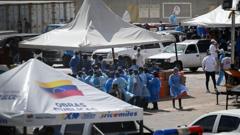
Inside the warehouse, the heat is oppressive. Forensic teams consisting of a handful of local doctors and volunteers work in blue medical gowns and paper caps, moving methodically from one body bag to the next. The process is painfully slow. Because many of the victims suffered severe crush injuries beneath thousands of tons of concrete, visual identification is frequently impossible.
The state lack of computerized dental databases or centralized DNA logging means that identification relies almost entirely on personal effects. A faded tattoo, a specific article of clothing, or a wedding band. Families wait outside the perimeter gates for days, sitting on plastic chairs or directly on the hot asphalt, waiting for their names to be called over a crackling megaphone.
When a relative is called inside, they are walked down the rows of coffins. The emotional toll is visible on the faces of the forensic staff, who are operating with a severe shortage of basic medical supplies. Formaldehyde is scarce. To combat the rapid decomposition accelerated by the coastal humidity, workers sprinkle white powderings of lime over the remains before sealing them back into the bags.
Private Solidarity Filling Public Voids
Where the official state apparatus has faltered, ordinary citizens and private entities have stepped in to prevent a total humanitarian collapse. The National Funeral Homes Association, despite operating under severe economic constraints, mobilized quickly to donate hundreds of coffins, transport vehicles, and embalming supplies to the coastal region. Private hearses line the roads leading out of La Guaira, offering free transportation for families who wish to bury their relatives in less congested municipal cemeteries further inland.
Volunteers have established field kitchens outside the makeshift morgue, distributing coffee, water, and small portions of food to the grieving families who refuse to leave the gates. Psychology students from universities in Caracas have traveled down the winding mountain highway to offer basic grief counseling on the sidewalks.
This grassroots mobilization stands in sharp contrast to the actions of the state authorities. The government has militarized the access routes to La Guaira, establishing strict checkpoints and requiring specialized permits for independent journalists and international aid workers attempting to enter the disaster zone. Officials claim these measures are necessary to maintain public order and prevent looting. However, local residents view the heavy military presence as an attempt to control the narrative and obscure the true scale of the devastation.
The Logistics of a Mass Casualty Event
Managing a crisis of this magnitude requires a highly sophisticated logistical network, something that the current administration was wholly unprepared to deploy. The United Nations has coordinated the arrival of search and rescue teams from dozens of nations, bringing specialized canine units and acoustic listening devices to locate survivors. Yet, the integration of these foreign teams with local military commands has been plagued by bureaucratic delays.
International shipments of emergency supplies, including thousands of body bags provided by the UN, have sat on tarmacs awaiting customs clearance while the death toll rose. The lack of coordinated heavy lifting equipment remains the single greatest obstacle to recovery operations. Without large cranes and industrial excavators, clearing the deep basements of collapsed high-rise structures is a near-impossible task.
The long-term public health implications of the current situation are mounting. The decision to utilize the port as a temporary mortuary has effectively halted legitimate commercial shipping operations in one of the country's most vital maritime gateways. Furthermore, the proximity of the makeshift facility to residential coastal communities raises immediate concerns regarding groundwater contamination and the spread of food-borne illnesses, particularly as the region enters its seasonal period of heavy rainfall.
The Reality Beyond the Broadlines
Public anger is beginning to outpace the initial shock of the disaster. On the streets of La Guaira, the initial silence of grief has been replaced by open denunciation of the regional government and state development agencies. Citizens are openly questioning why the building codes updated after previous historical earthquakes were systematically ignored during the construction boom of the last two decades.
The financial reality for the survivors is equally bleak. Those who have managed to identify and claim their relatives face the immediate challenge of securing a burial plot. Municipal cemeteries in the capital region were already facing severe space shortages prior to June 24. Now, workers are digging mass trenches in the hillsides of public burial grounds, marking individual remains with simple wooden stakes or hand-written numbers.
The twin earthquakes have exposed the structural frailty of a nation's infrastructure and the deep inefficiencies of its governing institutions. As the rescue phase transitions permanently into a recovery and salvage operation, the families waiting outside the port warehouse are left with little more than the grim task of reclaiming what remains of their households. The recovery of northern Venezuela will not be measured in months, but in decades, and the scars left by the makeshift morgues of La Guaira will remain long after the rubble is cleared.