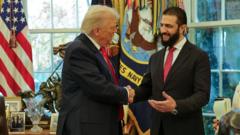
The United States officially stripped Syria of its decades-old designation as a state sponsor of terrorism, dismantling the final major financial embargoes choking Damascus and signaling a radical realignment of American foreign policy in the Middle East.
Decades of diplomatic isolation vanished overnight through administrative updates issued by the State Department and the Treasury's Office of Foreign Assets Control. Concurrently, Washington revoked the global terrorist designation for Hay'at Tahrir al-Sham, the Islamist insurgent faction formerly known as al-Nusra Front that spearheaded the overthrow of Bashar al-Assad. Ahmed al-Sharaa, the erstwhile militant leader now occupying the presidential palace, watched his government transition from international pariah to a jurisdiction cleared for private sector capital. In similar developments, read about: Why the Trump Administration is Targeting B1 and B2 Visas for Asylum Seekers.
This monumental shift did not happen in a vacuum. It represents a calculated gamble by the White House, betting that economic rehabilitation can anchor stability in a fractured state faster than perpetual punitive isolation.
The Mechanics of Delisting
Removing a nation from the terrorism sponsor registry requires navigating a rigid statutory labyrinth. The process kicked off formally when the executive branch notified Congress of its intent, triggering a mandatory forty-five-day review window. With that clock expired and no congressional block materialized, the Treasury Department scrubbed the regulations that had criminalized standard banking operations and trade with Damascus since the late nineteen-seventies. Reuters has also covered this critical topic in great detail.
For international lenders and multinational conglomerates, the operational reality shifted immediately. Treasury Secretary Scott Bessent and Secretary of State Marco Rubio framed the move as an engine for reconstruction. Corporations previously facing draconian secondary sanctions for touching Syrian markets can now legally explore infrastructure, energy, and telecommunications projects.
Yet, institutional skepticism runs deep among veteran policy analysts. Moving a country off a sanctions blacklist is administrative; erasing the structural risks of a post-conflict nation is entirely different.
Weighing the Counter-Arguments
Critics inside the national security establishment argue that the administration moved too aggressively. Hay'at Tahrir al-Sham maintains hardline origins, having emerged directly from the regional apparatus of al-Qaeda before orchestrating a formal organizational divorce. Skeptics question whether a rebranding campaign by leadership genuinely reflects a permanent ideological transformation or merely a pragmatic maneuver to unlock global financial networks.
Consider a hypothetical scenario where foreign capital floods into Syrian reconstruction projects without adequate transparency safeguards. Local factions or remnants of shadow networks could siphon development funds, weaponizing international goodwill to rearm under the guise of commercial enterprise.
Proponents of the policy counter with an equally stark reality. Keeping Syria under a maximum-pressure regime guaranteed total economic collapse, mass refugee outflows, and a permanent power vacuum that invited hostile actors to fill the void. Deprived of options, a broken state inevitably breeds radicalization. Washington decided that managed engagement offers leverage that total embargoes forfeited years ago.
The Regional Ripple Effects
The immediate beneficiaries span a war-torn domestic economy desperate for hard currency, modern technology, and grid repair. Commercial banks in Damascus are racing to overhaul compliance frameworks to plug back into SWIFT and international settlement channels.
Beyond Syria's borders, the shockwaves hit Tehran hardest. As Washington extended olive branches to Damascus, the Treasury simultaneously hammered Iran with fresh, expansive sanctions targeting its aviation, digital asset, and shipping sectors. Severing Syria from the Axis of Resistance shifts the geopolitical balance across the Levant, forcing neighboring capitals to recalculate their security dependencies.
Diplomacy remains a dirty business defined by uneasy compromises. The removal of these sanctions opens a narrow, fragile window for normalization. Whether the new leadership in Damascus can transform this diplomatic lifeline into sustainable governance will dictate the stability of the entire region for the next generation.


