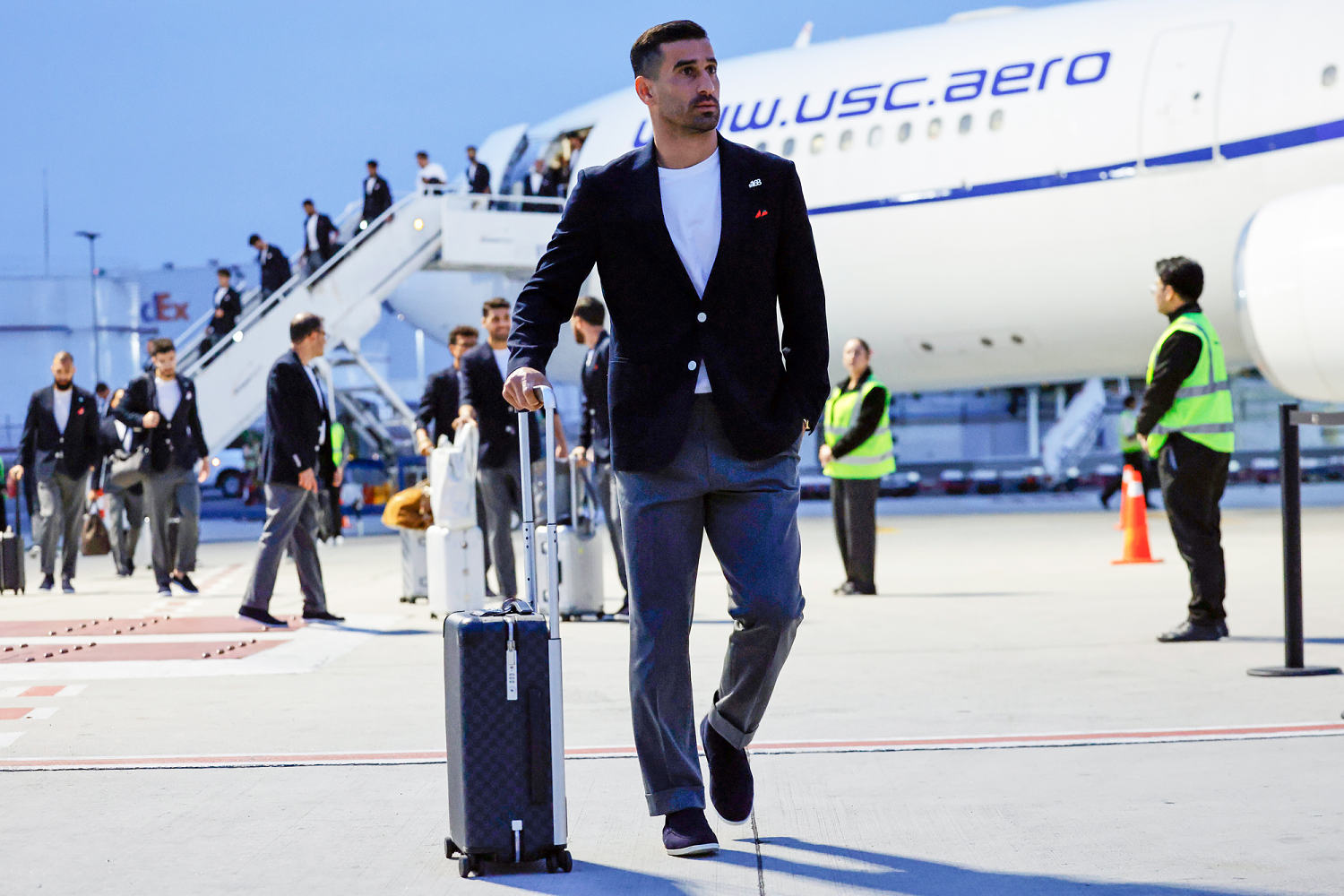
The Iranian national soccer team landed in Tijuana on Sunday morning, completing a frantic charter flight from Turkey that effectively marked the beginning of the most logistically compromised and politically explosive campaign in modern World Cup history. Team Melli has arrived in Mexico, but the story is not that they are training; the story is that they have been forced into geopolitical exile just days before the tournament kicks off. While the players have stepped onto Mexican soil under heavy National Guard escort, a major diplomatic row between Washington and Tehran has left their coaching staff fractured, their administrative leadership barred from North America, and their actual game-day logistics in absolute chaos.
This is not a routine pre-tournament training camp. It is a desperate, last-minute workaround to a multi-nation immigration standoff that threatens the competitive integrity of the tournament.
The Tijuana Exile
Iran was never supposed to be in Baja California. The Iranian Football Federation originally selected Tucson, Arizona, as its high-altitude training base to prepare for three grueling group-stage matches, all of which are scheduled to take place on United States soil.
That plan collapsed entirely over the spring. As military conflicts in the Middle East escalated, Washington made it clear that hosting the Iranian delegation for an extended stay on American soil was a political non-starter. Mexican President Claudia Sheinbaum revealed that FIFA explicitly approached her government to intervene after U.S. authorities refused to let the Iranian squad set up a permanent camp. The compromise brokered by soccer's governing body was stark: Mexico would allow the team to sleep, eat, and train in Tijuana, but the United States would strictly control their entry for actual games.
The logistical reality facing coach Amir Ghalenoei is unprecedented for an elite sporting event. The squad arrived at 5:05 a.m. at Tijuana International Airport after a grueling flight from Antalya, Turkey, leaving them completely upended by a 12-hour time difference. Ghalenoei immediately criticized the political maneuvering, pointing out that a professional squad requires at least two weeks to adapt to such an extreme biological shift.
Instead, they are trapped in a border town, looking across the fence at the country where they must play their matches.
The Visa Weapon
The most crippling blow to the Iranian campaign is not the travel distance, but the deliberate thinning of their support staff. While the U.S. State Department eventually approved visas for the active players, coaches, and core trainers, it systematically denied or delayed entry to the federation’s executive spine.
Among those left stranded without U.S. visas are:
- Hedayat Mombeini, Secretary-General of the Iranian Football Federation
- Mehdi Mohammad Nabi, Vice President of the Federation
- Mehdi Kharati, Executive Director
- Mohsen Motamedkia, Media Director
In total, 14 crucial backroom staff and administrators were excluded from the travel manifest. U.S. Secretary of State Marco Rubio defended the tight restrictions, signaling that any individuals with ties or historical military service obligations to the Islamic Revolutionary Guard Corps (IRGC) are legally ineligible for entry.
The Iranian federation has fiercely protested the move, calling it "vindictive behavior" designed to deny Team Melli a level playing field. They have lodged a formal complaint with FIFA, arguing that the host nation is violating its explicit international obligations to provide free, unhindered access to qualified participants.
| Match Date | Opponent | Venue | Travel Logistics |
|---|---|---|---|
| June 15 | New Zealand | SoFi Stadium, Los Angeles | Same-day border transit from Tijuana |
| June 21 | Belgium | SoFi Stadium, Los Angeles | Same-day border transit from Tijuana |
| June 26 | Egypt | Lumen Field, Seattle | Flight from Mexico, immediate return |
The Same Day Dictum
The operational nightmare deepens when looking at the conflicting directives surrounding match-day travel. Iranian Ambassador to Mexico Abolfazl Pasandideh revealed a staggering condition tied to the team’s current U.S. visas: the squad is legally required to enter and leave U.S. territory on the exact same day as their matches.
"We can enter in the morning, and we must leave the same day," Pasandideh stated.
This completely contradicts standard elite sports science and explicit FIFA regulations. World Cup protocols dictate that a head coach must deliver a mandatory press conference at the match venue twenty-four hours before kickoff. Furthermore, professional athletes cannot realistically clear international border security, drive or fly to a stadium, play 90 minutes of high-intensity international soccer, and clear customs back into Mexico in a single 24-hour cycle without severe physical degradation.
While Iranian team spokesman Amir Mahdi Alavi insisted that the visas are technically multiple-entry and that they plan to arrive at venues one to two days early, local immigration reality suggests otherwise. The friction between legal diplomatic restrictions and athletic necessity has turned Iran's group stage into a logistical war of attrition.
Politics Over Sport
This is a crisis that FIFA President Gianni Infantino desperately tried to avoid. During the FIFA Congress in Vancouver, Infantino took the stage to forcefully guarantee that Iran would participate fully, attempting to shut down mounting political pressure from Western factions calling for the team's total expulsion from the tournament.
But a compromise that forces a team to base itself in a separate country, stripped of its administrative staff and subjected to emergency border-crossing schedules, is a failure of tournament hosting guidelines. The United States accepted strict host obligations when it won the bid for this expanded tournament. By leveraging domestic immigration policy to functionally cripple a political adversary’s athletic delegation, Washington has established a dangerous precedent for future international sporting events.
Captain Ehsan Hajsafi, leading his team through the security cordon in Tijuana, summarized the mood of a squad that feels targeted not for its play, but for its passport. The players are focusing entirely on New Zealand on June 15, but they are doing so under the psychological weight of an administration that views their presence as a threat rather than a celebration of sport.
The competitive balance of Group H has been fundamentally altered before a single ball has been kicked, proving that even on the world’s grandest athletic stage, the border always wins.